The Saint Valentine's Day Massacre
1929 · Chicago, United States
The Saint Valentine's Day Massacre took place in Chicago, where seven members of Chicago's North Side Gang were murdered, allegedly on the orders of Al Capone.
October 17, 1931
Al Capone was convicted of income tax evasion and sentenced to 11 years in prison, marking a significant victory for law enforcement against organized crime.
Chicago, United States | U.S. Federal Government
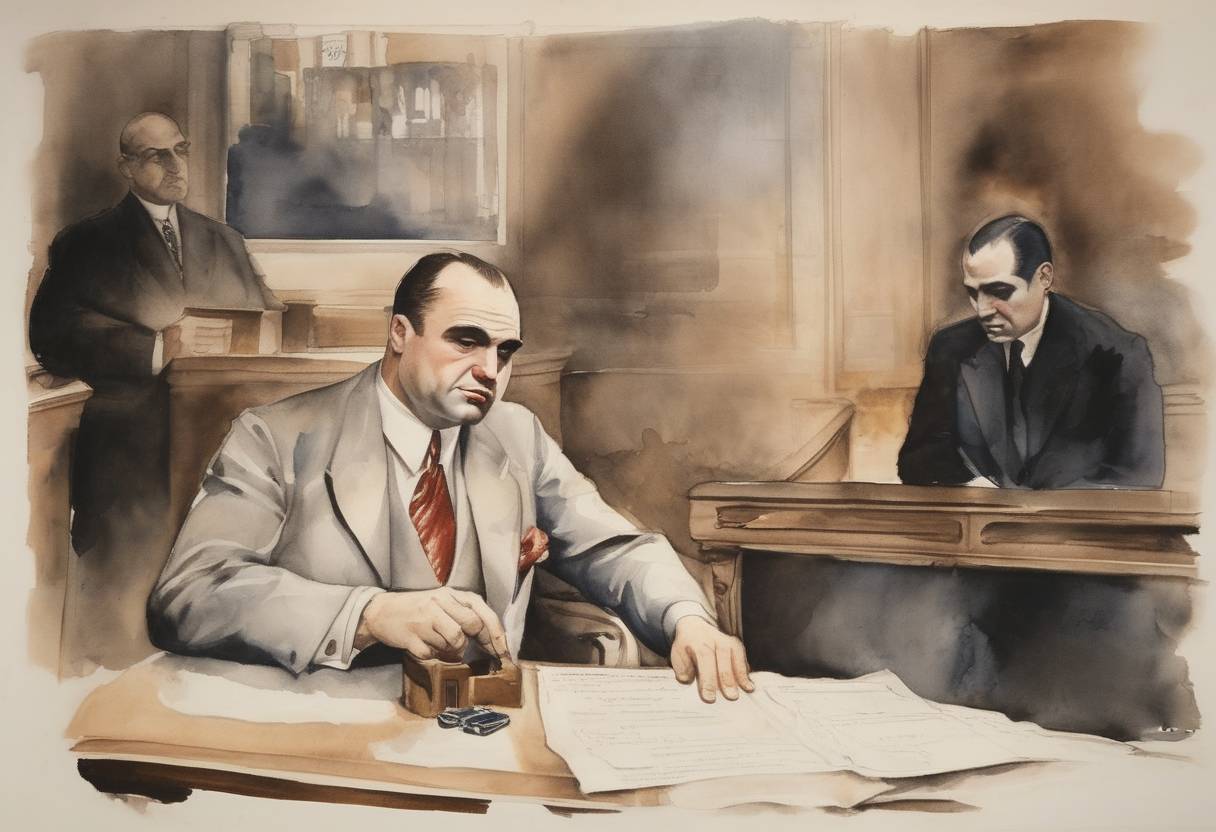
On October 17, 1931, Alphonse “Al” Capone, one of the most notorious gangsters in American history, was convicted of income tax evasion and sentenced to 11 years in federal prison. This event marked a significant victory for law enforcement in their battle against organized crime during the Prohibition era.
Al Capone rose to infamy during the 1920s as the leader of the Chicago Outfit, a powerful criminal organization involved in illegal activities such as bootlegging, gambling, and prostitution. Despite his criminal empire’s vast reach and influence, Capone managed to evade law enforcement for years, primarily due to his ability to bribe officials and intimidate witnesses.
The U.S. government, frustrated by Capone’s continued evasion of justice, shifted their strategy to target him for tax evasion. This approach was inspired by the realization that while Capone’s violent crimes were difficult to prosecute due to lack of evidence and witness intimidation, his financial records could provide a more tangible trail of his illegal activities.
The investigation was led by the Internal Revenue Service (IRS) and the Treasury Department, with special agents like Frank J. Wilson playing a crucial role. They meticulously pieced together evidence of Capone’s substantial income from his criminal enterprises, which he had failed to report on his tax returns.
Capone’s trial began on October 6, 1931, in the U.S. District Court in Chicago. The prosecution presented compelling evidence of Capone’s unreported income, including testimony from accountants and financial experts. Despite attempts by Capone’s defense team to discredit the evidence and argue for a mistrial, the jury found him guilty on October 17, 1931.
Capone was sentenced to 11 years in federal prison, fined \(50,000, and charged \)7,692 for court costs. He was also ordered to pay $215,000 in back taxes plus interest. This conviction was a landmark achievement for law enforcement, demonstrating that even powerful crime figures could be brought to justice through innovative legal strategies.
Capone began serving his sentence at the U.S. Penitentiary in Atlanta but was later transferred to the infamous Alcatraz prison in San Francisco Bay. His incarceration marked the decline of his criminal empire and served as a warning to other organized crime figures.
The conviction of Al Capone was a pivotal moment in the history of law enforcement in the United States. It underscored the effectiveness of using financial crimes as a tool to combat organized crime and set a precedent for future prosecutions. The case also highlighted the importance of the IRS and federal agencies in tackling complex criminal networks, paving the way for more sophisticated investigative techniques in the years to come.
Source: en.wikipedia.org