The Death of Mumtaz Mahal and the Commissioning of the Taj Mahal
1631 · Burhanpur, India
Mumtaz Mahal dies during childbirth, prompting her husband, Mughal Emperor Shah Jahan, to commission the Taj Mahal.
July 31, 1658
Aurangzeb was proclaimed the Mughal Emperor of India, marking the beginning of his reign.
Delhi, India | Mughal Empire
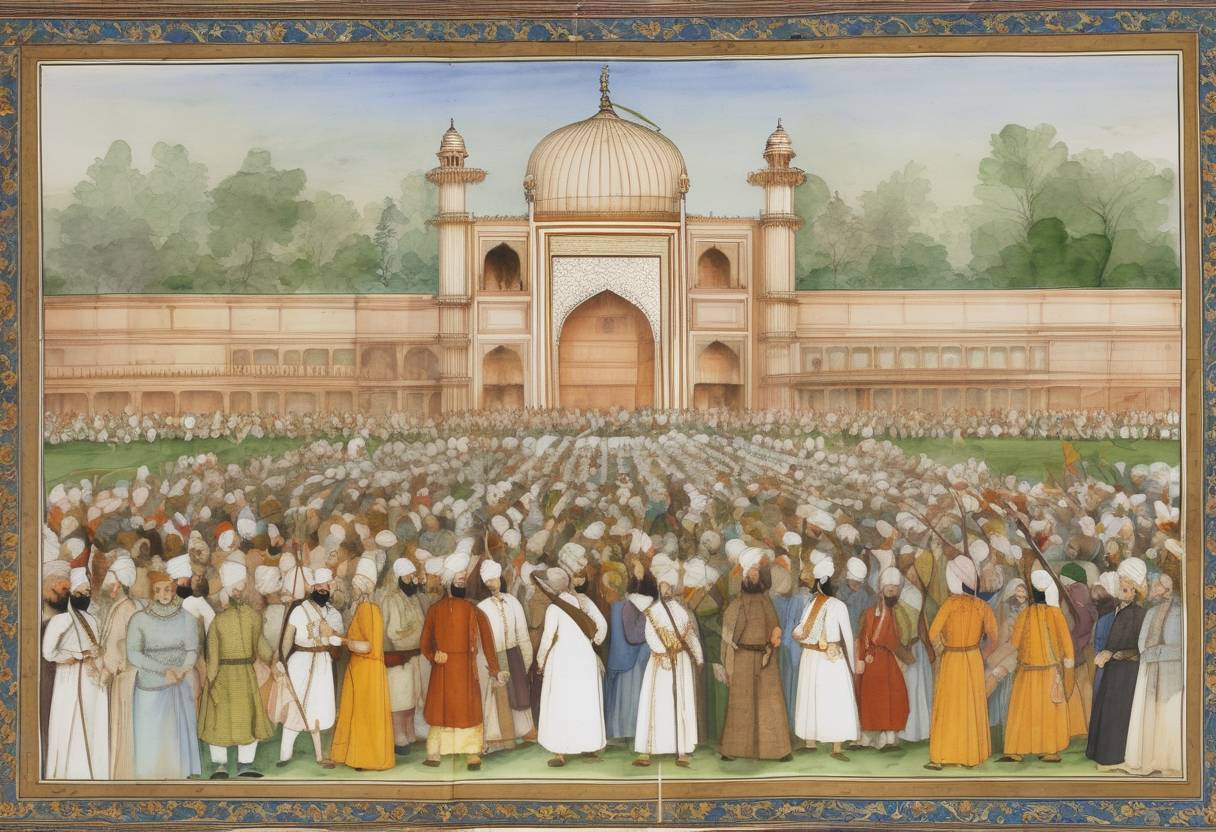
On July 31, 1658, Aurangzeb was formally proclaimed as the Mughal Emperor of India, marking the beginning of his reign, which would last until his death in 1707. This event was a pivotal moment in the history of the Mughal Empire, as it set the stage for significant changes in the empire’s administration, religious policies, and territorial expansion.
Aurangzeb’s rise to power was marked by a bitter succession struggle among the sons of Shah Jahan, the then-reigning Mughal Emperor. Shah Jahan had four sons: Dara Shikoh, Shah Shuja, Aurangzeb, and Murad Baksh. The emperor favored his eldest son, Dara Shikoh, as his successor. However, Aurangzeb, a skilled military leader and strategist, was determined to claim the throne for himself.
The struggle for succession began in earnest when Shah Jahan fell ill in 1657. Aurangzeb, leveraging his military prowess and strategic acumen, formed alliances and defeated his brothers in a series of battles. The most significant of these was the Battle of Samugarh in May 1658, where Aurangzeb defeated Dara Shikoh, effectively eliminating his main rival.
Aurangzeb’s reign is often characterized by his efforts to expand the Mughal Empire and his implementation of strict Islamic policies. Some key aspects of his rule include:
Territorial Expansion: Aurangzeb extended the empire’s boundaries to its greatest extent, encompassing almost the entire Indian subcontinent. His campaigns in the Deccan region and against the Marathas were particularly notable, although they also drained the empire’s resources.
Religious Policies: Known for his orthodox Sunni Muslim beliefs, Aurangzeb reversed many of the liberal policies of his predecessors. He reimposed the jizya tax on non-Muslims and destroyed several Hindu temples, actions that have been subjects of historical debate and controversy.
Administrative Changes: Aurangzeb was a hands-on ruler who emphasized centralization and efficiency in governance. He personally supervised the administration and sought to enforce Islamic law more rigorously.
Aurangzeb’s reign marked the zenith of the Mughal Empire’s territorial reach, but it also sowed the seeds of its decline. His relentless military campaigns and strict policies strained the empire’s finances and alienated many of its subjects, particularly in the Deccan and among the Hindu majority.
After Aurangzeb’s death in 1707, the Mughal Empire began to fragment, leading to a period of instability and the eventual rise of regional powers. The empire’s weakened state made it vulnerable to external forces, paving the way for British colonial expansion in the 18th century.
Aurangzeb remains a complex and controversial figure in Indian history, remembered for both his administrative acumen and his polarizing religious policies. His reign is a subject of extensive study and debate among historians, reflecting the intricate dynamics of power, religion, and governance in the Mughal era.
Source: www.britannica.com