1950 · Osan, South Korea
The United States engaged in its first military action of the Korean War during the Battle of Osan, resulting in a withdrawal against North Korean forces.
July 5, 1950
The Battle of Osan, the first engagement between American and North Korean forces during the Korean War, took place.
Osan, South Korea | United States Army
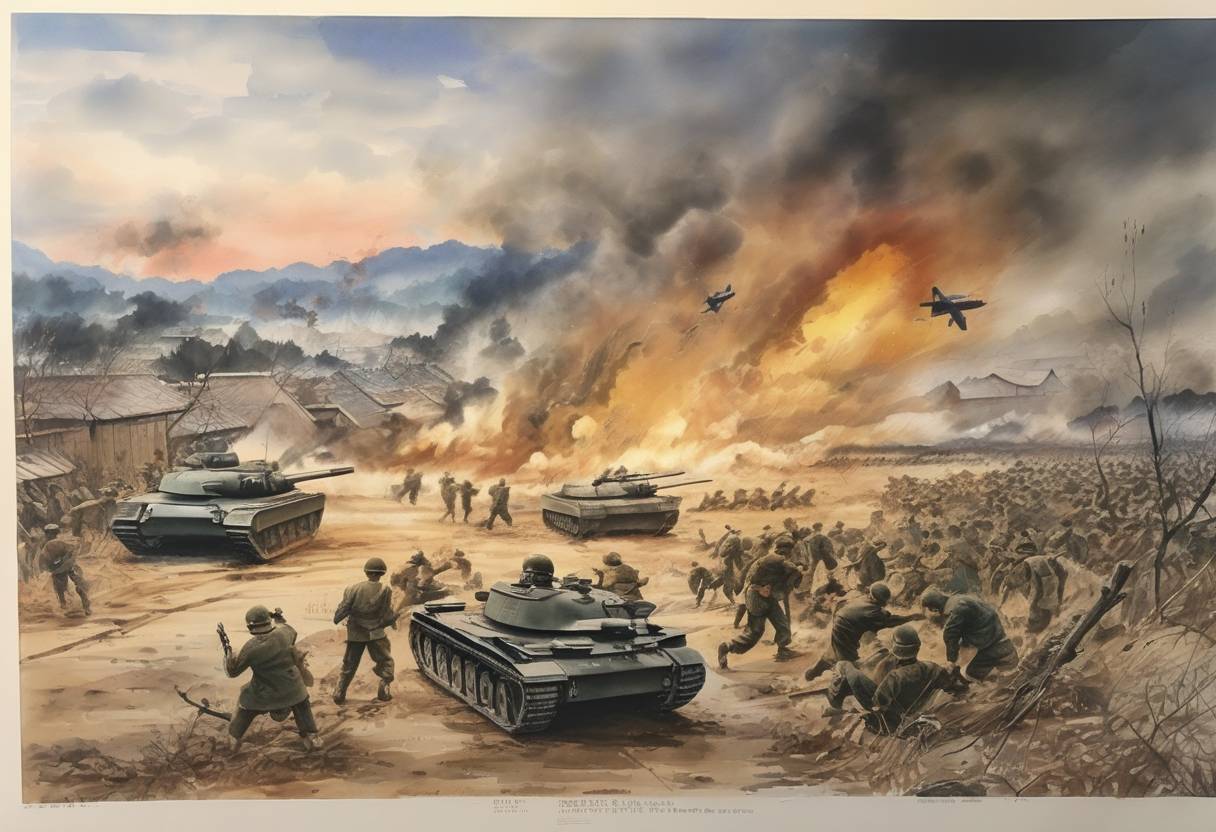
The Battle of Osan, fought on July 5, 1950, marked the first military engagement between American and North Korean forces during the Korean War. This battle was a critical early confrontation that highlighted the challenges faced by U.S. forces in the initial stages of the conflict.
The Korean War began on June 25, 1950, when North Korean forces, backed by the Soviet Union and China, crossed the 38th parallel and invaded South Korea. The rapid advance of the North Korean People’s Army (KPA) prompted the United Nations, led by the United States, to intervene in support of South Korea.
In response to the invasion, the United States deployed Task Force Smith, a hastily assembled unit of the 24th Infantry Division, to South Korea. This task force was named after its commander, Lieutenant Colonel Charles B. Smith. The unit was composed of approximately 540 soldiers, many of whom were inexperienced and inadequately equipped for combat.
On July 5, 1950, Task Force Smith took up defensive positions near the town of Osan, approximately 20 miles south of Seoul. Their mission was to delay the advancing North Korean forces and buy time for additional U.S. and UN reinforcements to arrive.
The North Korean forces, led by the 105th Armored Division, approached Osan with a formidable array of tanks and infantry. Task Force Smith, armed with limited anti-tank weaponry, faced overwhelming odds. The American soldiers were equipped with outdated 2.36-inch bazookas, which proved largely ineffective against the heavily armored Soviet-made T-34 tanks used by the North Koreans.
The battle commenced in the early morning hours, with North Korean tanks leading the assault. Despite their valiant efforts, Task Force Smith was unable to halt the advance. The American forces inflicted some casualties on the North Koreans but were ultimately forced to retreat after suffering significant losses.
The Battle of Osan was a sobering experience for the United States and highlighted the need for better preparation and equipment in the face of a well-armed adversary. Task Force Smith suffered approximately 150 casualties, including killed, wounded, and missing soldiers.
The engagement underscored the urgency of reinforcing U.S. and UN forces in Korea. In the weeks following the battle, additional American troops and resources were deployed to the Korean Peninsula, leading to a more robust and coordinated military response.
The Battle of Osan is remembered as a testament to the bravery of the soldiers who faced overwhelming odds and as a pivotal moment that shaped the early course of the Korean War. It served as a wake-up call for the United States, prompting a reevaluation of military strategy and preparedness in the region.
Source: en.wikipedia.org