The Battle of the Herrings: February 12, 1429
1429 · Rouvray, France
The English capture the town of Rouvray during the Hundred Years' War, known as the Battle of the Herrings, which saw French and Scottish forces defeated.
September 10, 1547
The Battle of Pinkie Cleugh took place, marking the last pitched battle between England and Scotland. It was part of the Rough Wooing, a war between England and Scotland over the marriage of Mary, Queen of Scots, to Edward VI of England.
Musselburgh, Scotland | Kingdom of England
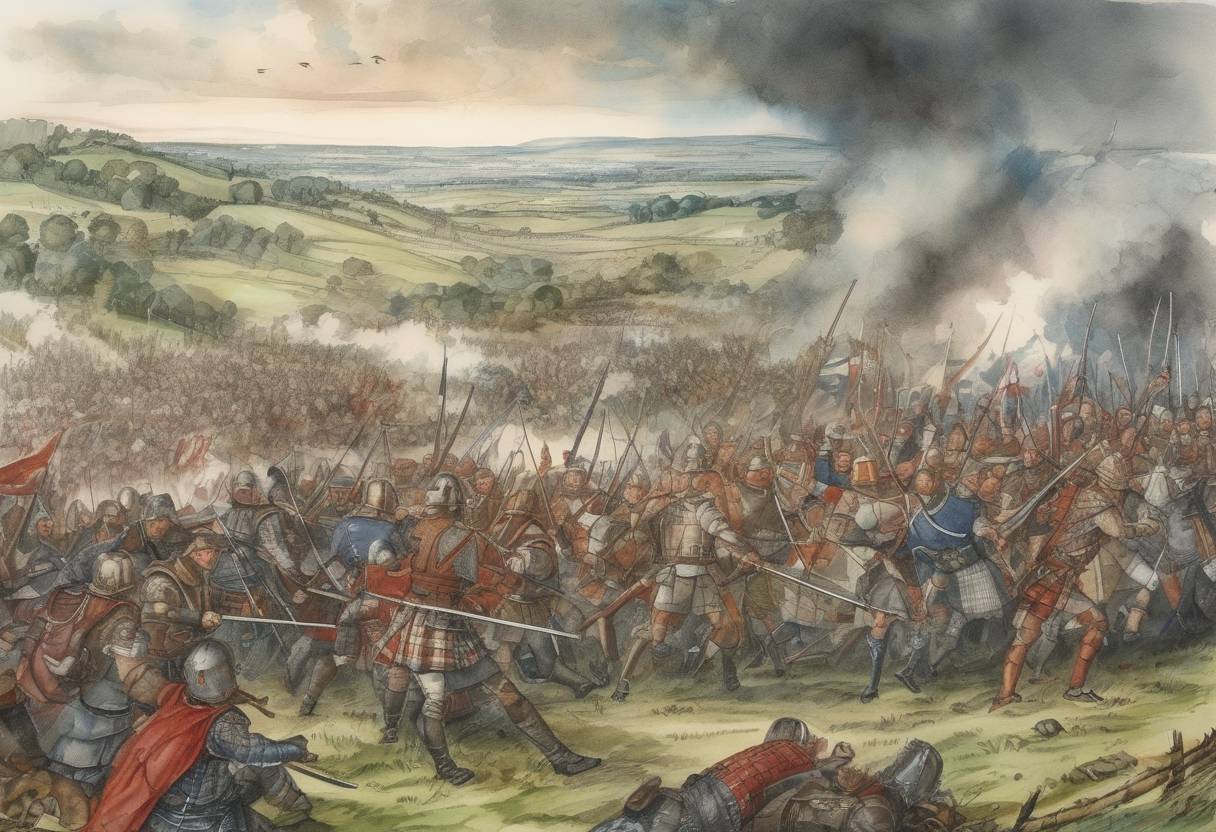
The Battle of Pinkie Cleugh occurred on September 10, 1547, and is recognized as the last pitched battle between the kingdoms of England and Scotland. This battle was a significant event within the larger conflict known as the “Rough Wooing,” a series of military campaigns initiated by England under the reign of Henry VIII and continued by his successor, Edward VI. The primary objective of the Rough Wooing was to secure a marriage alliance between Mary, Queen of Scots, and Edward VI, thereby uniting the two crowns under English influence.
The Rough Wooing began in 1543 when Henry VIII sought to compel the Scots to agree to the marriage treaty, known as the Treaty of Greenwich. However, the Scots rejected the treaty, leading to increased hostilities. Following Henry VIII’s death in 1547, the English government, led by the Lord Protector Edward Seymour, Duke of Somerset, intensified efforts to enforce the marriage proposal through military means.
The Battle of Pinkie Cleugh took place near Musselburgh, east of Edinburgh. The English forces, commanded by the Duke of Somerset, were well-equipped with modern artillery and a strong cavalry. The Scottish army, led by the Earl of Arran, was larger in number but less organized and technologically inferior.
The Battle of Pinkie Cleugh was a devastating blow to the Scottish forces and marked a significant moment in the Rough Wooing. Despite the victory, the English were unable to secure the marriage alliance they sought. The battle did not lead to a lasting peace or union, as the Scots continued to resist English dominance.
The Battle of Pinkie Cleugh remains a poignant reminder of the turbulent relationship between England and Scotland during the 16th century and the complexities of dynastic politics in the period.
Source: en.wikipedia.org