Death of Pepin the Short and the Division of His Kingdom
768 · Saint-Denis, Frankish Kingdom
Pepin the Short, King of the Franks, dies. His kingdom is divided between his sons Charlemagne and Carloman I, setting the stage for the Carolingian Empire.
February 26, 0747
The death of Carloman, the Frankish mayor of the palace of Austrasia, occurs, leading to the consolidation of power by his brother Pepin the Short.
Vienne, Frankish Kingdom | Frankish Kingdom
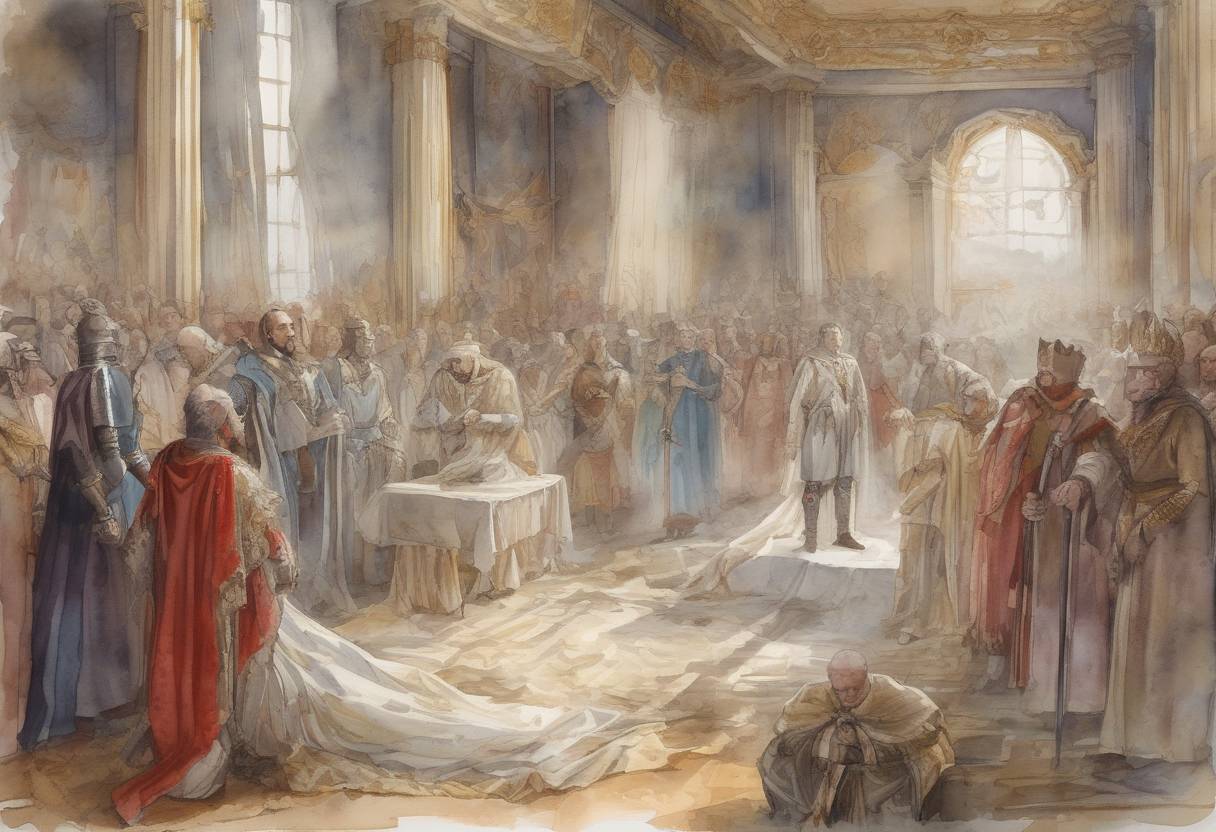
On February 26, 747, Carloman, the Frankish mayor of the palace of Austrasia, passed away, an event that significantly impacted the political landscape of the Frankish Kingdom. His death paved the way for his brother, Pepin the Short, to consolidate power, ultimately leading to the establishment of the Carolingian Dynasty.
Carloman and Pepin the Short were sons of Charles Martel, the powerful Frankish leader who served as the de facto ruler of the Frankish realms. Upon Charles Martel’s death in 741, his territories were divided between Carloman and Pepin. Carloman received Austrasia, Alemannia, and Thuringia, while Pepin took control of Neustria, Burgundy, and Provence.
As mayor of the palace, Carloman wielded considerable influence, effectively governing Austrasia on behalf of the Merovingian king, Childeric III, who was largely a figurehead. Carloman was known for his piety and support of the Church, which he demonstrated by convening the Concilium Germanicum in 742, a synod aimed at reforming the Frankish Church and strengthening its ties with Rome.
In a surprising move, Carloman abdicated his position in 747 to pursue a monastic life. He traveled to Rome, where he became a monk at the monastery of Monte Cassino. His abdication left Pepin as the sole ruler of the Frankish territories, significantly altering the power dynamics within the kingdom.
Carloman’s death on February 26, 747, removed any potential challenges to Pepin’s authority, allowing him to consolidate his power further. This consolidation was crucial in Pepin’s eventual decision to depose Childeric III in 751 and declare himself King of the Franks, marking the end of Merovingian rule and the beginning of the Carolingian Dynasty.
Pepin’s rise to kingship laid the groundwork for the future expansion and consolidation of the Frankish Empire under his son, Charlemagne. The Carolingian Dynasty would go on to play a pivotal role in shaping medieval European history, fostering a cultural and intellectual revival known as the Carolingian Renaissance.
Carloman’s decision to abdicate and his subsequent death were key turning points that enabled Pepin to establish a new era of Frankish leadership, characterized by a closer alliance with the papacy and a stronger centralized authority. This shift had lasting implications for the political and religious landscape of Europe.
Source: en.wikipedia.org