The Siege of Boston Begins: April 20, 1775
1775 · Boston, United States
The Siege of Boston begins during the American Revolutionary War, following the battles of Lexington and Concord.
March 5, 1770
The Boston Massacre occurred when British soldiers killed five civilian men. This event escalated tensions between the American colonists and the British government, contributing to the American Revolutionary War.
Boston, United States | British Army
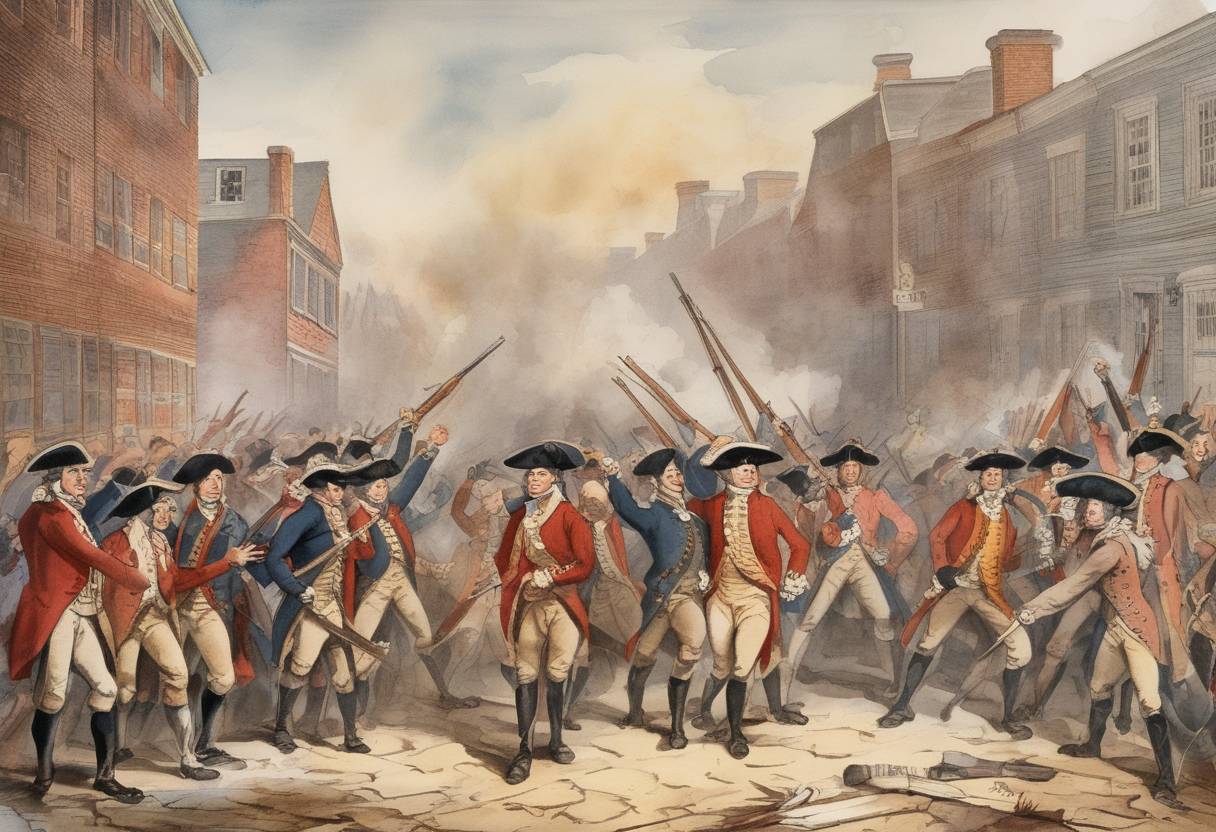
The Boston Massacre was a pivotal event in American history that occurred on March 5, 1770. It marked a significant escalation in the tensions between the American colonists and the British government, contributing to the series of events that eventually led to the American Revolutionary War.
In the years leading up to the Boston Massacre, the relationship between the American colonies and Great Britain had become increasingly strained. The British government, seeking to pay off debts from the Seven Years’ War, imposed a series of taxes on the colonies, such as the Stamp Act of 1765 and the Townshend Acts of 1767. These acts were deeply unpopular among colonists, who resented “taxation without representation.”
Boston, a hotbed of colonial resistance, saw frequent protests and acts of defiance against British authority. The presence of British troops in the city, sent to enforce the unpopular laws, only heightened tensions.
On the evening of March 5, a confrontation between a group of colonists and British soldiers escalated outside the Customs House on King Street (now State Street) in Boston. The soldiers, led by Captain Thomas Preston, were subjected to verbal abuse and pelted with snowballs, rocks, and other objects by the crowd.
Amidst the chaos, the soldiers opened fire on the crowd, killing five civilian men. The victims were Crispus Attucks, Patrick Carr, Samuel Gray, Samuel Maverick, and James Caldwell. Crispus Attucks, a man of African and Native American descent, is often remembered as the first casualty of the American Revolution.
The Boston Massacre had profound implications. It galvanized colonial opposition to British rule and was used as a powerful propaganda tool by colonial leaders like Samuel Adams and Paul Revere. Revere’s engraving of the event, though not entirely accurate, depicted the British soldiers as aggressors and fueled anti-British sentiment.
In the aftermath, the soldiers involved were put on trial. John Adams, who would later become the second President of the United States, served as their defense attorney. He argued that the soldiers acted in self-defense, and ultimately, six of the eight soldiers were acquitted, while two were convicted of manslaughter and received reduced sentences.
The Boston Massacre is often seen as a catalyst for the American Revolution. It highlighted the growing divide between the colonies and the British government and underscored the colonists’ desire for greater autonomy and respect for their rights.
The Boston Massacre is remembered as a turning point in American history. It exemplifies the escalating conflict between the colonies and Britain, which would culminate in the outbreak of the Revolutionary War in 1775. The event also underscores the power of propaganda and public opinion in shaping historical narratives and movements.
In summary, the Boston Massacre was not just a tragic incident but a significant moment that helped to unite the colonies against perceived British tyranny, setting the stage for the struggle for independence.
Source: www.history.com