Luna 10: The First Spacecraft to Orbit the Moon
1966 · Baikonur, Kazakhstan
The Soviet Union launched Luna 10, which later became the first spacecraft to orbit the Moon.
October 4, 1957
The Soviet Union launched Sputnik 1, the first artificial Earth satellite, marking the start of the space age and the U.S.-Soviet space race.
Baikonur, Kazakhstan | Soviet space program
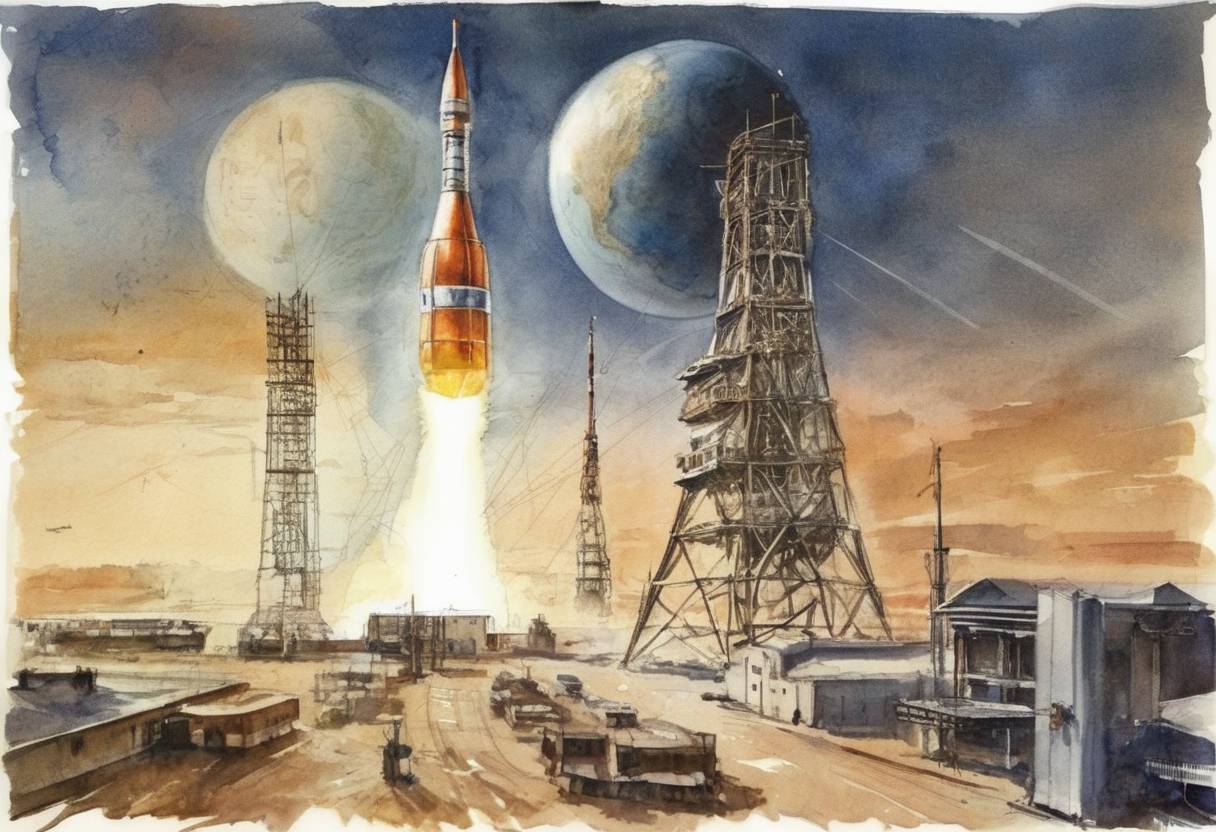
On October 4, 1957, the Soviet Union successfully launched Sputnik 1, the first artificial Earth satellite, from the Baikonur Cosmodrome in Kazakhstan. This historic event marked the beginning of the space age and ignited the U.S.-Soviet space race, a period of intense competition between the two superpowers in space exploration.
In the post-World War II era, both the United States and the Soviet Union were engaged in a Cold War, characterized by political tension and technological rivalry. The development of rocket technology, initially for military purposes, soon extended to space exploration. The Soviet Union, under the leadership of Nikita Khrushchev, aimed to demonstrate its scientific and technological prowess on the global stage.
Sputnik 1 was a spherical satellite, 58 centimeters (about 23 inches) in diameter, with four external radio antennas to broadcast radio pulses. It weighed approximately 83.6 kilograms (about 184 pounds). The satellite was launched aboard an R-7 rocket, a modified intercontinental ballistic missile.
Upon reaching orbit, Sputnik 1 transmitted radio signals back to Earth, which could be received by radio operators around the world. These signals provided valuable data on the density of the upper atmosphere and the propagation of radio signals in the ionosphere.
The successful launch of Sputnik 1 had profound implications:
Technological Achievement: It showcased the Soviet Union’s advanced capabilities in rocket technology and space exploration, challenging the United States’ technological leadership.
Political Repercussions: The launch intensified the Cold War rivalry, leading to a sense of urgency in the United States to catch up in space exploration.
Public Reaction: The event captured the world’s attention, sparking both awe and fear. In the United States, it led to a period of introspection and a reevaluation of its scientific and educational systems.
Sputnik 1’s launch marked the beginning of the space race, a key aspect of the Cold War. In response, the United States accelerated its own space program, leading to the creation of the National Aeronautics and Space Administration (NASA) in 1958. This competition spurred rapid advancements in space technology and exploration, culminating in the Apollo moon landings in 1969.
Sputnik 1’s successful launch was a pivotal moment in history, symbolizing human ingenuity and the potential for space exploration. It paved the way for future satellites and space missions, fundamentally transforming our understanding of space and our place in the universe.
The launch of Sputnik 1 remains a significant milestone, reminding us of the power of scientific achievement and the enduring quest to explore beyond our planet.
Source: en.wikipedia.org