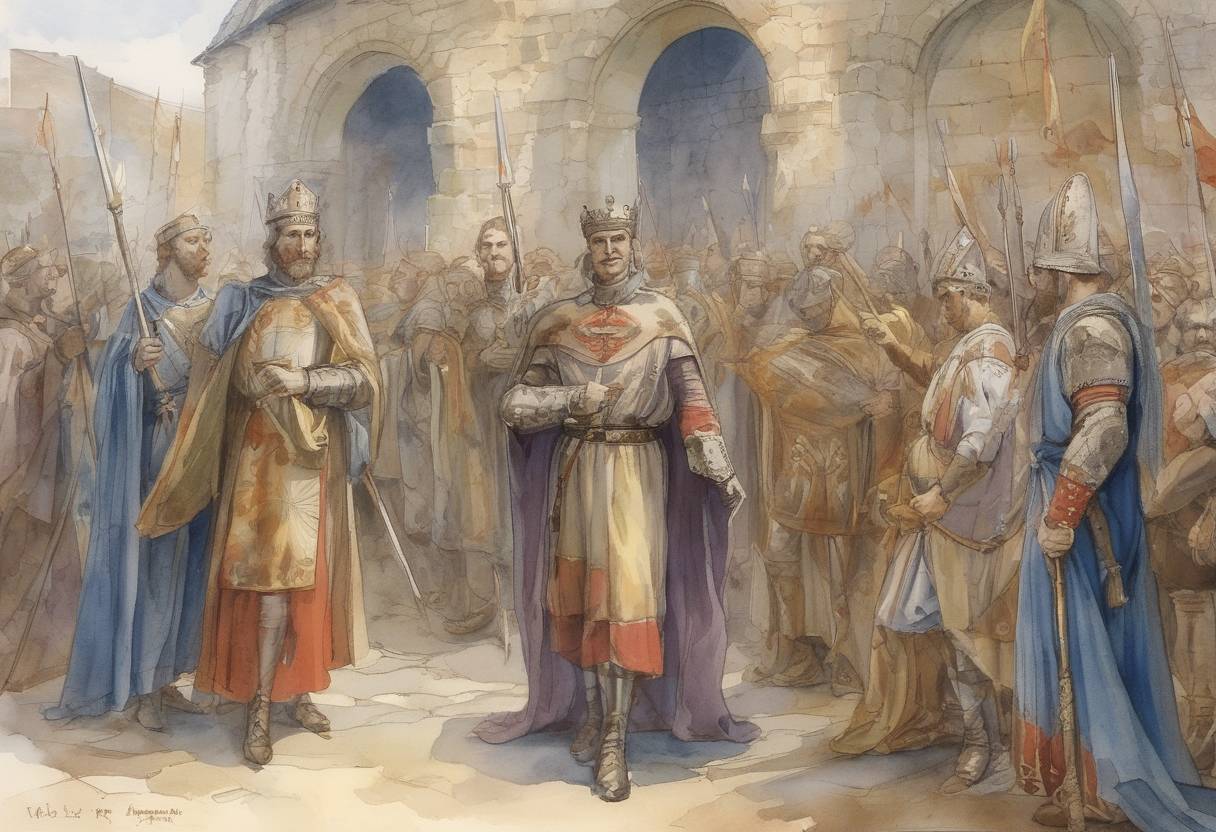
The Death of King Carloman II and the Unification of the Frankish Kingdom
On December 21, 884, King Carloman II of West Francia passed away, an event that significantly influenced the political landscape of the Frankish territories. His death marked a pivotal moment in the history of the Carolingian Empire, leading to the temporary unification of the Frankish kingdom under Charles the Fat.
Background
Carloman II was born around 866, the son of King Louis the Stammerer. Following his father’s death in 879, Carloman II and his brother, Louis III, inherited the West Frankish kingdom, which roughly corresponds to modern-day France. The brothers initially ruled jointly, but after Louis III’s untimely death in 882, Carloman II became the sole ruler of West Francia.
During his reign, Carloman II faced numerous challenges, including Viking invasions and internal noble dissent. The political fragmentation of the Carolingian Empire, which had begun under his grandfather, Charles the Bald, continued to pose significant difficulties.
The Death of Carloman II
Carloman II’s death in 884 was reportedly due to a hunting accident, although details remain sparse. His untimely demise left West Francia without a clear heir, as he had no surviving children. This lack of succession created a power vacuum and an opportunity for consolidation within the Carolingian dynasty.
Unification Under Charles the Fat
Following Carloman II’s death, Charles the Fat, who was already the ruler of East Francia (modern-day Germany) and Italy, was invited by the West Frankish nobility to assume control over West Francia. Charles was a son of Louis the German and a grandson of Louis the Pious, making him a legitimate Carolingian heir.
In 885, Charles the Fat was crowned King of West Francia, effectively uniting the Frankish territories under a single ruler for the first time since the division of the empire following the Treaty of Verdun in 843. His reign, however, was short-lived and fraught with challenges, including continued Viking raids and internal dissent.
Aftermath and Significance
The unification under Charles the Fat was a brief interlude in the ongoing fragmentation of the Carolingian Empire. By 887, Charles was deposed due to his inability to effectively manage the empire’s vast territories and address the Viking threat. His deposition marked the end of the united Carolingian Empire, leading to further divisions and the eventual rise of new political entities in Europe.
The events following Carloman II’s death highlight the complexities of succession and governance in medieval Europe, as well as the challenges faced by the Carolingian dynasty in maintaining control over a sprawling and diverse empire. The temporary unification under Charles the Fat serves as a reminder of the transient nature of political power during this period.