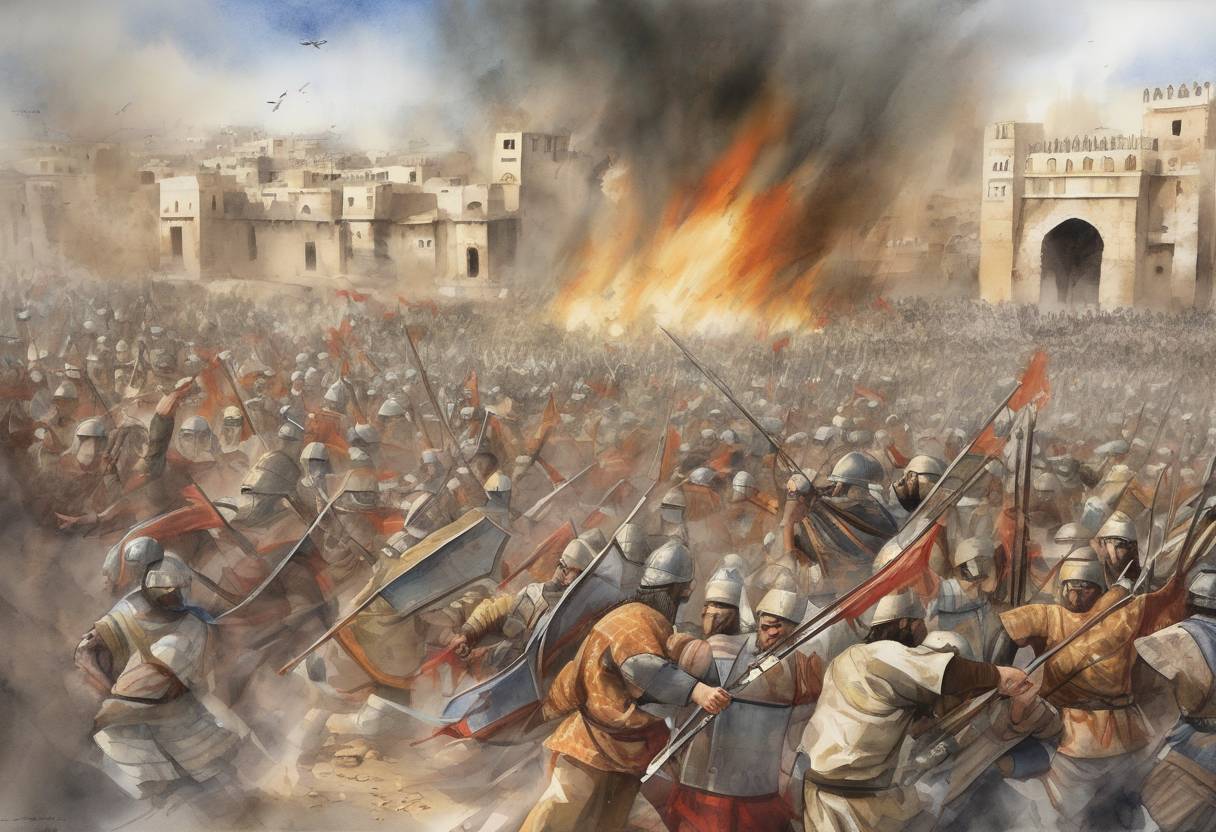
The Battle of Yarmouk: August 12, 636
The Battle of Yarmouk, which began on August 12, 636, stands as one of the most pivotal military engagements in the early Islamic conquests. This battle was fought between the forces of the Byzantine Empire and the Rashidun Caliphate, marking a decisive victory for the Rashidun forces and significantly influencing the Muslim conquest of the Levant.
Context and Prelude
- Byzantine Empire: At the time, the Byzantine Empire was one of the most powerful entities in the world, controlling vast territories across the Eastern Mediterranean.
- Rashidun Caliphate: The Rashidun Caliphate, under the leadership of Caliph Umar ibn al-Khattab, was rapidly expanding. The Muslim forces had already made significant inroads into Byzantine territories.
- Strategic Importance: The Levant was a crucial region for both empires due to its economic and strategic significance. Control over this area meant dominance over key trade routes and influence over the Eastern Mediterranean.
The Battle
- Location: The battle took place near the Yarmouk River, which is in present-day Syria and Jordan.
- Forces: The Rashidun army, commanded by Khalid ibn al-Walid, was significantly outnumbered by the Byzantine forces led by Emperor Heraclius’s brother, Theodore Trithyrius.
- Tactics: Khalid ibn al-Walid employed superior military tactics, including the use of mobile cavalry units and strategic positioning, which allowed the Rashidun forces to effectively counter the larger Byzantine army.
Key Events
- Initial Skirmishes: The battle began with a series of skirmishes and maneuvers, testing the strengths and weaknesses of both sides.
- Main Engagement: Over several days, intense fighting ensued. The Rashidun forces demonstrated remarkable discipline and coordination, which eventually led to the encirclement and defeat of the Byzantine army.
- Byzantine Retreat: The Byzantine forces, unable to withstand the sustained assault and tactical prowess of the Rashidun army, were forced into a chaotic retreat.
Aftermath and Significance
- Decisive Victory: The victory at Yarmouk was decisive for the Rashidun Caliphate, effectively ending Byzantine control over the Levant.
- Expansion of Islam: This triumph paved the way for further Muslim conquests in the region, including the eventual capture of Jerusalem and other key cities.
- Byzantine Decline: The loss significantly weakened the Byzantine Empire’s hold in the East, contributing to its gradual decline over the following centuries.
- Military Legacy: The battle is often cited as a classic example of effective military strategy and leadership, particularly highlighting Khalid ibn al-Walid’s prowess as a commander.
The Battle of Yarmouk remains a significant event in world history, illustrating the dynamic shifts in power during the early Islamic period and setting the stage for the further spread of Islam across the Middle East and beyond.