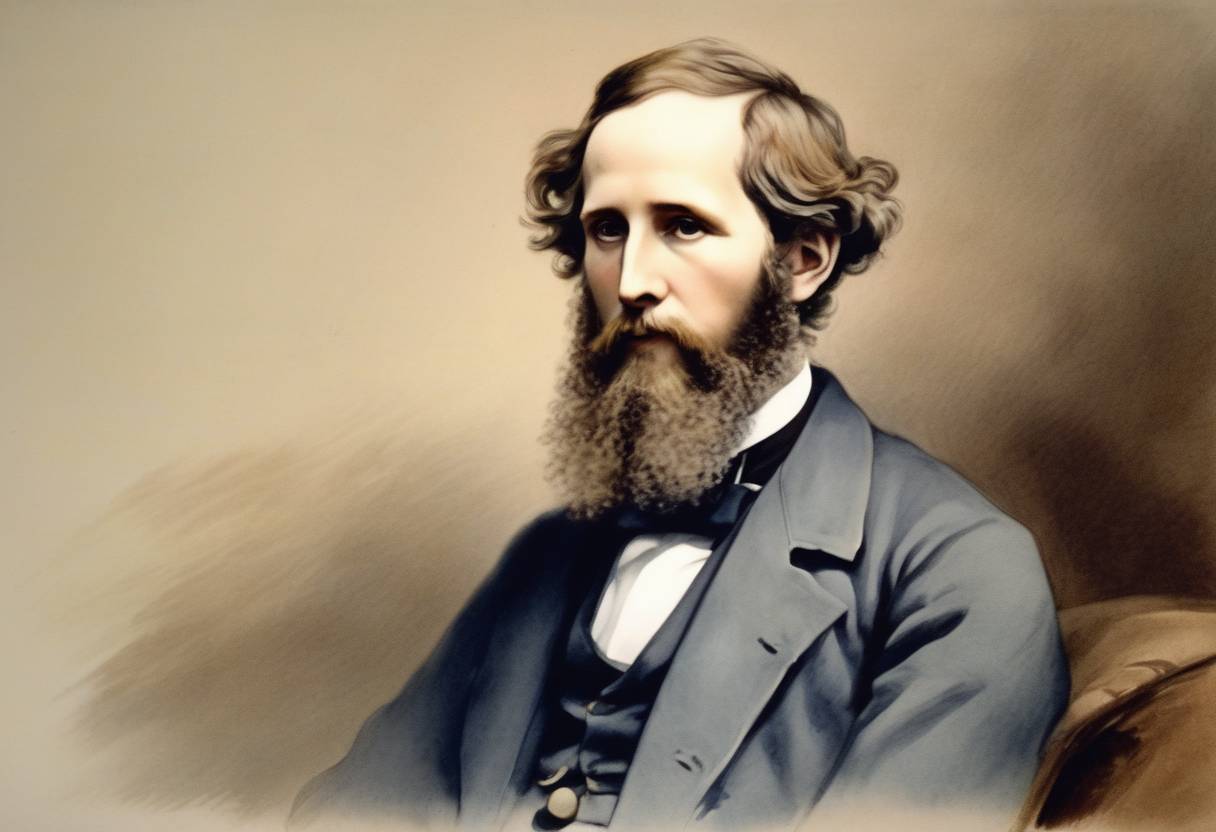
Death of James Clerk Maxwell: November 4, 1879
James Clerk Maxwell, a celebrated Scottish physicist renowned for his groundbreaking contributions to the field of electromagnetic theory, passed away on November 4, 1879, in Cambridge, England. His work laid the foundation for numerous significant developments in physics and engineering.
Early Life and Education
Maxwell was born on June 13, 1831, in Edinburgh, Scotland. A prodigious student with a natural curiosity for the physical sciences, he attended the University of Edinburgh and later, Trinity College, Cambridge. His early academic endeavors foreshadowed his remarkable ability to conceptualize and solve complex problems.
Contributions to Electromagnetic Theory
Maxwell’s most notable achievement is the formulation of Maxwell’s Equations, a set of partial differential equations that describe the behavior of electric and magnetic fields and their interactions with matter. These equations unified the previously separate forces of electricity and magnetism into a single theory of electromagnetism.
His 1865 paper “A Dynamical Theory of the Electromagnetic Field” demonstrated that light is an electromagnetic wave, traveling at the speed of light, effectively linking the fields of electromagnetism and optics. This insight paved the way for advancements in communication technologies and fundamentally altered the understanding of light and electromagnetism.
Achievements and Legacy
Besides his work on electromagnetism, Maxwell made significant contributions to the study of gases, leading to the kinetic theory of gases and the development of statistical mechanics. His research on color perception, including the creation of the first color photograph, further exemplified his diverse scientific interests and capabilities.
Maxwell’s influence extends beyond his own discoveries; his ideas inspired subsequent physicists, including Albert Einstein, who built upon them in the development of the theory of relativity.
Maxwell’s death at the age of 48 was attributed to abdominal cancer, cutting short a career of incredible contributions to the field of physics. His legacy endures through the profound impact of his theories, which continue to underpin modern electrical and communications engineering.
Historical Significance
James Clerk Maxwell is often credited with forming the bridge between classical and modern physics. His theoretical frameworks not only consolidated the understanding of electromagnetic phenomena but also laid the groundwork for the future exploration of advanced theories, including quantum mechanics and relativity. His works are indispensable in the annals of scientific history, marking him as one of the most influential scientists of the 19th century.