Arrest of Maximilien Robespierre - July 27, 1794
1794 · Paris, France
Maximilien Robespierre, a leading figure of the French Revolution, was arrested by the National Convention, marking the end of the Reign of Terror.
June 30, 1794
In France, during the Reign of Terror, artist Jacques-Louis David publicly unveiled his famous painting 'The Death of Marat'. The masterpiece depicted the assassination of Jean-Paul Marat, a radical journalist and politician, who was murdered by Charlotte Corday in 1793.
Paris, France | National Convention
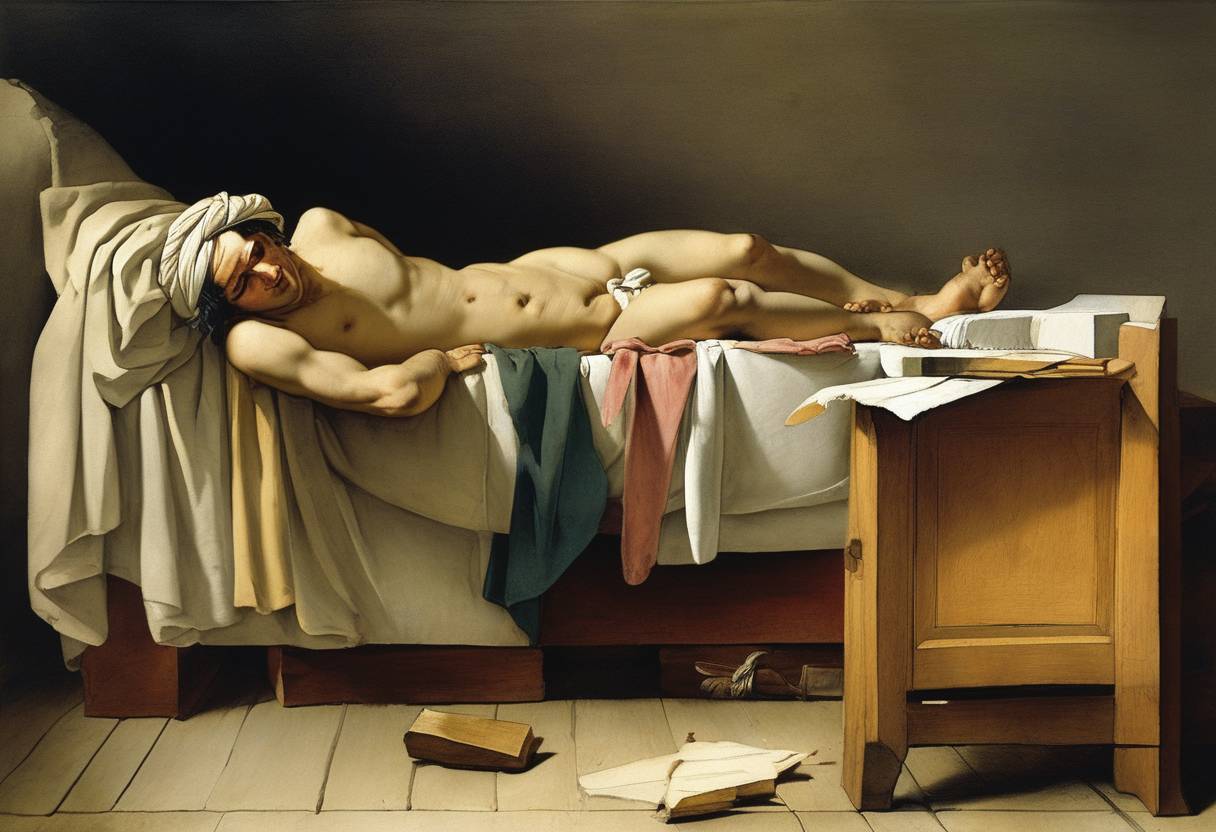
On June 30, 1794, Jacques-Louis David, a prominent French painter closely associated with the radical political currents of the French Revolution, publicly unveiled his famous painting, The Death of Marat. This artwork became one of the defining images of the Reign of Terror, a period marked by intense political repression and mass executions.
Jean-Paul Marat was a passionate revolutionary journalist and a member of the radical Jacobin faction. Known for his fierce advocacy through the newspaper L’Ami du Peuple, Marat became a significant figure within the revolution, championing the cause of the common people and calling for radical reforms.
Marat’s assassination on July 13, 1793, by Charlotte Corday, a Girondin sympathizer, was a highly symbolic event. Corday, hoping to stem the radical tide of the Revolution, believed that by killing Marat, she could restore peace to France. Her action, however, led to Marat becoming a martyr for the revolution.
David’s The Death of Marat captures the immediate aftermath of the assassination. The painting depicts Marat slumped in his bathtub, where he frequently sought relief from a debilitating skin condition exacerbated by stress. David’s composition is both stark and poignant, focusing on the lifeless form of Marat, the letter from Corday clutched in his hand, and the blood-stained bath.
The artist chose to present Marat as a serene and noble figure, emphasizing his martyrdom for the revolutionary cause. David’s use of lighting and composition draws parallels to religious iconography, likening Marat’s death to that of a saint. The simplicity of the setting contrasts with the emotional depth conveyed by Marat’s outstretched hand and peaceful expression.
The unveiling of The Death of Marat took place as the Reign of Terror approached its peak. David, an ardent supporter of Maximilien Robespierre and the Jacobin cause, intended the painting as political propaganda. It was meant to solidify Marat’s status as a revolutionary hero and to inspire continued fervor among the revolutionaries.
The painting’s impact extended far beyond its initial unveiling. It became a powerful symbol of revolutionary sacrifice and was used to legitimize the severe measures taken by the ruling regime. It also cemented David’s position as the official artist of the revolution, demonstrating his ability to blend art with political expression.
Following the fall of Robespierre and the end of the Reign of Terror, David faced arrest and imprisonment due to his association with the Jacobins. Despite the political shifts, The Death of Marat endured as a masterpiece of neoclassical art and a testament to the turbulence and passion of the Revolutionary era.
Source: www.louvre.fr