Attack on the U.S. Embassy Annex in Beirut - September 20, 1984
1984 · Beirut, Lebanon
A suicide bomber in a truck attacked the U.S. Embassy annex in Beirut, Lebanon, killing 24 people, including two Americans.
April 13, 1975
A civil war broke out in Lebanon when a Christian militia called the Phalangists attacked a bus in the Ain el-Rammaneh district of Beirut, escalating sectarian tensions.
Beirut, Lebanon | Phalangists
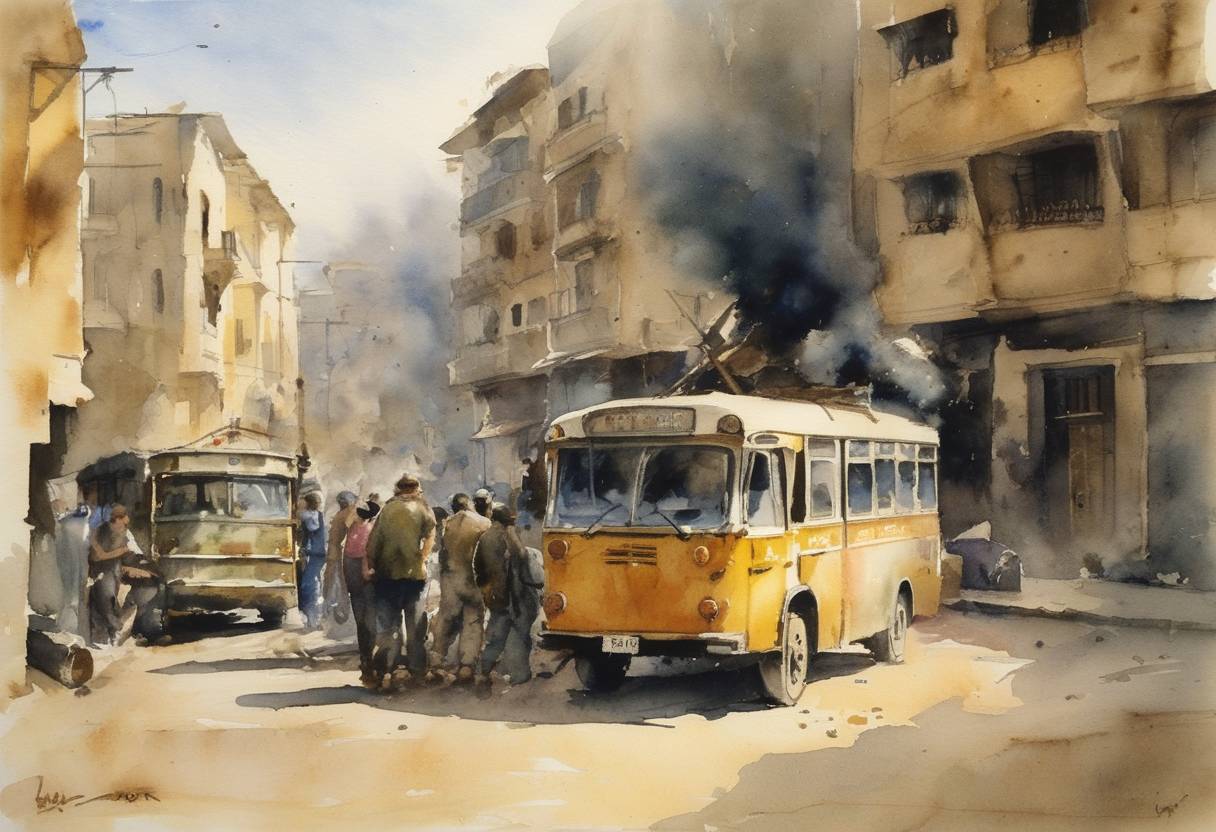
On April 13, 1975, a pivotal and tragic event occurred in Lebanon that marked the official start of the Lebanese Civil War. The conflict began when members of the Phalangists, a right-wing Christian militia group, attacked a bus in the Ain el-Rammaneh district of Beirut. This violent episode escalated pre-existing sectarian tensions within the country and set off a complex and protracted civil war that would last until 1990.
Lebanon, during the early 1970s, was a nation deeply divided along religious and ideological lines. The country had a fragile power-sharing arrangement known as the National Pact, which was established in 1943 to distribute political power amongst its various religious communities. However, demographic changes and increasing political grievances led to rising tensions, particularly between the Christian populations, who were heavily favored in the power structure, and the Muslims and Palestinians, who felt marginalized.
The presence of Palestinian refugees and guerrilla fighters (Fedayeen) further inflamed tensions. Palestinian Liberation Organization (PLO) operations from Lebanese territory led to confrontations with Israeli forces, exacerbating the internal discord.
On that fateful Sunday, a bus carrying Palestinians was ambushed by armed Phalangists after a failed assassination attempt on a Phalangist leader earlier in the day. This retaliatory attack resulted in the deaths of about 27 Palestinian civilians. The bus ambush underscored the sectarian divide and rapidly led to widespread violence.
The Ain el-Rammaneh bus attack triggered a spiral of violence that spread quickly across Beirut and beyond. Militias of various factions—Christian, Sunni, Shia, and Palestinian—began forming and engaging in retaliatory attacks and assassinations. The instability invited external actors who had interests in Lebanon’s complex geopolitical landscape.
The start of the Lebanese Civil War on April 13, 1975, marked the beginning of a 15-year saga characterized by massive destruction, loss of life, and economic decline. The war fundamentally altered Lebanon’s social fabric and left profound legacies, which included displacement, sectarian division, and shifts in regional politics. It wasn’t until the Taif Agreement of 1989 that the conflict began to wind down, formally ending in 1990.
The war’s enduring impact is still felt today, influencing Lebanon’s political landscape and ongoing challenges in maintaining national unity and stability.
Source: www.britannica.com