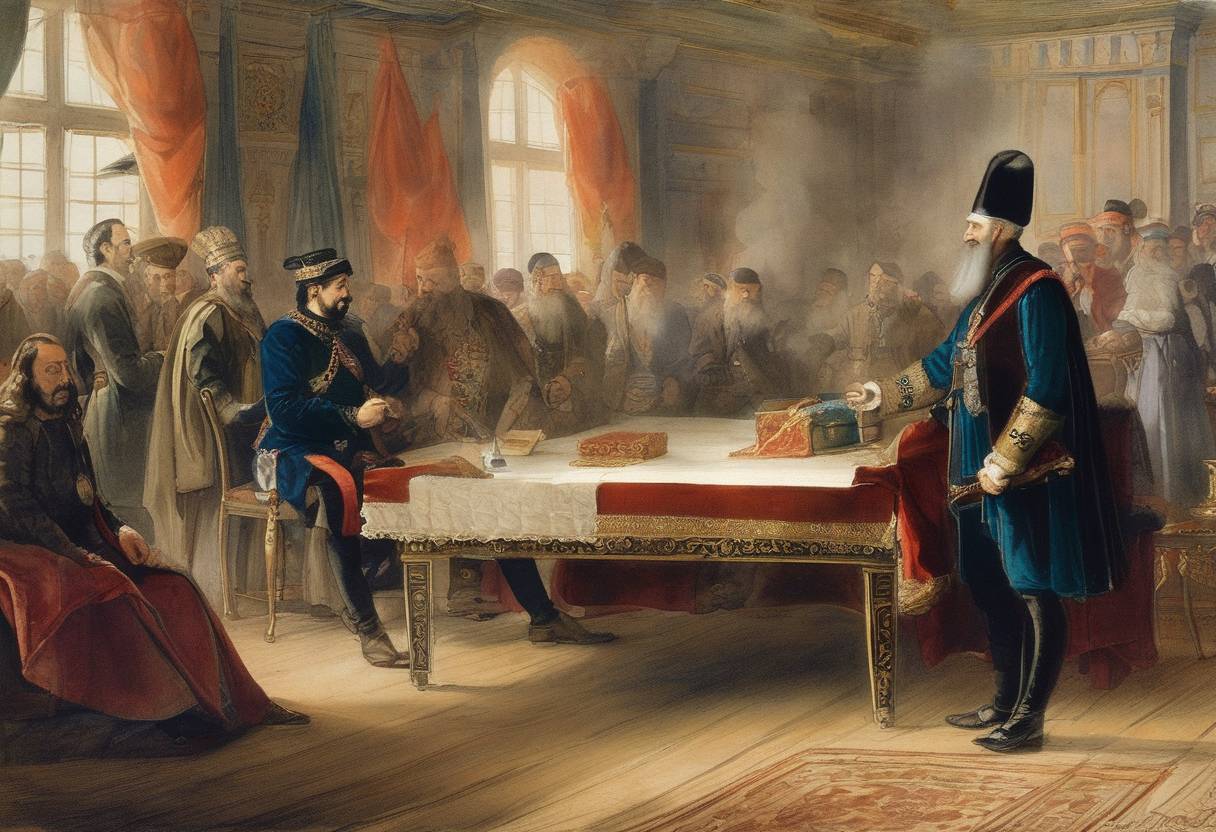
The Treaty of Karlowitz
The Treaty of Karlowitz, signed on January 26, 1699, marked a significant turning point in European history, concluding the Great Turkish War (1683–1697) between the Ottoman Empire and the Holy League. This agreement is particularly notable for ending Ottoman hegemony in much of Central Europe and facilitating the rise of the Habsburg Empire.
Background
The protracted conflict began largely as part of the larger Turkish War, where Ottoman expansion in Europe reached its zenith but began facing serious setbacks as European powers rallied to oppose it. The Ottoman Empire’s ambitions were checked by an alliance of European states known as the Holy League, which included the Habsburg Monarchy, the Polish-Lithuanian Commonwealth, the Republic of Venice, and Russia. This coalition was formed following the failed Ottoman siege of Vienna in 1683, a decisive event that demonstrated the vulnerability of Ottoman forces.
The Negotiations
Negotiations for peace were held in Sremski Karlovci, part of modern-day Serbia. The talks were mediated by English and Dutch representatives, reflecting the broad international interest in stabilizing Central Europe and curtailing Ottoman influence. The discussions were extensive and complex, involving multiple parties with varied objectives, but ultimately led to a resolution that redefined the political landscape of Europe.
Terms of the Treaty
Under the terms of the Treaty of Karlowitz:
Austria: The Habsburg Empire gained significant territories, including Hungary (excluding the Banat of Temeswar, which remained under Ottoman control), Transylvania, and Slavonia. This expansion considerably strengthened the Habsburg position in Europe.
Venice: Venice received the Morea (the Peloponnese peninsula in Greece) along with other territories in Dalmatia, enhancing its power in the Mediterranean.
Poland: The Polish-Lithuanian Commonwealth regained control of Podolia, which had been under Ottoman control.
Ottoman Empire: While retaining most of the core territories of its empire, the Ottoman Empire conceded defeat in its Central European ambitions, marking a retreat from centuries of territorial expansion in Europe.
Consequences
The treaty marked the shift in power dynamics in Central Europe. It was a significant blow to Ottoman prestige and initiated a period of territorial retreat for the empire, considered the beginning of the “Eastern Question” in European diplomatic history. Conversely, the treaty solidified the Habsburg Monarchy’s role as a dominant force in Central and Eastern Europe, setting the stage for its future conflicts and diplomacy within the continent.
The Treaty of Karlowitz not only realigned borders but also set a precedent for future treaties involving the Ottoman Empire, increasingly integrating European-style diplomacy in international relations. The subsequent stabilization allowed for economic and cultural development in the reclaimed regions, contributing to the flourishing of the Baroque culture in Central Europe.
In summary, the Treaty of Karlowitz was a landmark pact that curtailed Ottoman influence in Europe, expanded the Habsburg Empire, and underscored the shifting balance of power that characterized the European political landscape at the dawn of the 18th century.