Deposition of Sultan Abdul Hamid II and Succession of Mehmed V
1909 · Istanbul, Ottoman Empire
The Sultan of the Ottoman Empire, Abdul Hamid II, was deposed and succeeded by his brother Mehmed V.
January 27, 1695
Mustafa II becomes Ottoman Sultan following the deposition of Ahmed II.
Constantinople, Ottoman Empire | Ottoman Empire
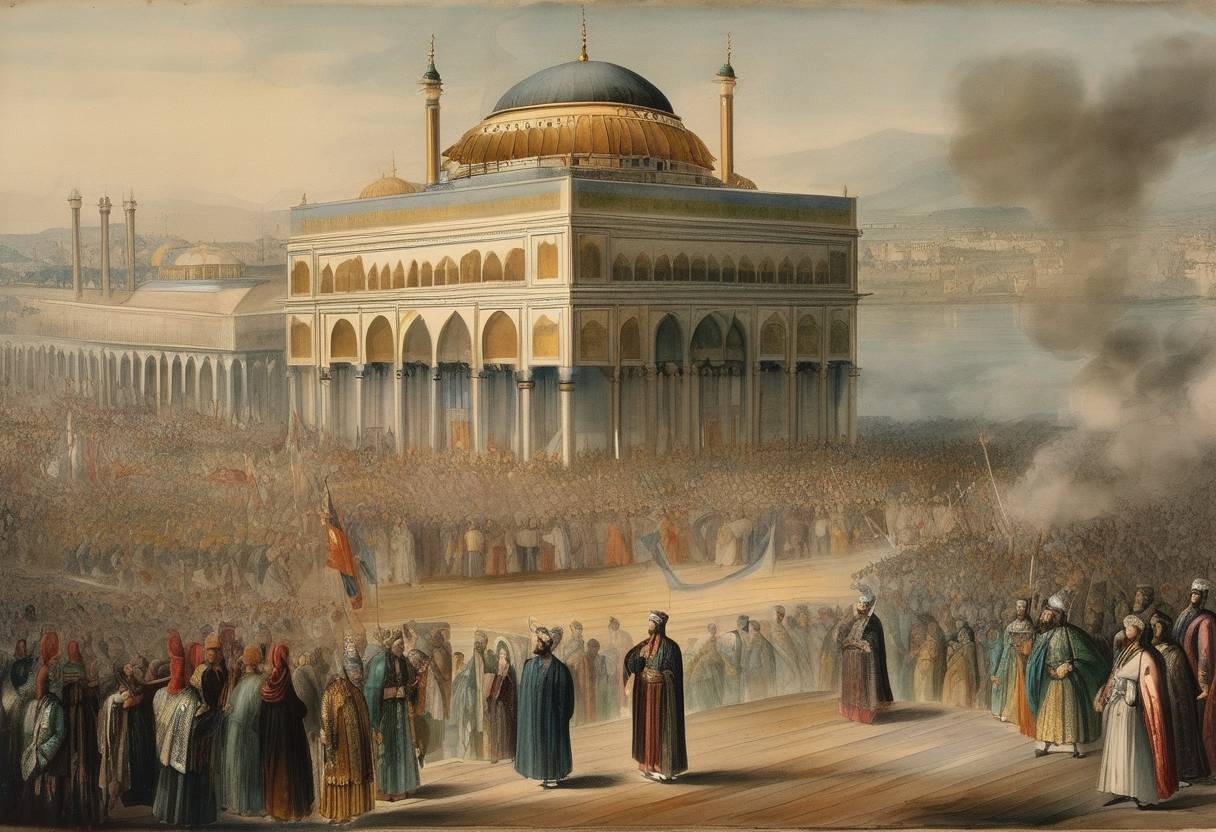
On January 27, 1695, Mustafa II ascended to the throne as the Sultan of the Ottoman Empire, following the deposition of his uncle, Sultan Ahmed II. Mustafa’s rise to power came amid ongoing challenges faced by the empire, both internally and on external fronts.
Mustafa II was born on June 6, 1664, in Edirne, within the sprawling Ottoman Empire. He was a son of Sultan Mehmed IV and came from the influential Köprülü family lineage through his mother, Sultan’s consort. His upbringing was typical of Ottoman royalty, preparing him for potential roles in governance through rigorous education and exposure to statecraft.
Mustafa II succeeded his uncle Ahmed II, who became Sultan following the death of Suleiman II in 1691. Ahmed II’s reign was marked by military pressures, such as the ongoing War of the Holy League initiated by his predecessors. The Ottomans faced alliances of European powers including the Holy Roman Empire, Poland, Venice, and Russia.
Sultan Ahmed II’s rule was characterized by military struggles and internal administrative difficulties. Success was limited, and the military defeats weakened his grip on power. On January 27, 1695, a palace coup orchestrated by significant state factions and decision-makers within the empire led to Mustafa II’s ascension to the throne. His accession marked a period loaded with aspirations for revitalization and reform amid waning Ottoman influence.
Upon becoming Sultan, Mustafa II inherited a burdensome war and sought to reclaim Ottoman glory through military campaigns aimed at rectifying the setbacks suffered by the empire. He was determined to stabilize the internal conditions and improve foreign relations.
Mustafa II embarked on several military campaigns, especially targeting the Habsburgs to regain lost territories. However, his reign was also marked by economic struggles and continued external pressure from European powers. By 1700, many of his efforts led to established peace negotiations, like the Treaty of Karlowitz in 1699, which significantly impacted Ottoman territorial holdings in Europe.
Mustafa II’s reign illustrated complex dynamics within the Ottoman political and military landscape during a period of European ascendancy. While his ascension marked hopes for a revival, it highlighted the broader structural challenges the empire faced, ushering in what would eventually lead to further retraction and transformation of the Ottoman state through subsequent reigns. His rule stands as a period illustrative of both attempts at resurgence and acknowledgment of the necessity for transformation within the Ottoman Empire.
Source: en.wikipedia.org