The Battle of Domstadtl: July 8, 1758
1758 · Domstadtl, Austrian Empire
The Battle of Domstadtl takes place during the Seven Years' War as a notable engagement between the Austrian forces and the Prussian army.
June 18, 1757
The Battle of Kolín took place during the Seven Years' War, where Austrian forces, commanded by Field Marshal Leopold Joseph von Daun, defeated the Prussian forces under King Frederick the Great.
Kolín, Czech Republic
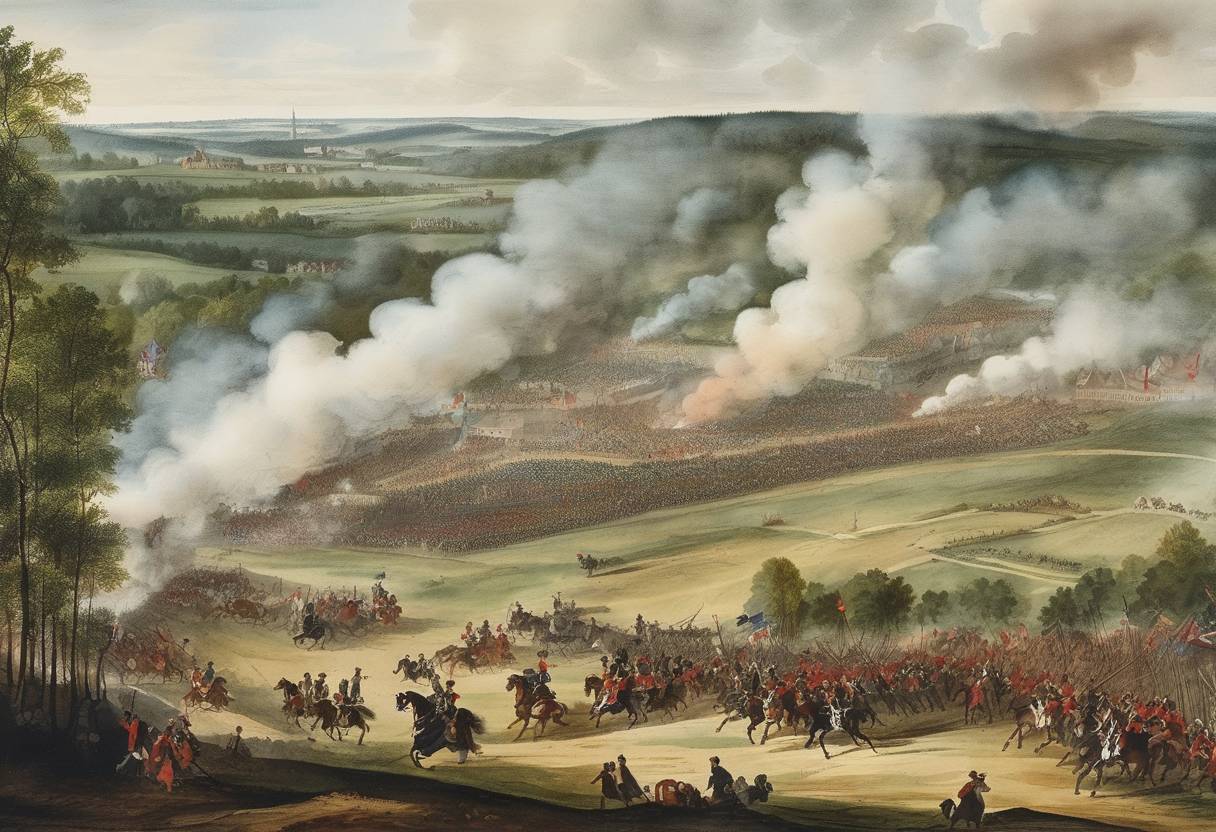
The Battle of Kolín, a pivotal engagement during the Seven Years’ War, occurred on June 18, 1757. This battle marked a significant turning point in favor of the Austrian forces against the Prussians, underlining the tactical prowess of the Austrian commander, Field Marshal Leopold Joseph von Daun.
The Seven Years’ War (1756–1763), a global conflict that involved most of the great powers of the time, saw various military campaigns across Europe. Prussia, led by King Frederick the Great, sought territorial expansion and dominance over its Habsburg rival, Austria. In early 1757, Frederick launched an invasion into Bohemia, seeking to deliver a decisive blow against Austria.
Before the Battle of Kolín, Frederick the Great had achieved a significant victory at the Battle of Prague on May 6, 1757. Following this, Prussian forces laid siege to Prague, although they faced stiff resistance from the garrison inside the city. To relieve Prague, Austrian Empress Maria Theresa sent Field Marshal von Daun with an army to disrupt Frederick’s plans and threatened his lines of supply.
The engagement took place near the town of Kolín, situated about 50 kilometers east of Prague. Frederick, confident of his previous successes, commanded an army of about 34,000. In contrast, von Daun’s Austrian force was approximately 54,000 strong. Despite being outnumbered, Frederick attacked, attempting to outmaneuver the Austrians through rapid movement and fierce infantry assaults.
Von Daun, aware of Frederick’s aggressive tactics, executed a defensive strategy, utilizing the hilly terrain to his advantage. Austrian forces were well-positioned and fortified, making it challenging for the Prussians to carve out a decisive victory. As the battle intensified, the tired and overstretched Prussian forces faced staunch resistance and strategic counterattacks from the Austrians.
The Battle of Kolín ended in a resounding defeat for the Prussian army, suffering heavy casualties with about 14,000 men lost, either killed, wounded, or captured. The tactical acumen of von Daun and the resilience of the Austrian troops turned the tide against Frederick, causing him to retreat and abandon the siege of Prague.
This victory marked the end of Prussia’s unbroken string of successes early in the war and forced Frederick to adopt a more cautious approach in subsequent campaigns. The win significantly bolstered Austrian morale and reinforced the strategic importance of coalition warfare against Prussia.
The Battle of Kolín was a critical moment in the Seven Years’ War, illustrating the potential for coordinated and well-led defense to overcome even the most aggressive strategies. It asserted Austria’s military capabilities and leadership under von Daun, while also highlighting the challenges Frederick the Great faced in sustaining his earlier victories without overextending his resources. The battle’s outcome influenced the subsequent course of the war, prompting shifts in alliances and strategies that would unfold over the remaining years of the conflict.
Source: en.wikipedia.org