Henry VIII’s Break with the Roman Catholic Church
1536 · London, England
The authority of the Pope was declared void in England as part of King Henry VIII's break with the Roman Catholic Church.
March 18, 1536
King Henry VIII of England dissolves the monasteries and confiscates their assets.
London, England | Church of England
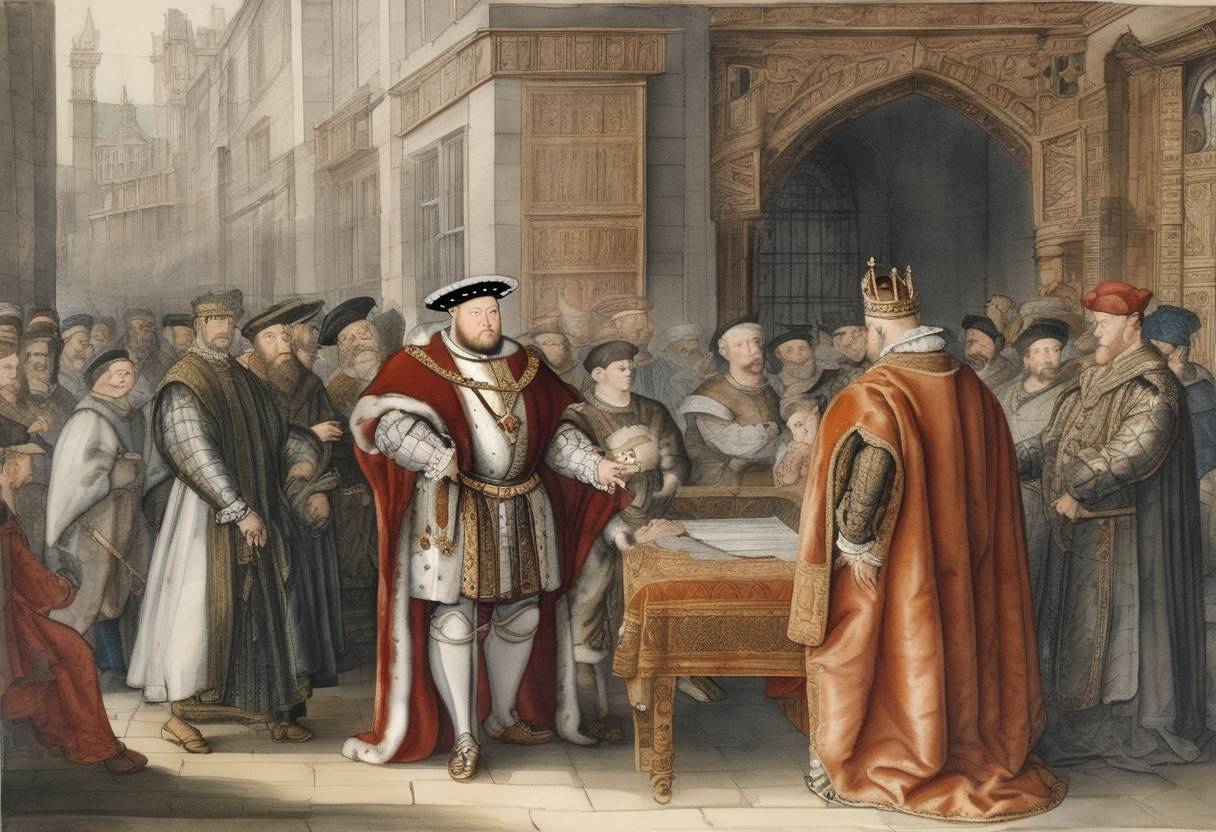
On March 18, 1536, during the reign of King Henry VIII of England, a significant phase in the Dissolution of the Monasteries was initiated. This ecclesiastical upheaval was part of Henry VIII’s broader strategy to consolidate power and wealth by dismantling monastic institutions across England, Wales, and Ireland.
The Dissolution of the Monasteries formed a pivotal component of the English Reformation, sparked by Henry VIII’s break from the Roman Catholic Church. This schism was primarily driven by political and personal motivations, notably, the King’s desire to annul his marriage to Catherine of Aragon—a request denied by Pope Clement VII. Consequently, Henry VIII asserted his supremacy over religious matters in England, leading to the establishment of the Church of England with the King as its Supreme Head.
The process began in earnest with the Act of Supremacy (1534), which declared Henry VIII as the Supreme Head of the Church of England. Subsequently, the Crown sought to dismantle the influence of monastic orders, perceived as loyal to Rome. In 1535, Thomas Cromwell, Henry’s chief minister, commissioned a survey known as the “Valor Ecclesiasticus” to assess the wealth of the monasteries. This evaluation provided the financial justification for their dissolution.
By early 1536, Parliament passed the “Act for the Dissolution of the Lesser Monasteries,” targeting monastic institutions with an annual income of less than £200. On March 18, the Act was effectively put into execution, marking the systematic closure and asset seizure of numerous smaller abbeys and priories.
The dissolution had profound socio-economic and cultural impacts. The Crown acquired vast wealth and lands, significantly increasing the royal treasury and redistributing property to the Tudor nobility, which fortified political loyalty to Henry VIII. This reallocation of resources contributed to the rise of a new class of landowners.
Culturally, the dissolution led to the loss of monastic libraries, artifacts, and historical architecture. Religious scholars and monks were displaced, altering the educational framework and traditional monastic life that had endured for centuries.
The operation continued in phases until 1541, encompassing larger religious houses and culminating in the dismantling of England’s monastic network. The Dissolution of the Monasteries remains a significant event in English history, symbolizing the sweeping religious transformations of the Reformation period.
Source: en.wikipedia.org