The First Use of Tanks in Warfare: Battle of the Somme, September 15, 1916
1916 · Somme, France
The first use of tanks in warfare occurred during the Battle of the Somme in World War I, marking a significant development in military technology.
November 20, 1917
The Battle of Cambrai begins during World War I, marking the first large-scale use of tanks in combat by British forces.
Cambrai, France | British Army
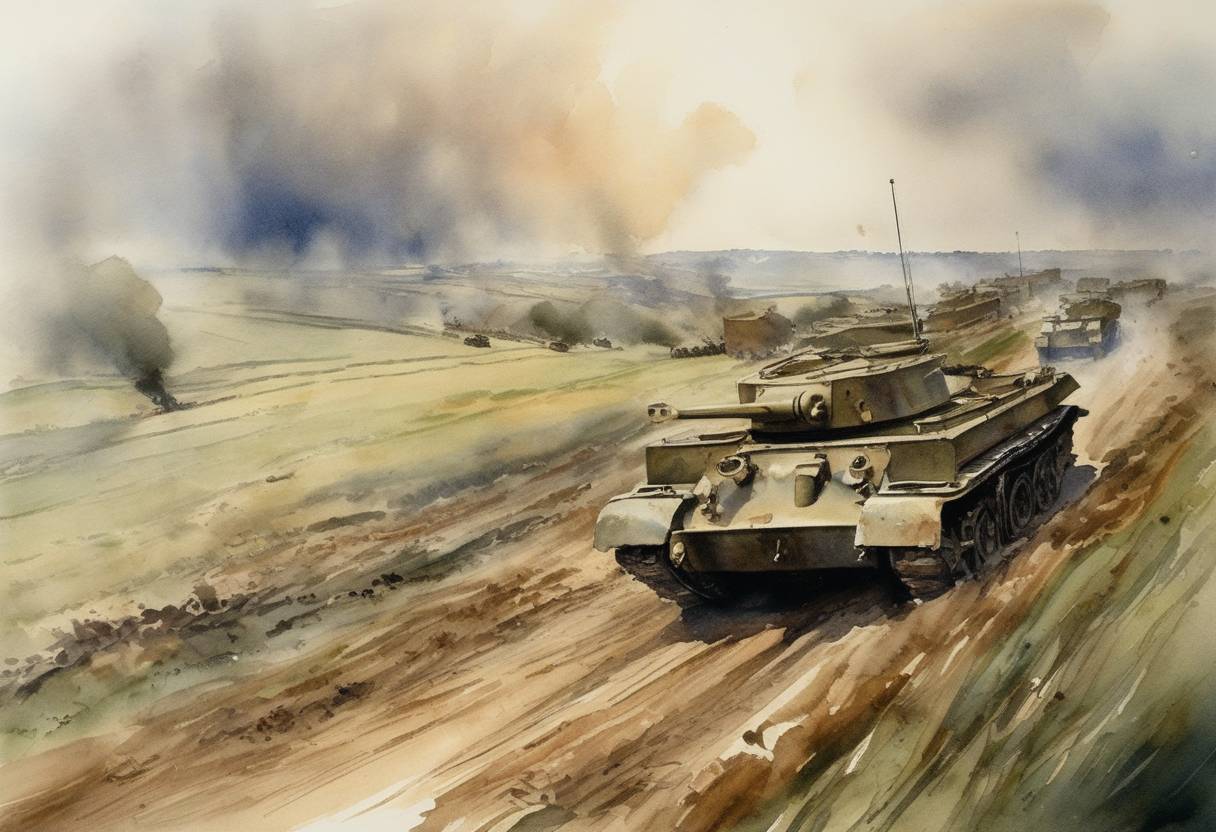
On November 20, 1917, during World War I, the Battle of Cambrai commenced, marking a significant moment in military history as the British forces launched the first large-scale offensive using tanks. This event demonstrated the potential of mechanized warfare and set the stage for future military tactics.
By 1917, World War I had settled into a grueling stalemate with trench warfare dominating the Western Front. Traditional methods of attack had resulted in high casualties with minimal territorial gains. The British Army, seeking a breakthrough, planned an attack centered around Cambrai in northern France, capitalizing on recent advancements in tank technology.
Led by General Sir Julian Byng, the offensive aimed to penetrate the German Hindenburg Line. The British committed around 476 tanks, supplied by the Mark IV model, to support infantry units along a 10-kilometer front. The attack was notable not only for its scale but also for the use of technical and strategic innovations. The plan involved:
In its early stages, the battle was a success for the British. The tanks enabled rapid advances, capturing significant German positions and making unprecedented territorial gains in a single day. They achieved this without the traditional preliminary artillery bombardment, which often warned the enemy of impending attacks.
Despite the initial success, the offensive eventually faltered due to various factors such as mechanical failures of the tanks, logistical challenges, and stiff German counterattacks. The initial British gains were largely reversed by early December. Nevertheless, the Battle of Cambrai was pivotal in showcasing the tanks’ potential and the need for coordinated mechanized assaults.
While the Battle of Cambrai was not the decisive breakthrough longed for by the Allies, its strategic significance in the evolution of warfare cannot be overstated. It marked a watershed moment in the utilization of technology on the battlefield, setting the course for modern armored warfare.
Source: www.britannica.com