Kim Jong-il's Ascension as Supreme Leader of North Korea
1994 · Pyongyang, North Korea
Kim Jong-il is confirmed as the Supreme Leader of North Korea following the death of his father, Kim Il-sung.
October 27, 1949
The Constitution of the Korean People's Democratic Republic was adopted, formally establishing North Korea's governmental structure.
Pyongyang, North Korea | Supreme People's Assembly
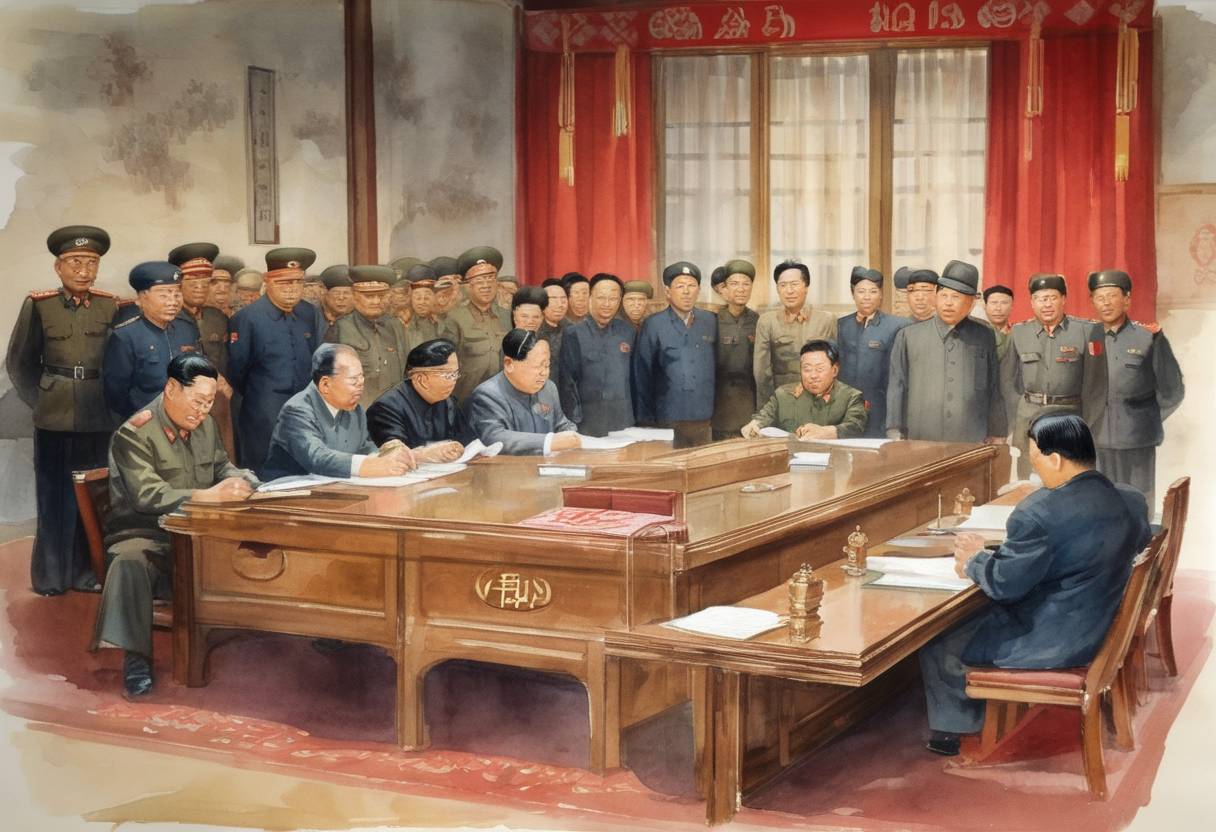
On October 27, 1949, the Constitution of the Korean People’s Democratic Republic was adopted, formally establishing the governmental structure of what is now known as North Korea. This marked a significant step in the process of solidifying the political framework and ideology of the newly founded state, which had emerged in the northern part of the Korean Peninsula following World War II and the subsequent departure of Japanese forces.
Following Japan’s surrender in 1945, Korea was liberated from 35 years of colonial rule. The peninsula was divided into two occupational zones along the 38th parallel: the Soviet Union occupied the north, while the United States took control of the south. The division was intended to be temporary but eventually solidified due to the Cold War tensions between the superpowers.
In the north, the Soviet Union supported the establishment of a socialist government. Kim Il-sung, a prominent communist leader and former guerrilla fighter against Japanese rule, emerged as the head of the new government. Under Soviet guidance, efforts were made to form a political system aligned with Marx-Leninist principles.
The 1949 Constitution laid the groundwork for the state’s structure, emphasizing socialism and centralized control. Key aspects included:
The adoption of the Constitution was a critical step in the formation of North Korea as a socialist state under the influence of the Soviet Union. It helped to institutionalize the leadership of Kim Il-sung, who would dominate the political landscape of the country for decades. Furthermore, it entrenched the ideological divide that would lay the groundwork for future tensions between North and South Korea, ultimately leading to the outbreak of the Korean War in 1950.
This Constitution symbolized the formal inception of a distinctly North Korean identity, separate from the South, influenced heavily by socialist ideology and the leadership cult that would later define the regime.
Source: www.britannica.com