Battle of Ivry: March 14, 1590
1590 · Ivry-la-Bataille, France
Battle of Ivry: Henry IV of France defeats the forces of the Catholic League under the Duke of Mayenne during the French Wars of Religion.
October 22, 1575
The Battle of Dormans took place as part of the Wars of Religion in France. It was a victory for the Catholic forces of King Henry III over the Protestant forces led by the Duke of Bouillon.
Dormans, France | French monarchy
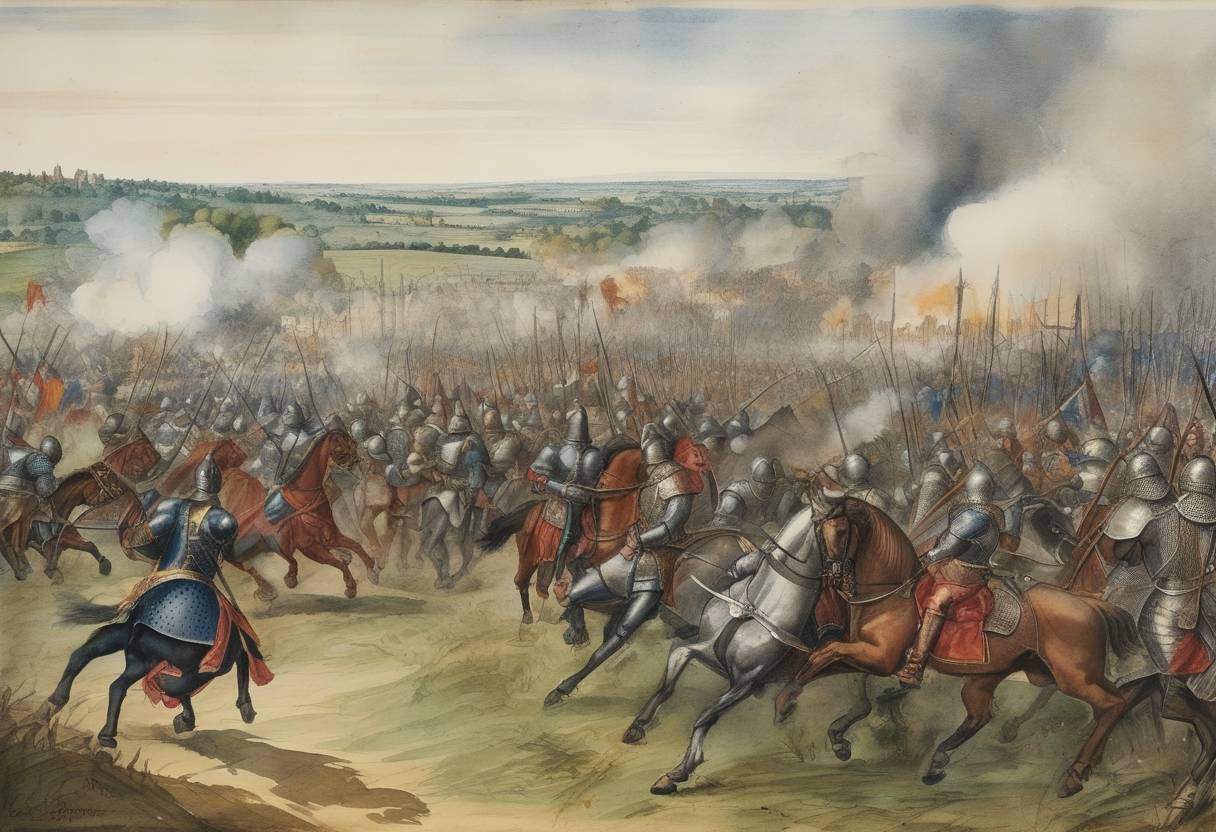
The Battle of Dormans, which occurred on October 22, 1575, was a significant confrontation during the French Wars of Religion. These wars were a series of eight conflicts in France during the latter half of the 16th century, primarily fought between Roman Catholics and Huguenots (French Calvinist Protestants).
The unstable political landscape of France, intensified by religious tensions, set the stage for periodic civil wars. King Henry III, seeking to consolidate his power and chaotically disparate nation, was ruling France at this turbulent time. The Catholic forces were aligned with the monarchy, whereas Protestant factions were often supported by powerful noble families, including the House of Bourbon.
The confrontation at Dormans involved the Catholic forces led by King Henry III against the Protestant forces commanded by Henri I de La Tour d’Auvergne, commonly known as the Duke of Bouillon. Amidst the fractured political alliances, the Protestant forces aimed to challenge the monarchy’s authority and secure greater religious and political freedoms.
The battle took place in the region of Dormans, located in the north-eastern part of France near the River Marne. The Catholic forces, under the direct influence of King Henry III, managed to achieve a decisive victory against the Huguenots. This triumph was bolstered by the strategic prowess of the Catholic commanders, who effectively leveraged their numerical superiority and strategic positioning.
The victory at Dormans boosted Catholic morale and temporarily strengthened King Henry III’s position. However, it did little to resolve the underlying religious conflicts that were fracturing the country. The outcome of the battle did not decisively end the hostilities and instead foreshadowed the continuation of the French Wars of Religion, which witnessed further bloodshed and political machinations in the ensuing years.
The Battle of Dormans exemplifies the complex interplay of religious and political dynamics that defined 16th-century France. While a tactical victory for the Catholic crown, the battle underscored the sustained resilience and defiance of the Protestant factions. The conflict highlighted the profound religious divides within France, which required robust solutions beyond martial victories to achieve lasting peace.
The Wars of Religion would continue until 1598, culminating in the Edict of Nantes, which granted substantial rights to the Huguenots and sought to bring some measure of religious tolerance to the kingdom. The events surrounding the battle and the broader conflict underscore the long, arduous journey towards a more harmonious socio-political and religious landscape in France.
Source: en.wikipedia.org