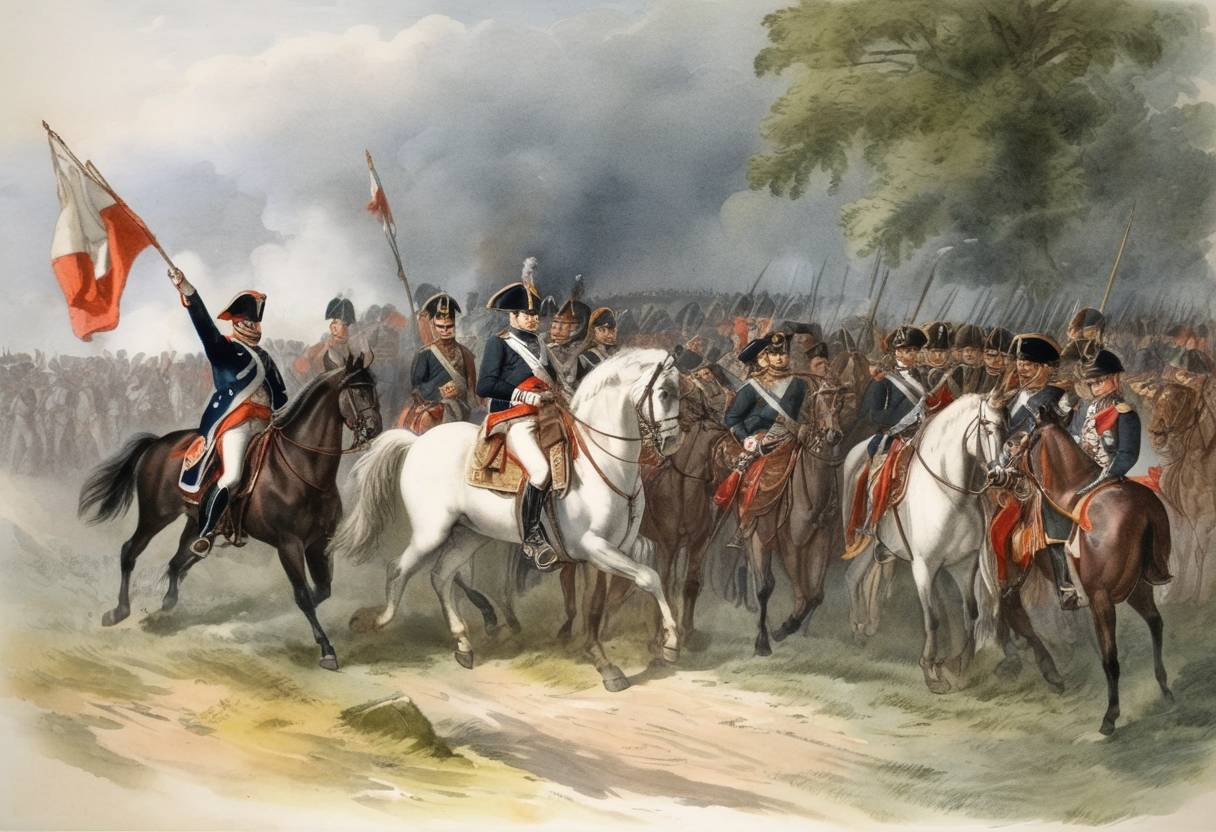
Battle of Wagram: July 6, 1809
The Battle of Wagram, a major engagement during the War of the Fifth Coalition, occurred on July 6, 1809. It was a decisive conflict between the forces of the First French Empire, led by Napoleon Bonaparte, and the Austrian Empire under Archduke Charles. The battle took place near the village of Wagram, close to Vienna, Austria.
Context and Prelude
The War of the Fifth Coalition began in April 1809, as the Austrian Empire sought to challenge French dominance in Europe following the upheaval of the Napoleonic Wars. Austria formed an alliance with Great Britain, hoping to capitalize on French forces being stretched across multiple fronts.
After a series of engagements, including the Battle of Aspern-Essling in May 1809, where the Austrians managed to halt the French advance, Napoleon regrouped his forces for a renewed offensive across the Danube. By early July, the French army had been reinforced, standing ready to strike at the Austrian positions near Vienna.
The Battle
On July 5, 1809, Napoleon initiated a wide-ranging assault to bring Archduke Charles’s army to a decisive battle. As the engagement unfolded into July 6, the French forces, utilizing their superior numbers and tactical artillery deployments, sought to break through the Austrian lines. Key to the French strategy was a massive central attack intended to split the Austrian forces.
The Franco-Polish and other allied contingents under Napoleon’s command executed a series of coordinated maneuvers to achieve this goal. Despite fierce resistance and initial Austrian successes in repelling parts of the French attack, the sustained pressure from Napoleon’s army began to take its toll.
Outcome and Significance
By the end of July 6, the Austrians were in retreat, having suffered significant casualties. Estimates suggest that French forces incurred around 40,000 casualties, while Austrian losses were higher, numbering around 45,000. The strategic withdrawal of the Austrian army marked a crucial French victory.
The Battle of Wagram significantly bolstered Napoleon’s position in Europe, leading to the signing of the Treaty of Schönbrunn in October 1809. This treaty imposed harsh terms on Austria, including territorial cessions and economic burdens, and temporarily removed Austria as a threat to French hegemony.
Broader Impact
The victory at Wagram solidified Napoleon’s military reputation further but also showcased the increasing difficulty of waging campaigns across Europe, which involved extended lines of communication and supply. The battle marked one of Napoleon’s last grande batailles, where sheer force size and tactical innovation secured victory despite substantial opposition. This battle indicated the beginning of challenges that would later escalate, contributing to the decline of Napoleonic Europe.