The Doom Bar Alteration: November 19, 1911
1911 · Camel Estuary, United Kingdom
The Doom Bar, a notorious sandbank at the mouth of the Camel Estuary on the north coast of Cornwall, England, was wrecked by engineers from the Board of Trade.
August 21, 1879
The catastrophic Tay Bridge disaster investigation published its findings. The inquiry concluded that the bridge had been 'badly designed, badly constructed and badly maintained', which led to its collapse in December 1879 while a train was crossing, resulting in the deaths of 75 people.
Dundee, United Kingdom | Board of Trade
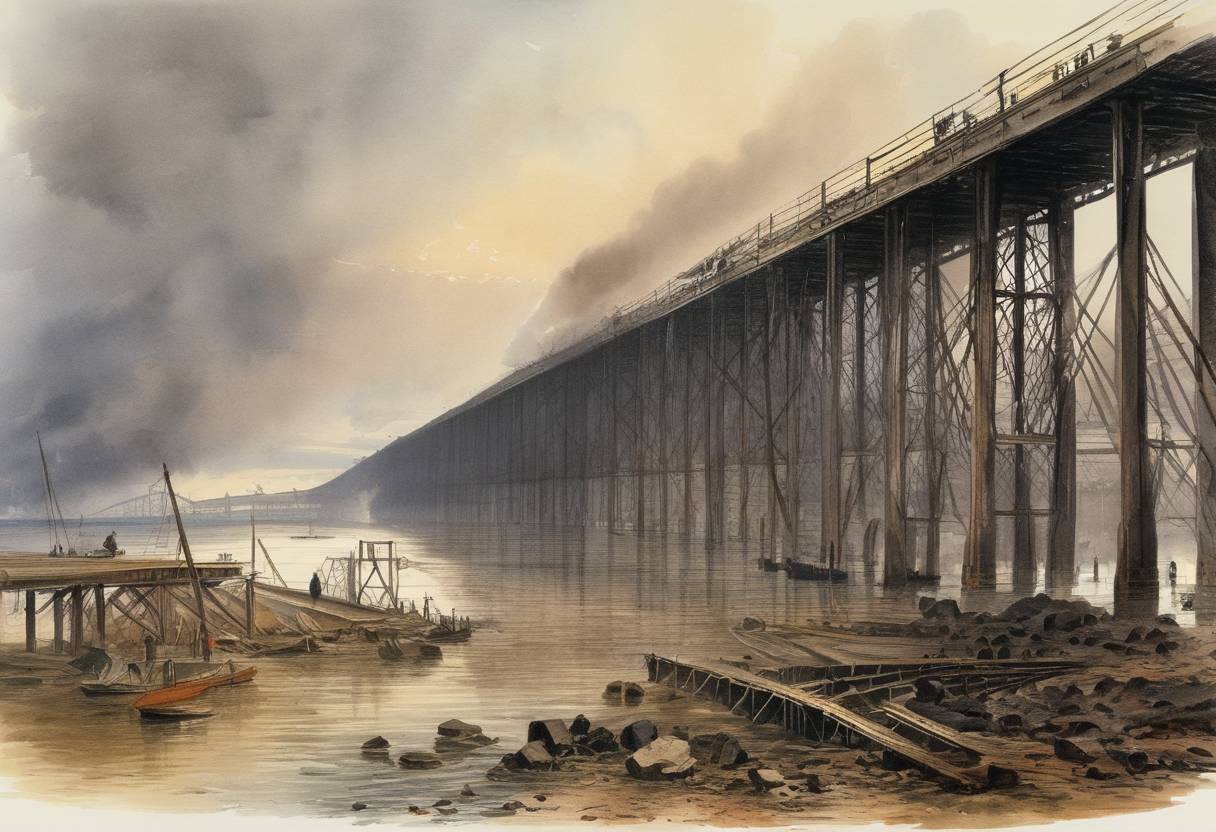
On August 21, 1880, the official investigation into the catastrophic Tay Bridge disaster published its findings, bringing to light the multitude of factors that led to one of the most infamous structural failures of the 19th century. The Tay Rail Bridge, located in Dundee, Scotland, had suffered a disastrous collapse on December 28, 1879, during a violent storm. The incident tragically resulted in the deaths of approximately 75 people as a train attempted to cross the structure.
The Tay Bridge, completed in 1878, represented a significant engineering achievement of its time, designed by the noted engineer Sir Thomas Bouch. Spanning over two miles, it was the longest bridge in the world at its completion and was intended to optimize rail traffic between Edinburgh and Dundee.
On the evening of December 28, 1879, a gale swept through Scotland, with wind speeds estimated between 70-80 mph. As a northbound train traversed the bridge, the central section, known as the “high girders”, gave way. The train and its passengers plunged into the River Tay, resulting in the tragic loss of life.
The Board of Trade inquiry, led by Henry Cadogan Rothery, laid out a comprehensive examination of the causes leading to the disaster. Published on August 21, 1880, the findings outlined several critical concerns:
Design Flaws: The inquiry concluded that the bridge had been poorly designed with an inadequate understanding of the wind forces it would encounter. The structural calculations performed failed to factor in dynamic loads and the potential wind forces.
Construction Issues: It was found that improper materials were used, including poorly cast iron piers. These materials did not meet the necessary standards to withstand the stresses imposed upon them.
Maintenance Failures: Continuous maintenance work was lacking, leading to deterioration that weakened the structure. Insufficient inspections failed to identify critical vulnerabilities that might have been remediated.
The inquiry’s findings had far-reaching implications. Sir Thomas Bouch faced severe criticism, and his reputation as an engineer was irrevocably damaged, affecting his subsequent projects. The disaster spurred changes in engineering standards and practices, emphasizing the necessity for rigorous safety protocols and quality control in construction projects. This incident highlighted the importance of considering environmental factors in structural design.
Additionally, the lessons learned informed future bridge engineering, prompting more exhaustive testing and analysis methodologies to prevent similar tragedies. The devastation underscored the paramount importance of ensuring the structural integrity and safety of public infrastructure. The Tay Bridge disaster and its investigation remain pivotal in the annals of civil engineering history.
Source: www.railwaysarchive.co.uk