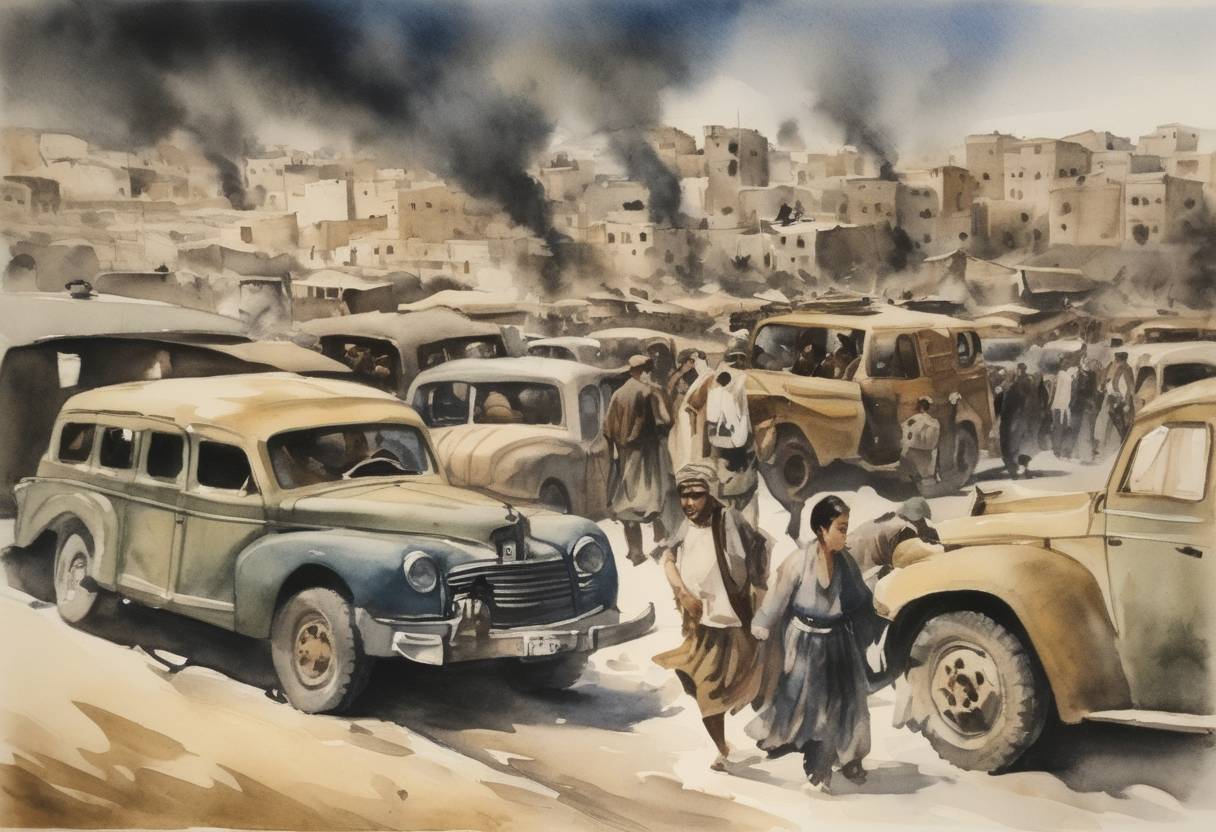
The Deir Yassin Massacre: April 9, 1948
On April 9, 1948, the village of Deir Yassin, located just west of Jerusalem, became the site of a violent and tragic event during the turbulent months leading up to the establishment of the State of Israel. This incident was part of the broader conflict between Jewish and Arab communities in Mandate Palestine, known as the 1948 Arab-Israeli War.
Context and Prelude
In the months leading to April 1948, tensions in Palestine escalated dramatically following the United Nations General Assembly’s adoption of Resolution 181 in November 1947, which recommended the partition of Palestine into separate Jewish and Arab states. Jewish and Arab populations were increasingly drawn into armed conflict, leading to widespread violence and disruptions throughout the region.
Deir Yassin was a small Arab village with a population of around 600. It occupied a strategic position near the road between Tel Aviv and Jerusalem, making it significant in terms of supply routes for Jewish forces besieged in Jerusalem.
The Attack
The attack on Deir Yassin was orchestrated by two Jewish paramilitary groups, the Irgun (Etzel) and Lehi (Stern Gang), with the tacit support of the Haganah, the primary Jewish defense force. The operation began early in the morning on April 9 and resulted in the village being overtaken by Jewish forces over the course of the day.
The assault on Deir Yassin resulted in the deaths of an estimated 100 to 250 Arab residents, including women and children, an event which sparked immediate outrage and fear among the Arab population. The tactics employed during the attack, as well as the high number of civilian casualties, were widely condemned.
Aftermath and Significance
News of the Deir Yassin massacre quickly spread throughout the region, contributing to the mass exodus of Palestinian Arabs from their homes and exacerbating the refugee crisis. This exodus, known to Palestinians as the Nakba, or “catastrophe,” became a significant aspect of the ongoing Israeli-Palestinian conflict.
The event also intensified the animosity between Jewish and Arab communities, significantly impacting both regional and international perceptions. While Jewish leadership, including the Haganah, condemned the tactics used by the Irgun and Lehi, the psychological impact of the massacre was profound and lasting. It sent shockwaves through the Arab world, influencing the course of the ensuing war and its legacy.
Deir Yassin remains a potent symbol within the larger narrative of the Israeli-Palestinian conflict, representing deep-seated grievances and historical memory for many Palestinians. The massacre underscored the complexities and devastating human impact of the conflict, shaping the discourse for both Israelis and Palestinians in the years that followed.