The Battle of Okinawa: April 1, 1945
1945 · Okinawa, Japan
The Battle of Okinawa began during World War II, one of the largest amphibious assaults in the Pacific Theater, lasting until June 22, 1945.
July 21, 1944
The Battle of Guam commenced during World War II as American forces began their assault to retake the island from Japanese control.
Guam, Guam | United States Armed Forces
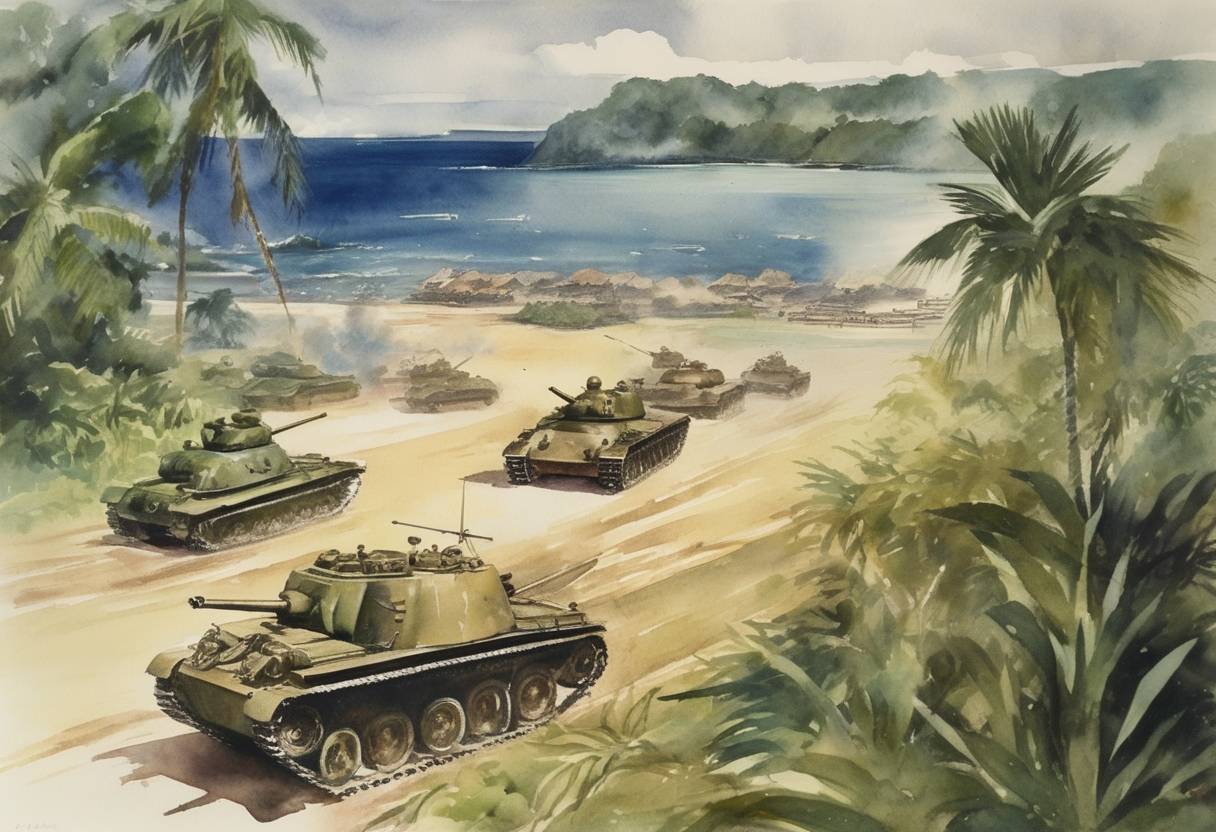
The Battle of Guam, part of the wider Pacific Campaign during World War II, began on July 21, 1944, marking the start of the United States’ operation to recapture the island from Japanese forces. This battle was integral to the broader strategy of advancing the Allied position in the Pacific and regaining territory lost early in the war.
Guam, the southernmost island in the Mariana chain and a strategically critical location in the Pacific, had been under Japanese control since shortly after the attack on Pearl Harbor in December 1941. The capture of Guam was part of the broader U.S. military objective known as “Operation Forager,” which aimed to secure the Mariana Islands as a base for further operations, including air attacks on the Japanese home islands.
The preparation for the assault on Guam involved an extensive pre-invasion bombardment. Naval and aerial forces targeted Japanese defenses, aiming to weaken the fortifications and reduce Japanese capabilities to repel the invasion. This preparatory phase sought to capitalize on the momentum generated by the successful capture of Saipan earlier in July 1944.
On July 21, 1944, American Marines and Army troops commenced their amphibious assault on Guam. The operation began with troops landing on the western beaches of the island, specifically near Apra Harbor and the beaches to the north in Agat. Despite the preliminary bombardments, U.S. forces encountered stiff Japanese resistance upon landing, facing fortified positions, rough terrain, and challenging jungle conditions.
Northern and Southern Landings: The invasion consisted of both northern and southern landing forces, with the primary objective of capturing the strategic high ground and the airfield located on Orote Peninsula.
Tactics and Maneuvers: Combat involved a mix of jungle guerrilla warfare and direct confrontations. American forces relied on their superiority in firepower, mobility, and coordination between different military branches.
The battle for Guam continued beyond the initial day of the assault, lasting until August 10, 1944, when the island was officially declared secured by American forces. The recapture of Guam enabled the establishment of significant military installations, including airfields from which B-29 bombers could strike the Japanese home islands, drastically altering the Pacific theater’s strategic dynamics.
Guam’s liberation was celebrated by the Chamorro people, the indigenous inhabitants of the island, who had endured harsh conditions under Imperial Japanese rule. The successful operation significantly boosted Allied morale and demonstrated the declining power of Japanese defensive capabilities in the Pacific. The liberation of Guam thus played a pivotal role in setting the stage for further Allied offensives, contributing to the eventual conclusion of the war in the Pacific.
Source: www.history.navy.mil