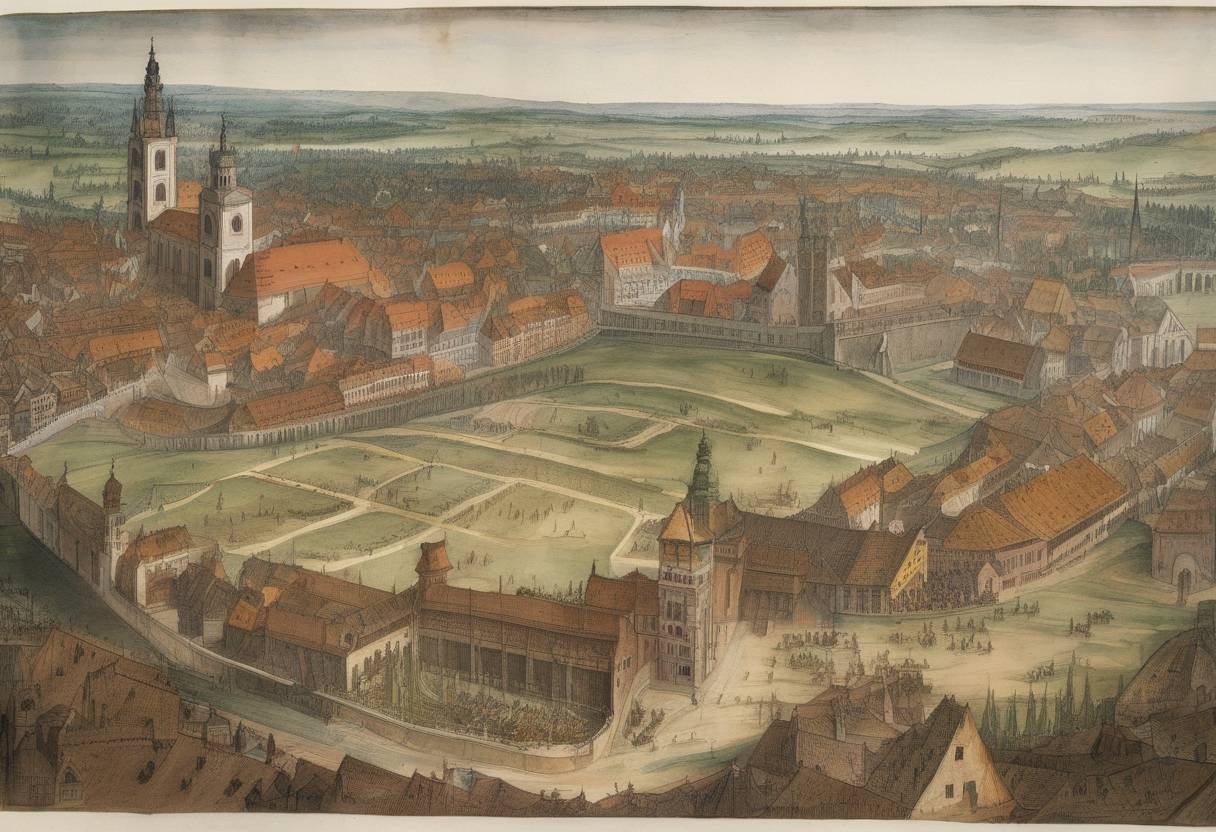
The Peace of Augsburg and the Assembly of January 22, 1555
On January 22, 1555, a pivotal Protestant assembly convened in Augsburg as part of a series of negotiations that would lead to the formulation of the Peace of Augsburg later that year. This assembly was vital in shaping the terms of the treaty which was eventually signed on September 25, 1555. The Peace of Augsburg marked a significant moment in the history of the Holy Roman Empire and the broader religious landscape of Europe during the Reformation.
Context Leading to the Assembly
By the mid-16th century, the Holy Roman Empire was deeply divided along religious lines. The Protestant Reformation, which began with Martin Luther’s Ninety-Five Theses in 1517, had gained substantial traction across German territories. The Schmalkaldic League, a defensive alliance of Protestant territories, had been in conflict with the Catholic forces of Emperor Charles V, leading to wars and political instability.
The Peace of Augsburg negotiations were an effort to resolve these ongoing religious conflicts. Charles V, burdened by conflicts across his vast empire and recognizing the growing power of Protestant princes, was inclined towards compromise to maintain imperial unity.
Key Issues Addressed
Religion and Rule: The assembly that convened on January 22, 1555, focused on consolidating positions among Protestant estates regarding religious practices and political governance. It sought to define the legal standing of Lutheranism within the Holy Roman Empire.
Cuius regio, eius religio: Although not finalized at this assembly, the principle of “Cuius regio, eius religio” (whose realm, his religion) became a central tenet of the Peace of Augsburg. This principle allowed rulers to choose the religion (Catholicism or Lutheranism) of their own territory.
Legal Status of Lutheranism: While the detailed terms were set in September, the January assembly reinforced the legitimacy of Lutheran practices within the empire and set the stage for establishing a framework where Lutheran territories could coexist alongside Catholic ones.
Broader Historical Significance
The assembly of January 22, 1555, and the eventual Peace of Augsburg signified one of the first formal recognitions of Protestantism in a major European polity. Although it temporarily settled religious conflicts within the empire, it laid the groundwork for future sectarian disputes and was a precursor to the later Thirty Years’ War.
The Peace of Augsburg did not recognize other emerging Protestant sects such as Calvinism, which would later contribute to further religious conflicts in Europe. Nonetheless, it represented an essential step in the gradual acceptance of religious pluralism and the decentralization of religious authority within the Holy Roman Empire.