Germany Annexes Western Poland - October 8, 1939
1939 · Warsaw, Poland
Germany annexes Western Poland, incorporating it into the Third Reich following the invasion of Poland at the start of World War II.
November 5, 1916
The Kingdom of Poland was proclaimed by the Act of November 5th, a puppet state of the German Empire and Austria-Hungary during World War I.
Warsaw, Poland | German Empire and Austria-Hungary
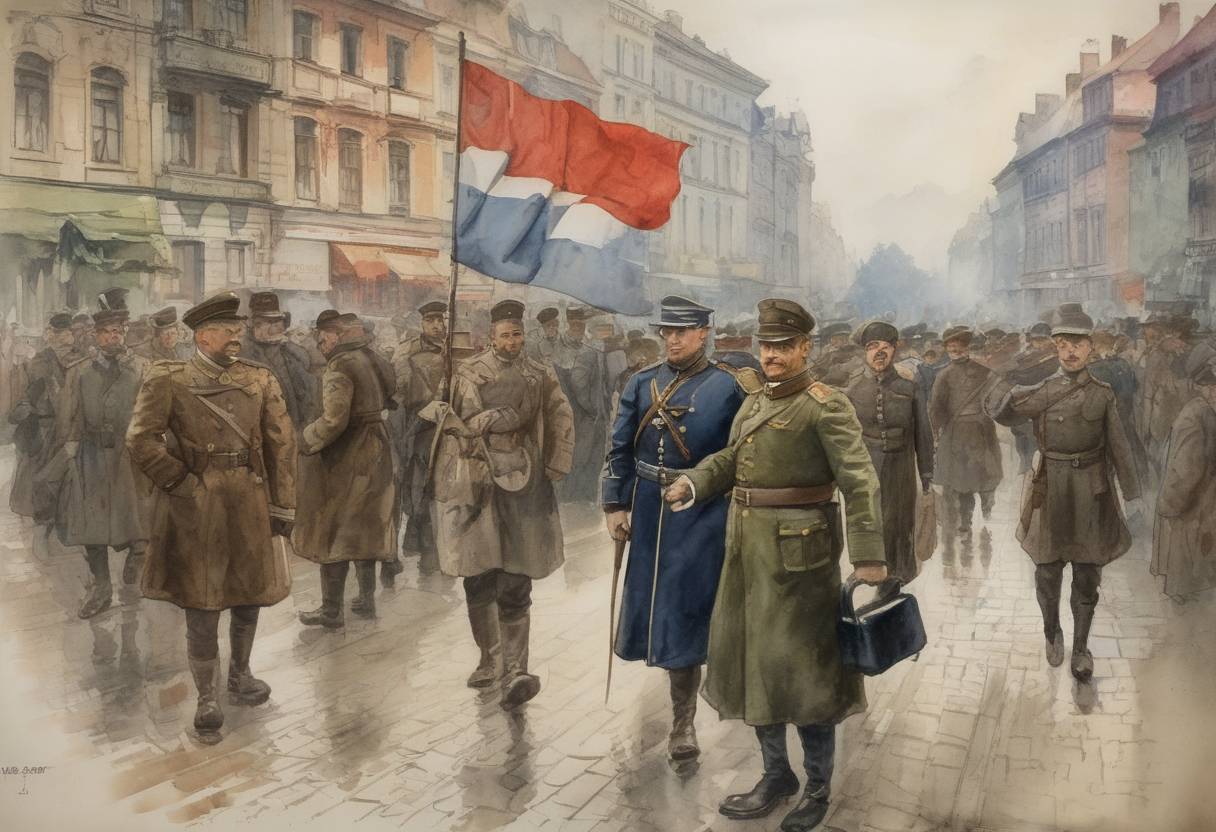
On November 5, 1916, during the tumultuous period of World War I, the Act of November 5th was proclaimed by the German Empire and Austria-Hungary, establishing the Kingdom of Poland as a puppet state. This event marked a significant moment in the complex geopolitical landscape of Eastern Europe during the war.
World War I Setting: By 1916, World War I had engulfed much of Europe, with the Central Powers (primarily Germany and Austria-Hungary) locked in a brutal conflict against the Allied Powers. The Eastern Front, where Germany and Austria-Hungary faced Russia, was a critical theater of war.
Polish Territories: Prior to the war, Poland had been partitioned in the late 18th century among Prussia, Russia, and Austria, effectively erasing it as a sovereign state. The Polish territories were thus under the control of these empires.
Strategic Interests: The Central Powers sought to weaken Russia by exploiting nationalist sentiments among the Poles. By promising autonomy or independence, they aimed to encourage Polish support against Russia and bolster their own war efforts.
Proclamation: The Act of November 5th was a joint declaration by Germany and Austria-Hungary, announcing the creation of a “Kingdom of Poland.” This new entity was intended to be a constitutional monarchy, albeit heavily influenced and controlled by the Central Powers.
Motivations: The proclamation was primarily a strategic move to gain Polish support and manpower for the Central Powers’ military campaigns. It was also a diplomatic maneuver to counter Russian influence and potentially draw Polish soldiers away from the Russian army.
Governance: The newly proclaimed kingdom lacked true sovereignty. Its governance was under the supervision of a Regency Council, which was subject to the authority of the occupying German and Austro-Hungarian forces.
Mixed Reactions: The Polish response to the proclamation was mixed. While some saw it as a step towards eventual independence, others viewed it skeptically, recognizing the limited autonomy and the puppet nature of the state.
Impact on Polish Nationalism: The act did, however, reignite Polish nationalist aspirations and laid the groundwork for future efforts towards independence.
Post-War Developments: The end of World War I and the subsequent Treaty of Versailles in 1919 led to the re-establishment of Poland as an independent nation. The geopolitical shifts and the collapse of the Central Powers facilitated the realization of a sovereign Polish state.
The Act of November 5th is a notable example of how wartime exigencies can influence national borders and identities. It highlights the complex interplay between military strategy and nationalist movements, as well as the broader impact of World War I on the map of Europe. While the Kingdom of Poland established in 1916 was short-lived and lacked genuine independence, it played a role in the eventual re-emergence of Poland as a nation-state after the war.
Source: en.wikipedia.org