The Death of Vladimir Lenin: January 21, 1924
1924 · Gorki, Soviet Union
Vladimir Lenin, the leader of the Bolshevik Revolution and the first head of the Soviet state, died, leading to a power struggle in the Soviet Union.
December 30, 1922
The Union of Soviet Socialist Republics (USSR) was officially established, uniting Russia, Ukraine, Belarus, and the Transcaucasian Federation (comprising Armenia, Azerbaijan, and Georgia) into a single federal state.
Moscow, Soviet Union | Soviet Union
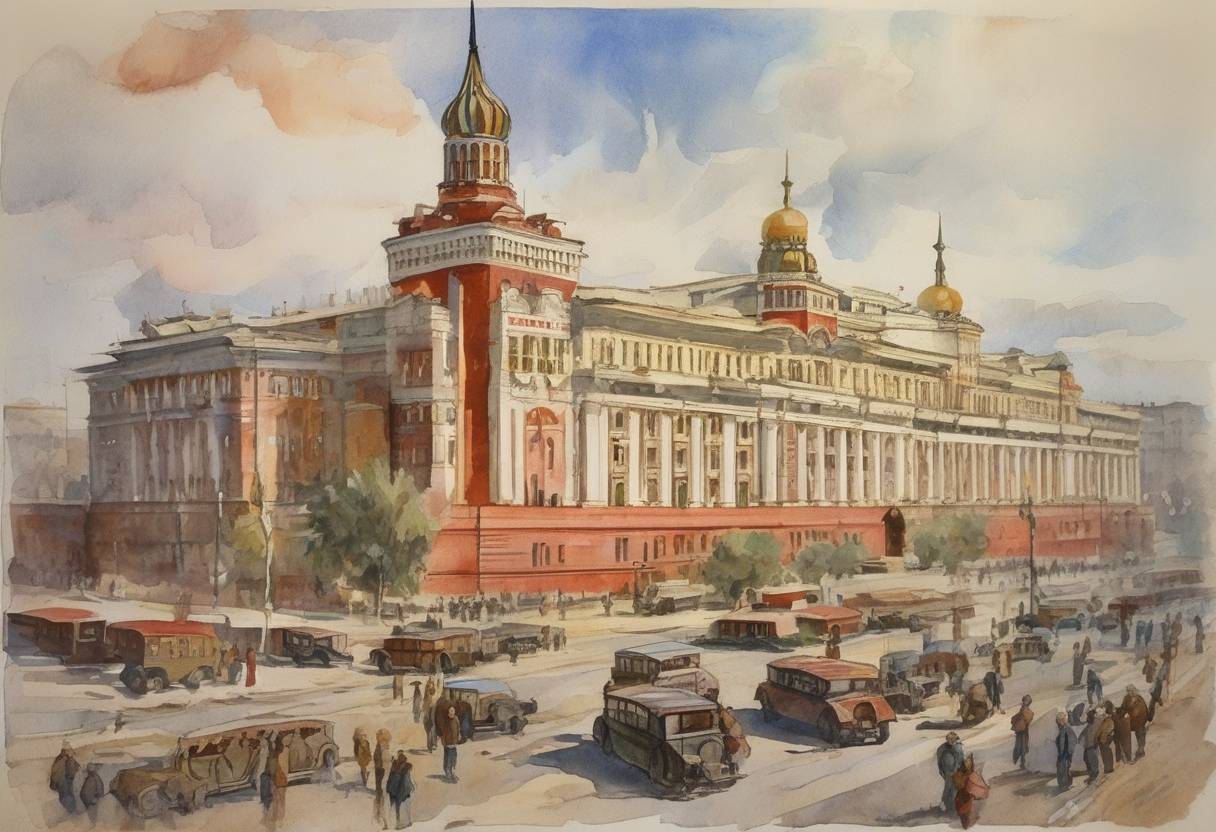
On December 30, 1922, a pivotal moment in 20th-century history occurred with the official establishment of the Union of Soviet Socialist Republics (USSR). This event marked the unification of Russia, Ukraine, Belarus, and the Transcaucasian Federation, which included Armenia, Azerbaijan, and Georgia, into a single federal state. The formation of the USSR was a significant development in the aftermath of the Russian Revolution and the subsequent civil war.
Russian Revolution and Civil War: The Russian Revolution of 1917 led to the overthrow of the Tsarist regime and the rise of the Bolsheviks, who sought to establish a socialist state. The ensuing civil war between the Red Army (Bolsheviks) and the White Army (anti-Bolsheviks) resulted in Bolshevik victory by 1921.
Nationalities Question: The Bolsheviks faced the challenge of integrating various ethnic and national groups within the former Russian Empire. The “nationalities question” was a significant issue, as many regions sought autonomy or independence.
Lenin’s Vision: Vladimir Lenin, the leader of the Bolsheviks, advocated for a union of Soviet republics that would allow for some degree of national self-determination while maintaining centralized control under the Communist Party.
First Congress of Soviets of the USSR: Delegates from the Russian Soviet Federative Socialist Republic (RSFSR), Ukrainian Soviet Socialist Republic, Byelorussian Soviet Socialist Republic, and the Transcaucasian Socialist Federative Soviet Republic convened in Moscow.
Signing of the Treaty on the Creation of the USSR: The congress ratified the Treaty on the Creation of the USSR, which formalized the union of these republics into a single federal entity. The treaty outlined the structure of the new state, emphasizing the supremacy of the Communist Party and the central government.
Adoption of the Declaration of the Creation of the USSR: Alongside the treaty, the declaration was adopted, which articulated the ideological foundations of the USSR, emphasizing the unity of workers and peasants across national lines.
Constitution of 1924: The formal constitution of the USSR was adopted in 1924, further solidifying the structure and governance of the union.
Expansion of the USSR: Over the following decades, the USSR expanded to include additional republics, eventually comprising 15 republics by the time of its dissolution in 1991.
Global Influence: The establishment of the USSR marked the beginning of a new era in global politics, as it emerged as a major world power and ideological rival to capitalist countries, particularly during the Cold War.
Legacy: The creation of the USSR had profound impacts on global geopolitics, economics, and culture, influencing international relations and the spread of communist ideology throughout the 20th century.
The establishment of the USSR on December 30, 1922, was a transformative event that shaped the course of history, setting the stage for significant political, social, and economic developments worldwide.
Source: en.wikipedia.org