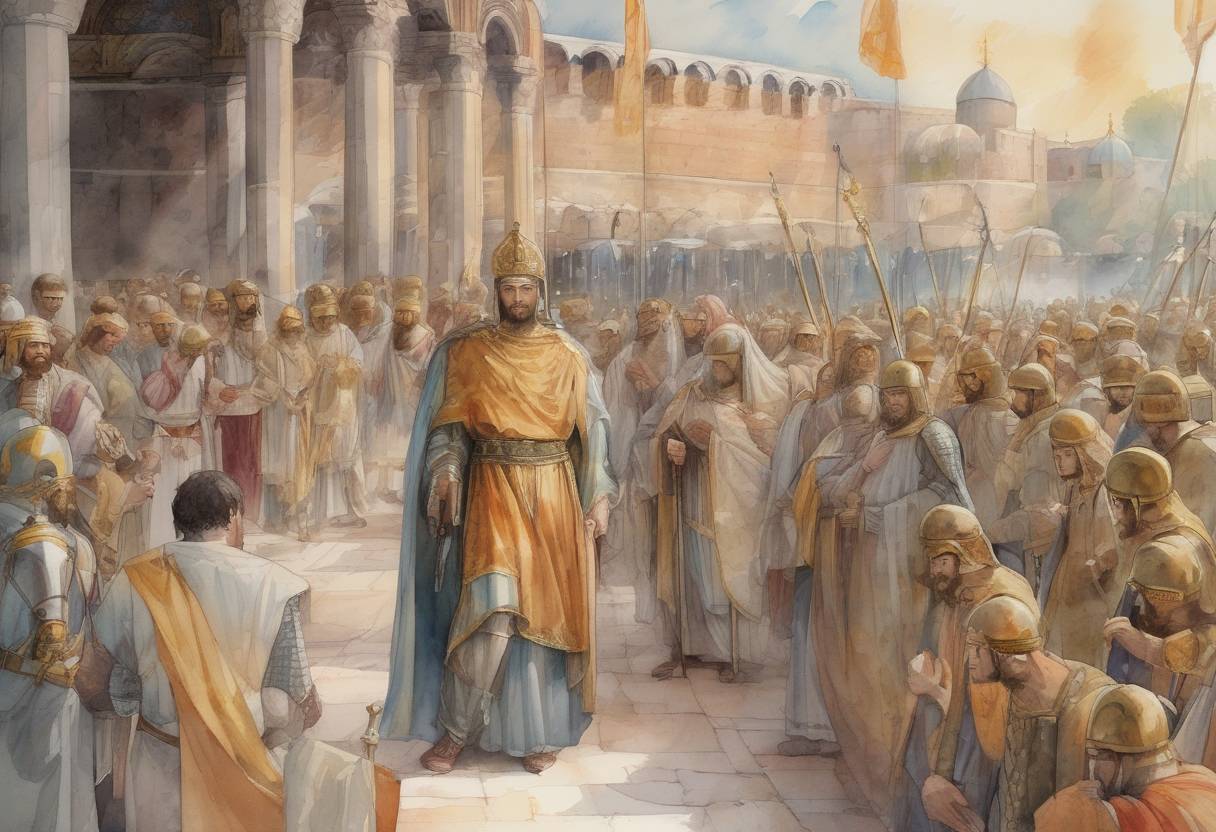
Maurice Becomes Byzantine Emperor - August 13, 582
On August 13, 582, Maurice ascended to the throne as the Byzantine Emperor, marking the beginning of a significant reign that would last until 602. Maurice’s rise to power came during a period of considerable military and political challenges for the Byzantine Empire.
Background
Maurice was born in 539 in Arabissus, Cappadocia, in the Eastern Roman Empire. He began his career as a soldier and quickly rose through the ranks due to his military prowess and leadership skills. By 578, he was appointed as the commander of the Byzantine army in the East, where he successfully campaigned against the Sassanian Persians.
Ascension to the Throne
Maurice’s path to the throne was facilitated by his predecessor, Emperor Tiberius II Constantine. As Tiberius fell ill, he adopted Maurice as his son and named him his successor. Upon Tiberius’s death on August 13, 582, Maurice was crowned emperor, marking the start of his reign.
Key Events During Maurice’s Reign
Military Campaigns: Maurice is noted for his military reforms and campaigns. He successfully defended the empire’s eastern borders against the Persians and managed to stabilize the Balkans by negotiating with the Avars and Slavs.
Administrative Reforms: Maurice implemented significant administrative reforms aimed at improving the efficiency of the empire. He reorganized the military and civil administration, which helped to stabilize the empire’s finances and strengthen its defenses.
Conflict with the Lombards: In Italy, Maurice faced challenges from the Lombards, who had invaded the region. His attempts to manage the situation involved complex diplomacy and military engagements.
Religious Policies: Maurice’s reign was marked by efforts to maintain religious unity within the empire. He supported the Chalcedonian position in the ongoing theological disputes of the time.
Aftermath and Historical Significance
Maurice’s reign ended abruptly in 602 when he was overthrown by a military revolt led by Phocas, who subsequently became emperor. Maurice and his family were executed, marking a violent end to his rule. Despite this, Maurice’s reign is often credited with temporarily stabilizing the Byzantine Empire and laying the groundwork for future military and administrative reforms.
His military treatise, the “Strategikon,” is considered a significant contribution to Byzantine military strategy and was used by subsequent generations. Maurice’s efforts to strengthen the empire’s borders and his administrative reforms had lasting impacts, influencing the structure and strategies of the Byzantine Empire for years to come.