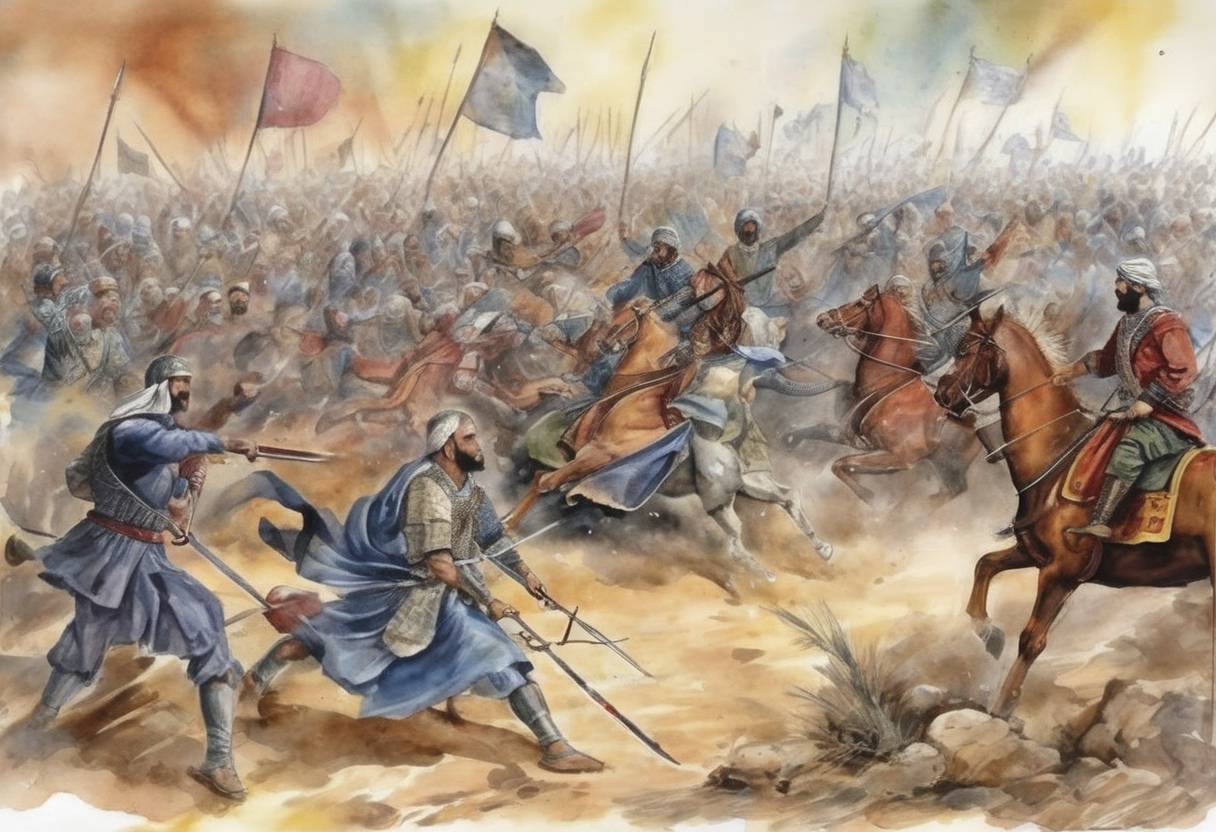
The Battle of Marj Rahit (684)
The Battle of Marj Rahit, fought on August 18, 684 CE, was a pivotal conflict during the Second Fitna, a period of civil war and political instability in the early Islamic Caliphate. This battle was a significant confrontation between the Umayyad forces, led by Marwan I, and the supporters of Abdullah ibn al-Zubayr, who had declared himself caliph in Mecca.
Context Leading to the Battle
The Second Fitna (680–692 CE) was a period marked by a series of conflicts and power struggles following the death of the Umayyad Caliph Muawiya I. His son, Yazid I, succeeded him, but his rule was contested by several factions, most notably by Abdullah ibn al-Zubayr, who established a rival caliphate in Mecca.
Abdullah ibn al-Zubayr: A prominent figure from the Quraysh tribe, he was a companion of the Prophet Muhammad and a strong opponent of the Umayyad dynasty. After Yazid’s death in 683 CE, ibn al-Zubayr’s influence grew, and he was recognized as caliph by many in the Islamic world, particularly in the Hejaz region.
Marwan I: A member of the Umayyad family, Marwan was appointed as caliph in 684 CE by the Umayyad supporters in Syria, following the death of Yazid I and the brief rule of his son, Muawiya II. Marwan’s ascension was crucial for the Umayyads to maintain their hold on power.
The Battle
The Battle of Marj Rahit took place near Damascus, in the region of Syria, which was a stronghold of Umayyad support. The conflict was primarily between the Kalb tribe, loyal to the Umayyads, and the Qays tribe, who supported ibn al-Zubayr.
Forces and Strategy: Marwan I’s forces were composed mainly of the Kalb tribe and other Syrian allies. The Qays tribe, supporting ibn al-Zubayr, was led by al-Dahhak ibn Qays al-Fihri. The battle was characterized by its intensity and the deep tribal rivalries that fueled the conflict.
Outcome: The Umayyad forces, under Marwan I, achieved a decisive victory. This victory was crucial in solidifying Marwan’s position as caliph and re-establishing Umayyad control over Syria and its surrounding regions.
Aftermath and Significance
The Battle of Marj Rahit had significant implications for the Islamic Caliphate:
Consolidation of Umayyad Power: Marwan I’s victory allowed the Umayyads to regain control over Syria, a vital region for their power base. It marked the beginning of the Marwanid branch of the Umayyad dynasty, which would continue to rule until the Abbasid Revolution in 750 CE.
Continued Conflict: Despite this victory, the Second Fitna continued, with Abdullah ibn al-Zubayr maintaining his claim to the caliphate in Mecca. The conflict persisted until 692 CE, when the Umayyads, under Caliph Abd al-Malik, finally defeated ibn al-Zubayr.
Tribal Dynamics: The battle highlighted the significant role of tribal affiliations and rivalries in the early Islamic period, influencing political and military alliances.
In summary, the Battle of Marj Rahit was a crucial event in the Second Fitna, reinforcing Umayyad authority and shaping the political landscape of the early Islamic Caliphate.