Woodrow Wilson's Historic Journey to the Versailles Peace Talks
1918 · Versailles, France
U.S. President Woodrow Wilson sails for the World War I peace talks in Versailles, becoming the first U.S. president to travel to Europe while in office.
January 8, 1918
U.S. President Woodrow Wilson delivered his Fourteen Points speech, outlining his vision for a post-World War I world that included the establishment of the League of Nations.
Washington, D.C., United States | United States Government
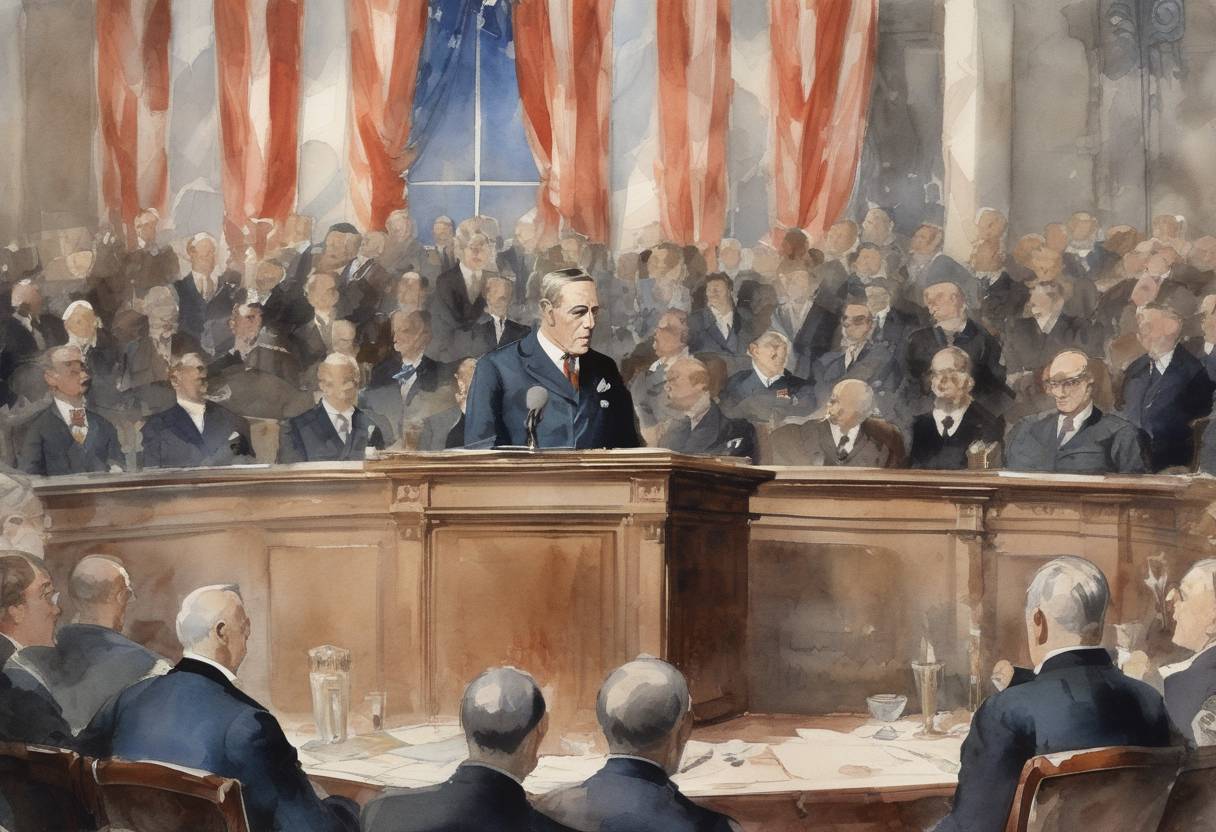
On January 8, 1918, U.S. President Woodrow Wilson delivered a landmark speech to a joint session of Congress, outlining his vision for a peaceful post-World War I world. This speech, known as the “Fourteen Points,” was a statement of principles intended to guide the peace negotiations and establish a framework for a stable and lasting peace.
World War I, which began in 1914, had engulfed much of Europe and involved many of the world’s great powers. By 1918, the war had caused unprecedented destruction and loss of life. As the conflict dragged on, there was a growing desire among the warring nations and their populations for a resolution that would prevent future wars of such magnitude.
President Wilson, who had initially kept the United States neutral, led the country into the war in 1917, citing the need to make the world “safe for democracy.” As the war neared its end, Wilson sought to articulate a vision for the post-war order that would prevent future conflicts and promote international cooperation.
Wilson’s Fourteen Points were a comprehensive plan for achieving peace and stability. The key points included:
Wilson’s Fourteen Points were significant for several reasons:
Despite Wilson’s efforts, the U.S. Senate ultimately rejected the Treaty of Versailles and the League of Nations, reflecting isolationist sentiments in the United States. However, the principles outlined in the Fourteen Points continued to influence international relations and the development of international organizations in the 20th century.
Wilson’s speech remains a pivotal moment in the history of diplomacy, representing an early attempt to articulate a vision for a cooperative and peaceful international order.
Source: en.wikipedia.org