The Capture of Rome and the Installation of Olybrius as Emperor
472 · Rome, Italy
After a siege, the Roman general Ricimer captures Rome and installs Olybrius as the Western Roman Emperor.
October 16, 0456
The Battle of Placentia took place, where the Roman general Ricimer defeated the Vandals under King Gaiseric.
Placentia, Italy | Western Roman Empire
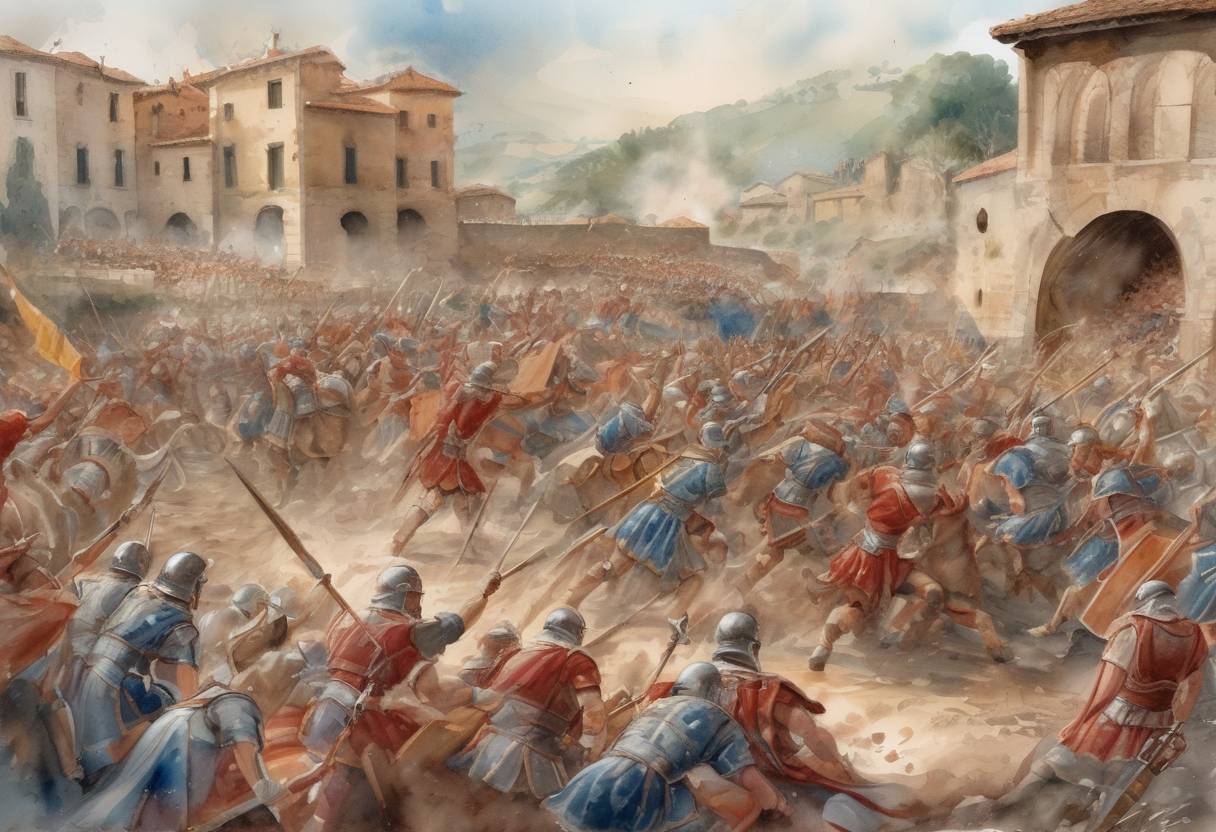
The Battle of Placentia, which occurred on October 16, 456, was a significant military engagement during the waning years of the Western Roman Empire. This battle saw the Roman general Ricimer face off against the Vandals, led by their formidable king, Gaiseric.
The Western Roman Empire, by the mid-5th century, was in a state of decline, plagued by internal strife and external threats. The Vandals, a Germanic tribe that had established a powerful kingdom in North Africa, were one of the most formidable threats to Roman stability. Under King Gaiseric, the Vandals had previously sacked Rome in 455, which had further destabilized the already fragile empire.
Ricimer, a Roman general of Germanic descent, had risen to prominence due to his military prowess and political acumen. He was a key figure in the Roman military hierarchy and wielded significant influence over the imperial court.
The confrontation at Placentia (modern-day Piacenza, Italy) was part of Ricimer’s efforts to curb the Vandal threat and restore some semblance of stability to the Western Roman Empire. The Vandals, known for their naval capabilities, had been conducting raids along the Italian coast, threatening Roman territories and trade routes.
On October 16, 456, Ricimer engaged the Vandal forces near Placentia. The battle was marked by Ricimer’s strategic acumen and the disciplined Roman forces, which managed to outmaneuver and decisively defeat the Vandals. This victory was significant as it temporarily halted Vandal incursions into Italy and bolstered Ricimer’s standing within the Roman political and military spheres.
The victory at Placentia solidified Ricimer’s position as a dominant military leader in the Western Roman Empire. However, despite this success, the empire continued to face numerous challenges, both from external threats and internal political instability. Ricimer would go on to play a crucial role in the politics of the Western Roman Empire, becoming a kingmaker and influencing the appointment of several emperors.
For the Vandals, the defeat did not significantly diminish their power. King Gaiseric continued to rule over a strong Vandal kingdom in North Africa, and the Vandals remained a formidable force in the Mediterranean for years to come.
The Battle of Placentia is a reflection of the complex dynamics of power during the late Roman Empire, illustrating the interplay between military might and political maneuvering in a period marked by transition and upheaval.
Source: en.wikipedia.org