The Netherlands Declares Independence from Spain: The Beginning of the Eighty Years' War
1568 · Dordrecht, Netherlands
The Netherlands declared independence from Spain, starting the Eighty Years' War.
March 13, 1567
The Battle of Oosterweel took place, marking the beginning of the Eighty Years' War. The Protestant forces, led by Flemish rebels, clashed with Spanish troops, resulting in a Spanish victory.
Oosterweel, Flanders (now Belgium) | Spanish Army
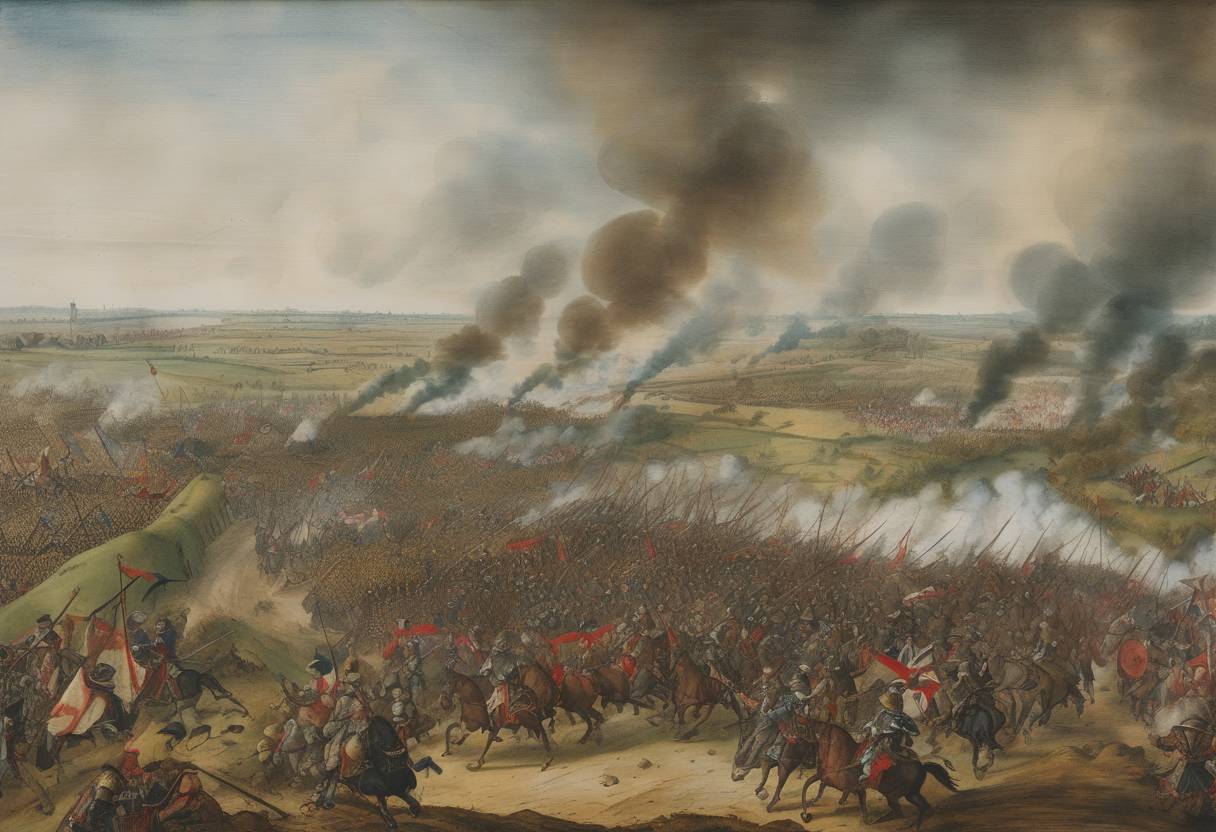
The Battle of Oosterweel, fought on March 13, 1567, is often regarded as the initial conflict marking the beginning of the Eighty Years’ War, a protracted struggle for independence by the Dutch provinces against Spanish rule.
The 16th century was a period of religious and political upheaval in Europe. The Protestant Reformation had swept through the continent, challenging the Roman Catholic Church’s authority and leading to religious tensions. In the Habsburg Netherlands, which included present-day Belgium, Luxembourg, and parts of the Netherlands, these tensions were particularly pronounced. The region was under the rule of King Philip II of Spain, a staunch Catholic, who sought to suppress Protestantism.
The rebellion against Spanish rule was brewing due to dissatisfaction with religious persecution and heavy taxation. Amidst this backdrop of tension, Flemish Calvinist rebels, inspired by the broader Protestant movement and seeking greater autonomy, took arms against the Spanish forces.
On March 13, 1567, the first significant clash occurred at Oosterweel, near Antwerp. A group of Flemish rebels, possibly led by figures like Jan de Marnix, assembled to resist Spanish control. However, they were ill-prepared for a direct military engagement against the well-organized Spanish troops.
The Spanish forces, commanded by Governor-General of the Netherlands, the Duke of Alba, quickly and decisively crushed the rebellion. The battle resulted in a Spanish victory, with many Protestants either killed or captured.
The aftermath of the Battle of Oosterweel set the tone for the prolonged conflict known as the Eighty Years’ War, which would last from 1568 to 1648. Despite the Spanish victory, the rebellion did not quell; it intensified the resolve of the Dutch provinces to seek independence.
The conflict eventually led to the establishment of the Dutch Republic, significantly altering the religious and political landscape of Europe. This battle demonstrated the deep-seated religious divisions and the growing resistance to centralized monarchical authority, themes that would dominate European politics well into the next century.
Source: en.wikipedia.org