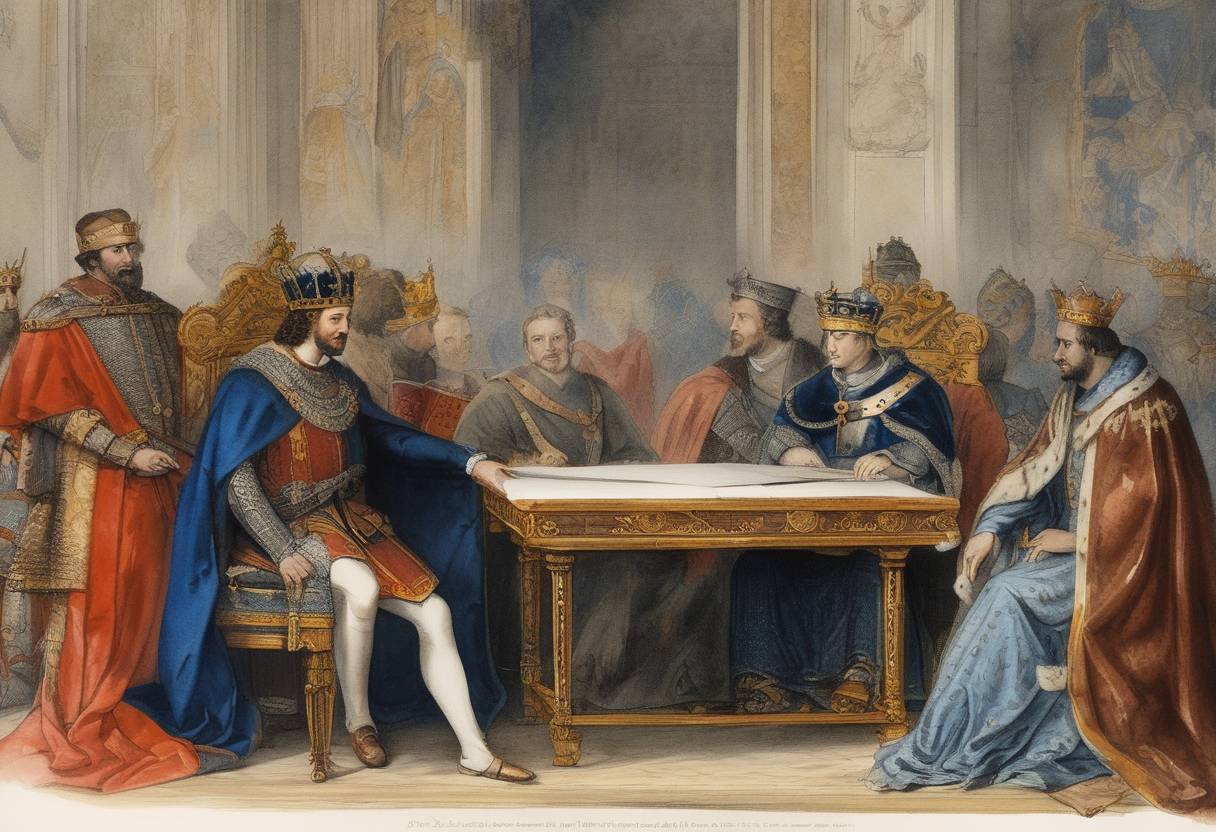
Treaty of Paris (1259)
On April 21, 1259, an important diplomatic agreement was reached with the signing of the Treaty of Paris between King Louis IX of France and King Henry III of England. This treaty played a crucial role in defining the geopolitics of Western Europe during the 13th century by establishing terms for the resolution of territorial disagreements and hostilities between the two powerful monarchies which were enduring remnants of the Angevin Empire.
Context and Prelude
The Treaty of Paris was the culmination of decades of conflict and negotiations. Since the early 13th century, tensions between England and France had been escalating due to disputes over territories in France that were held by English monarchs. The roots of these tensions traced back to the loss of Normandy in 1204 to the French crown and the subsequent struggles of English monarchs to reclaim lost territories.
King Henry III’s reign was marked by efforts to regain territories and influence in France, which had been substantially diminished compared to the Angevin Empire’s peak. His efforts encountered military failures and necessitated a diplomatic resolution to stabilize his rule and secure English holdings.
Provisions of the Treaty
The Treaty of Paris established a critical reorganization of English-held territories in France:
Restoration and Recognition: In exchange for acknowledging the French King as the suzerain over Gascony and a few other Aquitanian lands, King Henry III retained those territories but as a vassal to the French crown. This was a significant compromise given the long-standing claims of independence by English rulers over their French possessions.
Territorial Cessions: King Henry III agreed to relinquish claims to Normandy, Maine, Anjou, and Poitou which had been lost to French King Philip II Augustus decades earlier.
Mutual Alliances and Peace: The treaty established a period of sustained peace between France and England, marking an era of relatively stable relations which was beneficial for both kingdoms. It cleared several matters of contention and led to alliances which were foundational in shaping medieval European politics.
Aftermath and Significance
The Treaty of Paris in 1259 was significant not only for its immediate effects in reducing hostilities between France and England, but also for the broader historical consequences it entailed:
Stability in England: The agreement provided King Henry III with much-needed political stability domestically, which enabled economic and administrative reforms.
Precursor to the Hundred Years’ War: Although peace prevailed in the short-term, the coexistence and complex vassalage relationships laid out in the treaty would eventually contribute to underlying tensions resulting in the Hundred Years’ War later in the 14th century.
Impact on French Centralization: The treaty was a success for King Louis IX, consolidating French territorial gains and influencing the centralization efforts within France, enhancing the authority of the French Crown over its territory.
The Treaty of Paris is remembered as a pivotal moment of medieval diplomacy which underscores both kingdoms’ strategic necessities which steered them towards negotiations, shaping future relations and influencing medieval European history.