The Battle of Gravelines: July 13, 1558
1558 · Gravelines, France
The Battle of Gravelines took place during the Italian War of 1551–1559, where the Spanish forces defeated the French.
April 12, 1557
Spanish forces, led by the Duke of Alba, defeat the French at the Battle of St. Quentin during the Italian War of 1551-1559.
St. Quentin, France | Spanish Army
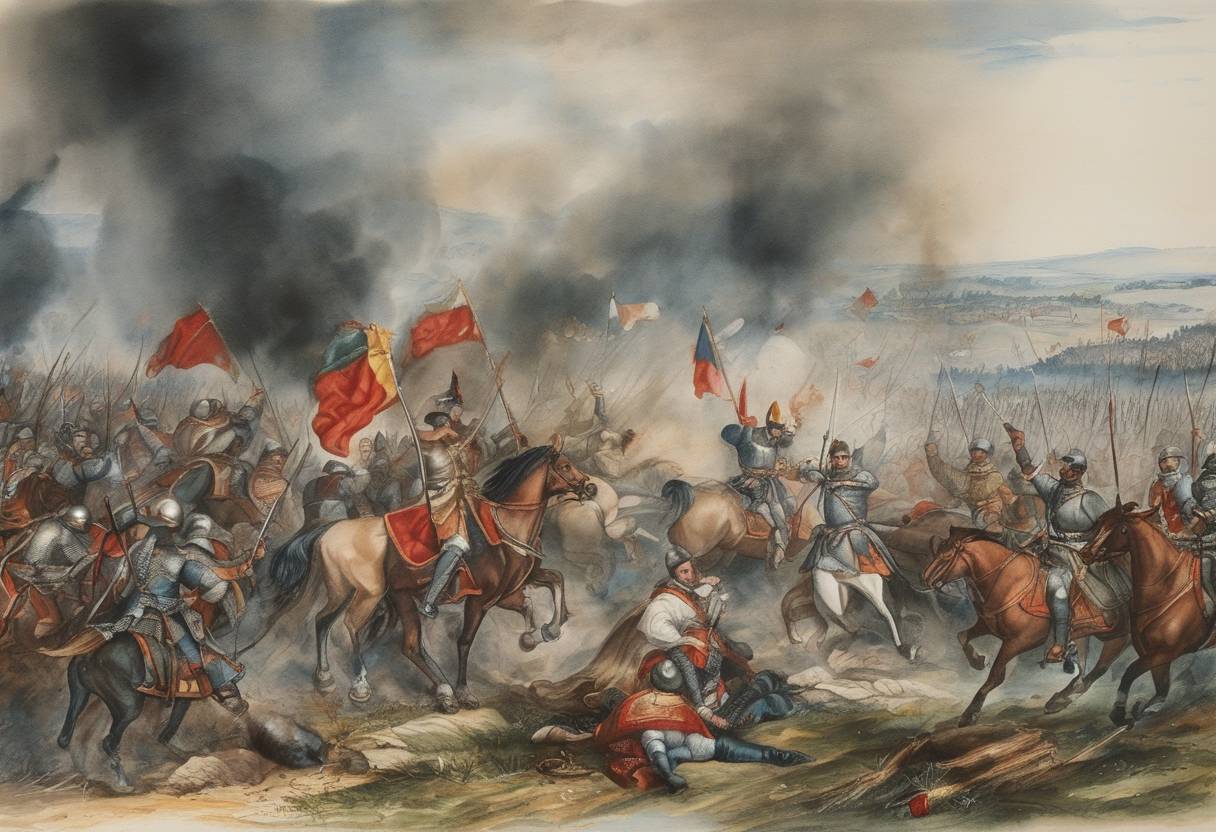
The Battle of St. Quentin, a pivotal clash during the Italian War of 1551-1559, occurred on August 10, 1557. It was not on December 4, but instead marks a significant event in the late summer of that year. Taking place near the town of St. Quentin in northern France, this battle resoundingly underscored the might of the Spanish Empire under King Philip II.
The conflict formed part of the larger Italian War, which embroiled much of Western Europe. It centered on control over the territories in Italy and involved major powers such as France, Spain, and the Holy Roman Empire. France, led by King Henry II, endeavored to challenge Spanish dominance and reclaim influence in Italy.
In the summer of 1557, as tensions escalated, French forces attempted to capture the town of St. Quentin in a strategic move meant to threaten Spanish positions in the region.
The Spanish army, commanded by the Duke of Alba, Fernando Álvarez de Toledo, alongside Emmanuel Philibert, Duke of Savoy, mobilized to relieve St. Quentin and confront the French forces. The Spanish forces comprised both seasoned Spanish troops and soldiers from the Holy Roman Empire.
On the day of battle, the Spanish forces executed a surprise maneuver that overwhelmed the French. The Spanish artillery and the tactics employed by the Duke of Alba were instrumental in breaking through the French defenses. The battle resulted in a decisive victory for Spain, effectively crippling French ambitions in the region.
The defeat at St. Quentin delivered a significant blow to France, both militarily and psychologically. The French army suffered heavy casualties, and the imprisonment of many of its soldiers put further strain on Henry II’s ability to wage war. The victory enhanced Spain’s standing in Europe and secured its dominance in northern France for the short term.
The battle also foreshadowed growing tensions within France that would contribute to the French Wars of Religion in the following decades. The victory at St. Quentin paved the way for future negotiations that eventually led to the Treaty of Cateau-Cambrésis in 1559, restoring temporary peace between Spain and France.
The Battle of St. Quentin underscored the effectiveness of Spanish military strategy and marked one of the last major triumphs for Habsburg Spain before the shifting tides of European power in the later 16th and 17th centuries. Its outcome exemplified the ephemeral nature of military victories in the complex web of continental alliances and rivalries.
Source: en.wikipedia.org