MAVEN Spacecraft Launch - November 18, 2013
2013 · Cape Canaveral, United States
NASA launched the MAVEN spacecraft to study the Martian atmosphere, aiming to understand the planet's climate history and the loss of its atmosphere.
May 5, 2018
NASA launched the InSight lander to Mars, aimed at studying the planet's interior to better understand its structure and evolution.
Vandenberg Air Force Base, United States | NASA
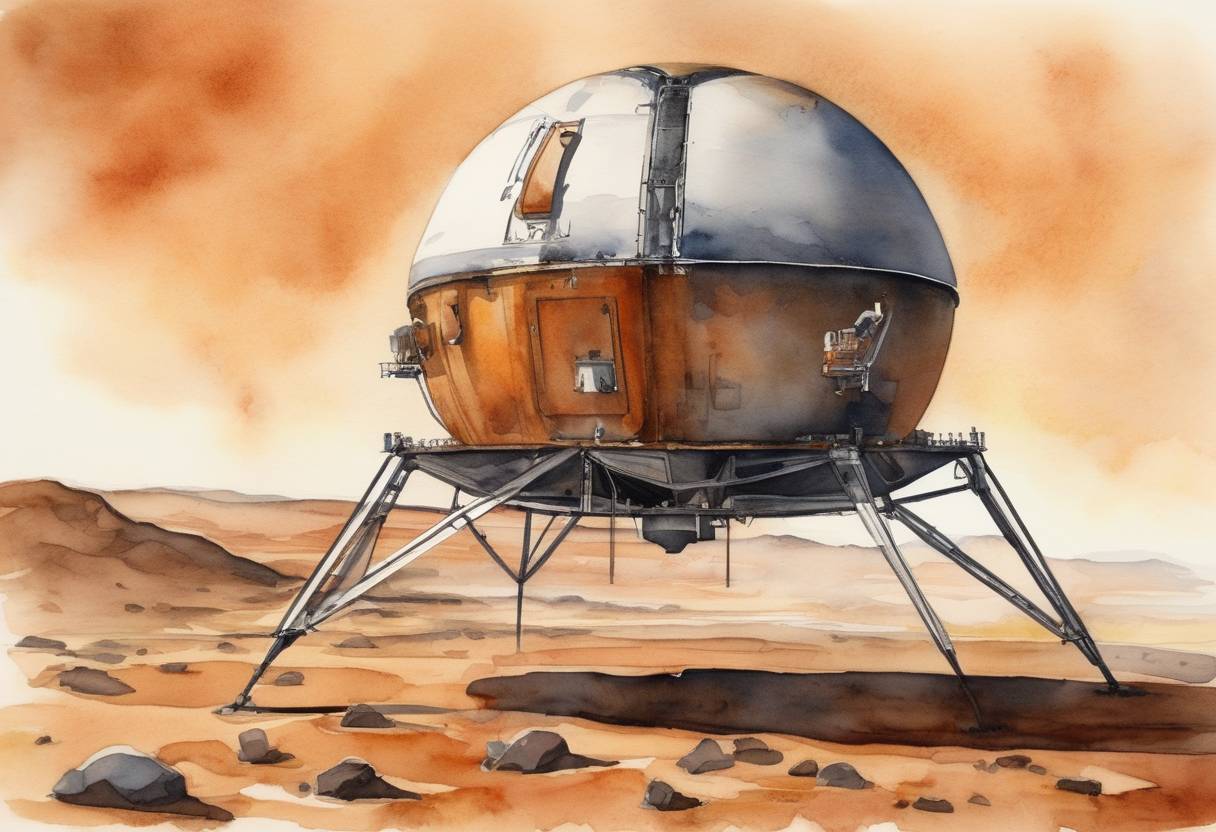
On May 5, 2018, NASA successfully launched the InSight lander from Vandenberg Air Force Base in California, marking a significant milestone in the exploration of Mars. The InSight (Interior Exploration using Seismic Investigations, Geodesy and Heat Transport) mission was designed to study the Red Planet’s interior, providing unprecedented insights into its structure and geological activity.
The primary goal of the InSight mission was to advance the understanding of Mars’ formation and evolution by investigating its internal structure. By examining the planet’s crust, mantle, and core, scientists aimed to answer fundamental questions about the processes that shaped the rocky planets within our solar system, including Earth.
Seismic Experiment for Interior Structure (SEIS): Provided by the French Space Agency (CNES), this seismometer was designed to measure “marsquakes,” offering crucial data about seismic activity on Mars and thereby revealing the planet’s internal structure.
Heat Flow and Physical Properties Package (HP^3): Developed by the German Aerospace Center (DLR), this instrument aimed to drill up to five meters into the Martian surface to assess how much heat was escaping from the planet’s interior.
Rotation and Interior Structure Experiment (RISE): Utilized the lander’s radio communications equipment to determine the wobble of Mars’ rotation axis, which provided insights into the size and density of its core.
The InSight mission was particularly noteworthy as it represented the first interplanetary launch from the West Coast of the United States. Additionally, its unique focus on geophysical research marked a new direction in Mars exploration, emphasizing the planet’s geological properties rather than solely its surface and atmosphere.
By exploring Mars’ internal characteristics, InSight contributed essential data to help scientists understand not only Mars but also the broader processes that govern planetary formation and evolution across the solar system. Such knowledge is vital for comparative planetology and aids in refining models of planetary dynamos and tectonics.
The successful launch of NASA’s InSight lander on May 5, 2018, was a pivotal advancement in planetary science. By studying the internal structure of Mars, the mission provided valuable information that expanded our understanding of terrestrial planets’ fundamental nature and evolution.
Source: www.nasa.gov