Founding of Quebec by Samuel de Champlain
1608 · Quebec City, Canada
Samuel de Champlain founded the city of Quebec, which became a significant French settlement in North America.
August 23, 1541
French explorer Jacques Cartier landed near Quebec City in his third voyage to Canada.
Quebec City, Canada | French exploration
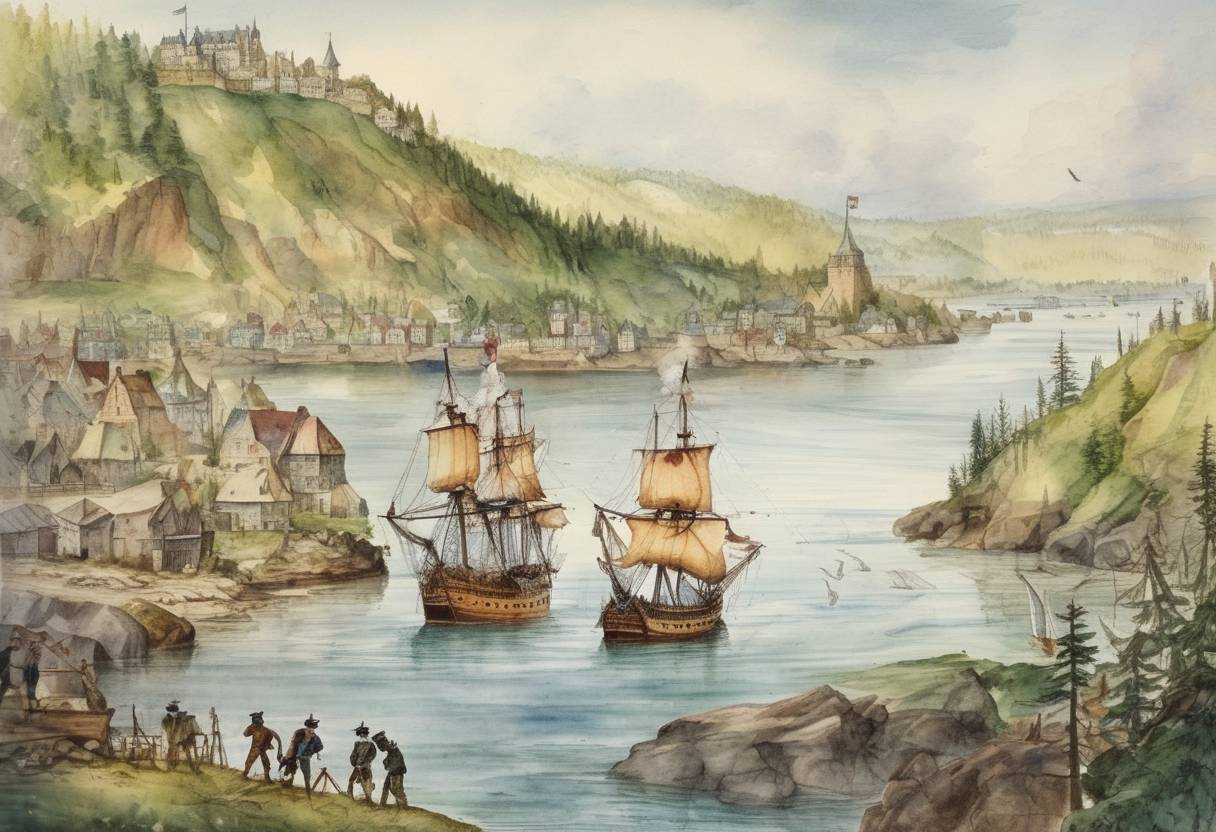
On August 23, 1541, the French explorer Jacques Cartier landed near what is now Quebec City during his third voyage to Canada. This expedition was part of France’s efforts to establish a permanent settlement in the New World and to find a northwest passage to Asia.
Jacques Cartier, born in 1491 in Saint-Malo, Brittany, was a prominent French navigator and explorer. His earlier voyages in 1534 and 1535-1536 had already established him as a key figure in the exploration of the Gulf of Saint Lawrence and the Saint Lawrence River. These expeditions were instrumental in claiming parts of Canada for France and in mapping the region.
Objective: The primary goal of Cartier’s third voyage was to establish a French colony in North America. This mission was part of a larger effort by King Francis I of France to expand French influence and find new trade routes.
Leadership: Although Cartier led the expedition, the official leader was Jean-François de La Rocque de Roberval, a nobleman appointed by the king. However, Cartier set sail ahead of Roberval, who was delayed in France.
Landing: Cartier arrived near the site of present-day Quebec City and established a settlement named Charlesbourg-Royal. This location was chosen for its strategic position along the Saint Lawrence River.
Harsh Conditions: The settlers faced numerous challenges, including harsh weather, scurvy, and tensions with the indigenous peoples, primarily the Iroquois.
Search for Riches: Cartier was also tasked with finding precious metals. He believed he had discovered gold and diamonds, but these turned out to be worthless iron pyrite and quartz, respectively.
Abandonment: Due to the difficulties encountered, Cartier eventually abandoned the settlement in 1542. When Roberval arrived later, he attempted to continue the colonization efforts but also faced insurmountable challenges and eventually returned to France.
Cartier’s voyages were crucial in laying the groundwork for future French claims in North America. Although his third voyage did not result in a permanent settlement, it contributed to the European understanding of the geography and potential of the Canadian region. Cartier’s explorations paved the way for subsequent French colonization efforts, which would eventually lead to the establishment of New France.
In summary, Jacques Cartier’s landing near Quebec City on August 23, 1541, marked a significant moment in the history of European exploration and the early attempts at colonization in North America. Despite the challenges and ultimate failure of the settlement, Cartier’s expeditions were foundational in the history of Canada.
Source: en.wikipedia.org