Proclamation of the State of Israel - May 14, 1948
1948 · Tel Aviv, Israel
David Ben-Gurion proclaimed the establishment of the State of Israel, leading to the end of the British Mandate for Palestine and the start of the 1948 Arab-Israeli War.
May 15, 1948
The Arab-Israeli War began following the declaration of the state of Israel, as neighboring Arab states invaded the newly established country.
Tel Aviv, Israel | Arab League
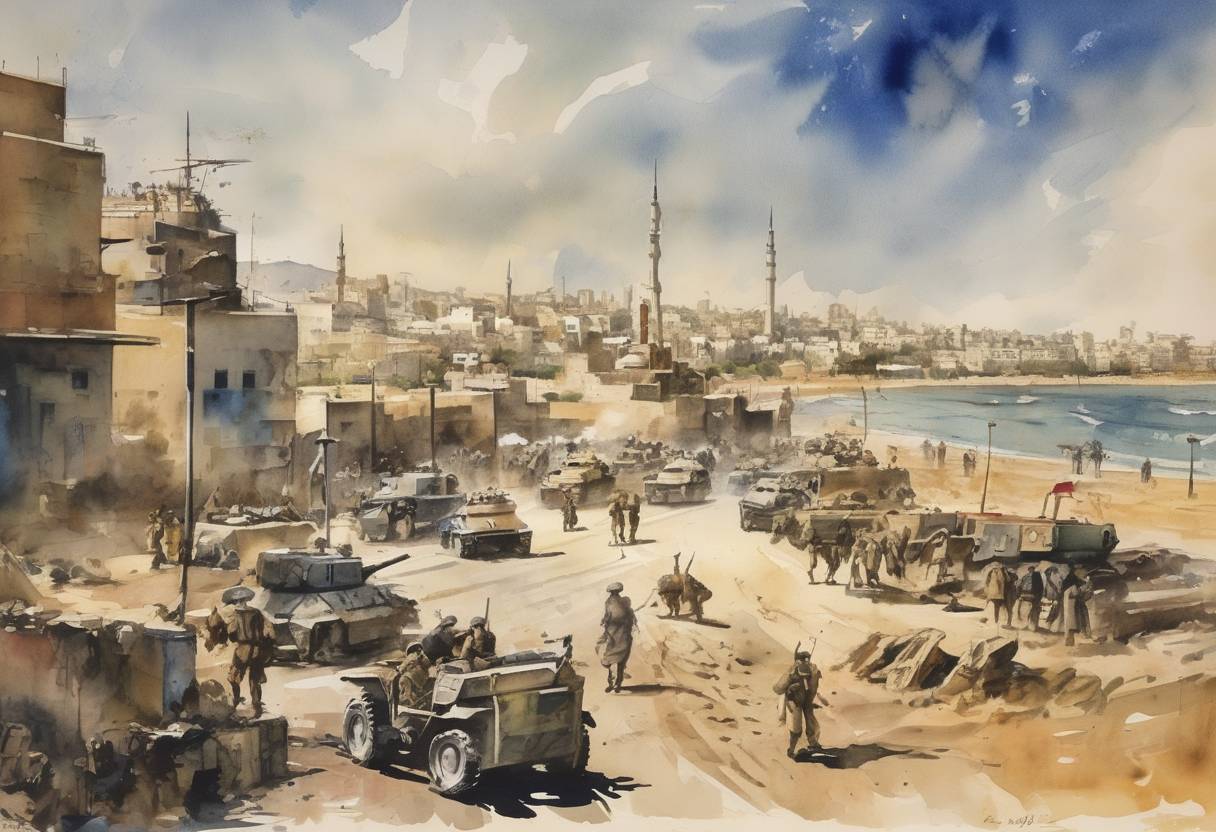
The Arab-Israeli War of 1948, also known as the War of Independence for Israelis and the Nakba (Catastrophe) for Palestinians, was a pivotal conflict that followed the declaration of the State of Israel on May 14, 1948. This declaration came after the United Nations General Assembly adopted Resolution 181 in November 1947, which proposed the partition of the British Mandate of Palestine into separate Jewish and Arab states, with Jerusalem as an international city. The Jewish leadership accepted the plan, but it was rejected by the Arab states and Palestinian Arab leaders, leading to escalating tensions and violence.
Declaration of War: On May 15, 1948, the day after Israel declared independence, neighboring Arab states, including Egypt, Transjordan (now Jordan), Syria, Lebanon, and Iraq, invaded the newly established state. This marked the beginning of the first Arab-Israeli war.
Military Engagements: The invading Arab armies aimed to support Palestinian Arabs and prevent the establishment of a Jewish state. Initial battles were fought in various regions, including the Negev Desert, the Galilee, and around Jerusalem.
Israeli Defense: The nascent Israeli Defense Forces (IDF), formed from various Jewish paramilitary groups like the Haganah, Irgun, and Lehi, mobilized to defend the new state. Despite being outnumbered and initially outgunned, the IDF managed to organize a robust defense and eventually went on the offensive.
Demographic Shifts: The war led to significant demographic changes, with hundreds of thousands of Palestinian Arabs fleeing or being expelled from their homes, an event Palestinians refer to as the Nakba. Simultaneously, Jewish communities in Arab countries faced persecution, leading to a mass exodus to Israel.
International Involvement: The conflict drew international attention, with the United States and the Soviet Union quickly recognizing the State of Israel. The UN attempted to mediate, appointing Count Folke Bernadotte as a mediator, though he was assassinated by the Lehi group in September 1948.
Armistice Agreements: The war officially ended in 1949 with a series of armistice agreements brokered by the United Nations. Israel expanded its territory beyond the UN partition plan, while the West Bank and East Jerusalem were controlled by Jordan, and the Gaza Strip by Egypt.
Long-term Impact: The 1948 Arab-Israeli War set the stage for ongoing conflict in the region, leading to further wars in 1956, 1967, and beyond. It also laid the groundwork for the enduring Israeli-Palestinian conflict, with issues of refugees, borders, and mutual recognition remaining unresolved.
The Arab-Israeli War of 1948 was a defining moment in Middle Eastern history, shaping the geopolitical landscape of the region and influencing international relations for decades to come.
Source: en.wikipedia.org