The Nero Decree: March 19, 1945
1945 · Berlin, Germany
Adolf Hitler issued the Nero Decree, ordering the destruction of German infrastructure to prevent its use by Allied forces.
May 1, 1945
Adolf Hitler's death was announced on German radio, with Grand Admiral Karl Dönitz succeeding him as President of Germany.
Berlin, Germany | Nazi Germany
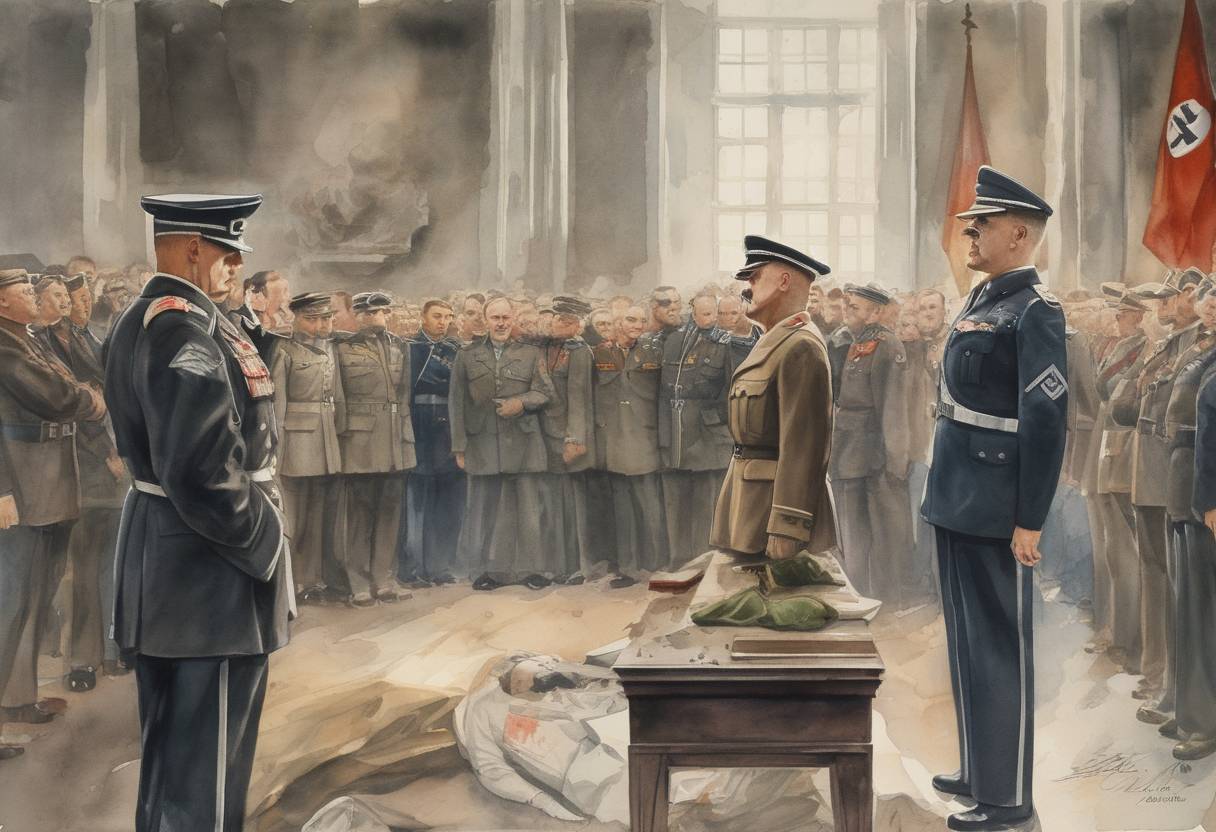
On May 1, 1945, a significant announcement was made over German radio that marked a pivotal moment in World War II and the history of Nazi Germany. The death of Adolf Hitler, the Führer of Nazi Germany, was officially announced, and it was declared that Grand Admiral Karl Dönitz would succeed him as the President of Germany.
In the final days of April 1945, Nazi Germany was on the brink of collapse. Allied forces were advancing from the west, and Soviet troops were closing in on Berlin from the east. Adolf Hitler, who had been residing in the Führerbunker beneath the Reich Chancellery in Berlin, was facing inevitable defeat.
On April 30, 1945, Adolf Hitler committed suicide alongside his wife, Eva Braun, whom he had married just a day earlier. Hitler’s death was a closely guarded secret initially, as the Nazi leadership sought to manage the transition of power and maintain some semblance of control.
On May 1, 1945, the German radio broadcast an announcement to the nation. The message was delivered by Reich Minister of Propaganda Joseph Goebbels, who stated that Hitler had died fighting against Bolshevism. The announcement was crafted to portray Hitler as a martyr for Germany, although the reality of his suicide was not disclosed to the public at that time.
In his last will and testament, Hitler had appointed Grand Admiral Karl Dönitz as his successor, naming him the President of Germany and Supreme Commander of the Armed Forces. Dönitz was a respected naval officer who had commanded the German U-boat fleet and later served as the Commander-in-Chief of the German Navy.
Dönitz’s appointment was part of Hitler’s plan to ensure the continuity of the Nazi regime, even in its final days. However, Dönitz’s government, known as the Flensburg Government, was short-lived. It operated from the town of Flensburg in northern Germany and sought to negotiate a favorable surrender with the Allies.
The announcement of Hitler’s death and the succession of Dönitz marked the beginning of the end for Nazi Germany. On May 7, 1945, Dönitz authorized the unconditional surrender of all German forces, which was signed at Allied headquarters in Reims, France. This surrender took effect on May 8, 1945, marking Victory in Europe (VE) Day.
The transition of power to Dönitz and the subsequent surrender effectively brought an end to World War II in Europe. The announcement of Hitler’s death and the collapse of the Nazi regime had profound implications for post-war Europe, leading to the division of Germany and the onset of the Cold War.
In summary, the announcement of Adolf Hitler’s death on May 1, 1945, and the succession by Karl Dönitz were crucial events in the final chapter of World War II, symbolizing the fall of Nazi Germany and paving the way for a new era in European history.
Source: en.wikipedia.org