The First Photograph of Earth from the Moon: August 23, 1966
1966 · Moon, Space
The Lunar Orbiter 1 took the first photograph of Earth from the Moon.
July 30, 1971
Apollo 15 astronauts David Scott and James Irwin become the first to ride in a lunar rover on the Moon.
Moon, Space | NASA
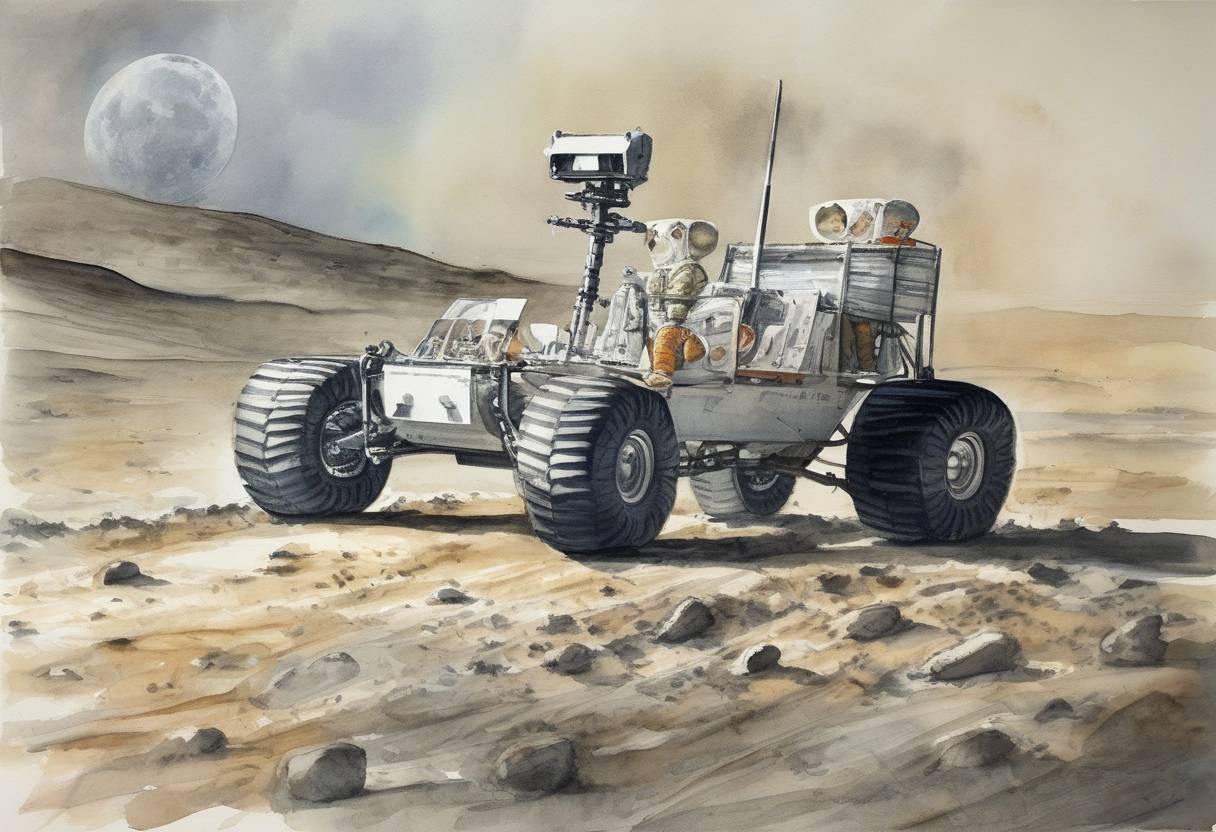
On July 30, 1971, during the Apollo 15 mission, astronauts David Scott and James Irwin made history by becoming the first humans to drive a vehicle on the Moon. This event marked a significant milestone in lunar exploration, as it introduced the Lunar Roving Vehicle (LRV), which greatly expanded the range and scope of scientific exploration on the lunar surface.
Apollo 15 was the ninth crewed mission in NASA’s Apollo program and the fourth to land on the Moon. It was the first of what were termed the “J missions,” which were designed to allow for longer stays on the Moon and more extensive scientific research. The mission’s primary objectives included exploring the Hadley-Apennine region, conducting scientific experiments, and deploying the LRV.
The Lunar Roving Vehicle was an electric-powered, four-wheeled rover designed to operate in the Moon’s low-gravity environment. Built by Boeing, the LRV could carry two astronauts, their equipment, and lunar samples. It was lightweight, weighing only about 460 pounds (210 kg) on Earth, and could travel at speeds up to 8 mph (13 km/h).
On July 30, 1971, after landing on the Moon on July 26, astronauts David Scott and James Irwin embarked on their first excursion using the LRV. The rover allowed them to travel further from the Lunar Module than previous missions, covering a total distance of approximately 17.25 miles (27.8 km) over three days of exploration.
During their first drive, Scott and Irwin explored the lunar surface, collecting samples and conducting experiments. The LRV enabled them to reach the base of the Apennine Mountains and the edge of Hadley Rille, a deep channel on the Moon’s surface, providing invaluable geological insights.
The introduction of the Lunar Roving Vehicle was a game-changer for lunar exploration. It allowed astronauts to cover more ground, carry more equipment, and collect a greater variety of samples than ever before. The data and samples gathered during Apollo 15 significantly advanced our understanding of the Moon’s geology and history.
Apollo 15’s successful use of the LRV set the stage for subsequent missions, Apollo 16 and Apollo 17, which also utilized rovers to explore the lunar surface. These missions further demonstrated the importance of mobility in extraterrestrial exploration, influencing future mission planning for both lunar and planetary exploration.
In summary, the first ride of the Lunar Roving Vehicle by David Scott and James Irwin on July 30, 1971, was a pivotal moment in space exploration, showcasing human ingenuity and expanding the horizons of scientific discovery on the Moon.
Source: en.wikipedia.org