Reinstatement of Slavery in French Colonies by Napoleon Bonaparte on May 20, 1802
1802 · Paris, France
Napoleon Bonaparte reinstated slavery in the French colonies, reversing its abolition during the French Revolution.
September 28, 1791
France passed a decree granting citizenship and equal civil rights to free people of color in French colonies. This was a significant move during the French Revolution, reflecting its ideals of liberty and equality, although it met with resistance in the colonies.
Paris, France | French National Assembly
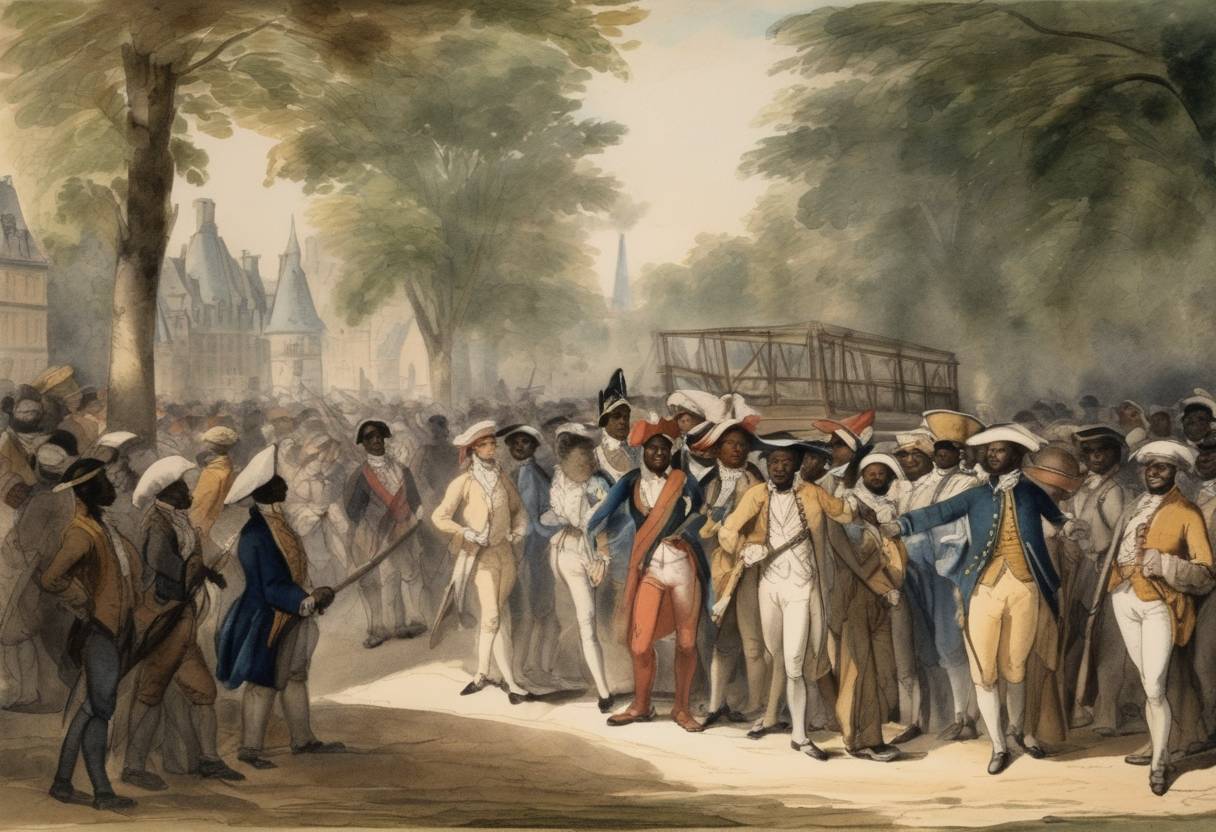
On September 28, 1791, the French National Constituent Assembly made a landmark decision during the French Revolution, passing a decree that granted citizenship and equal civil rights to free people of color, also known as “gens de couleur libres,” in the French colonies. This decision was a significant reflection of the revolutionary ideals of liberty, equality, and fraternity that were sweeping through France and aimed at extending these principles across its colonies.
The late 18th century was a period of profound social and political upheaval in France, driven by Enlightenment ideas advocating for human rights and equality. The French Revolution, which began in 1789, sought to dismantle the ancien régime’s hierarchical structures and promote universal rights. However, these principles often faced challenges in application, particularly regarding France’s colonial policies.
The free people of color in the French colonies primarily included individuals of mixed African and European descent. Despite their legal status as free citizens, they were often subjected to discriminatory practices and denied civil rights comparable to those of white colonists. The discrimination led to growing tension and calls for reform.
Earlier efforts to improve the rights of free people of color can be traced to the agitation by figures like Julien Raimond and Vincent Ogé, who actively lobbied for equality. Ogé, in particular, led a rebellion in Saint-Domingue (present-day Haiti) in 1790, calling for the enforcement of citizenship rights, though the revolt was quashed.
The revolutionaries in France had to balance the competing interests of various colonial and economic stakeholders. White colonists, known as “Békés,” vehemently opposed any move to grant equal rights to people of color, fearing economic and social upheaval.
Upon its passage, the decree of September 28, 1791, was supposed to apply only to colonies where the local government accepted it. It explicitly affirmed the revolutionary principles by extending civil equality but was met with significant resistance, particularly from the colonial planters and slave owners in the Caribbean. Despite the passage of the decree, its implementation faced obstacles due to the entrenched racial and economic hierarchies in the colonies.
This decree was instrumental in the broader struggle for racial equality and was a precursor to the more radical changes soon to follow. The tensions and grievances it brought to light contributed to the larger colonial upheaval and the subsequent Haitian Revolution, which ultimately led to Haiti’s independence in 1804.
In France, the decree signaled a commitment to revolutionary ideals, although the implementation in the colonies highlighted the complexities and contradictions in applying these ideals across diverse societies. The decree of September 28, 1791, stands as a testament to the turbulent and transformative times of the French Revolution, providing a pivotal moment in the long and fraught history of colonial and racial relations.
Source: www.britannica.com