André-Jacques Garnerin's First Recorded Parachute Jump
1797 · Paris, France
André-Jacques Garnerin makes the first recorded parachute jump from a hot air balloon over Paris.
October 15, 1783
Jean-François Pilâtre de Rozier and François Laurent d'Arlandes made one of the first untethered manned flights in a hot air balloon, developed by the Montgolfier brothers, in Paris.
Paris, France | Montgolfier brothers
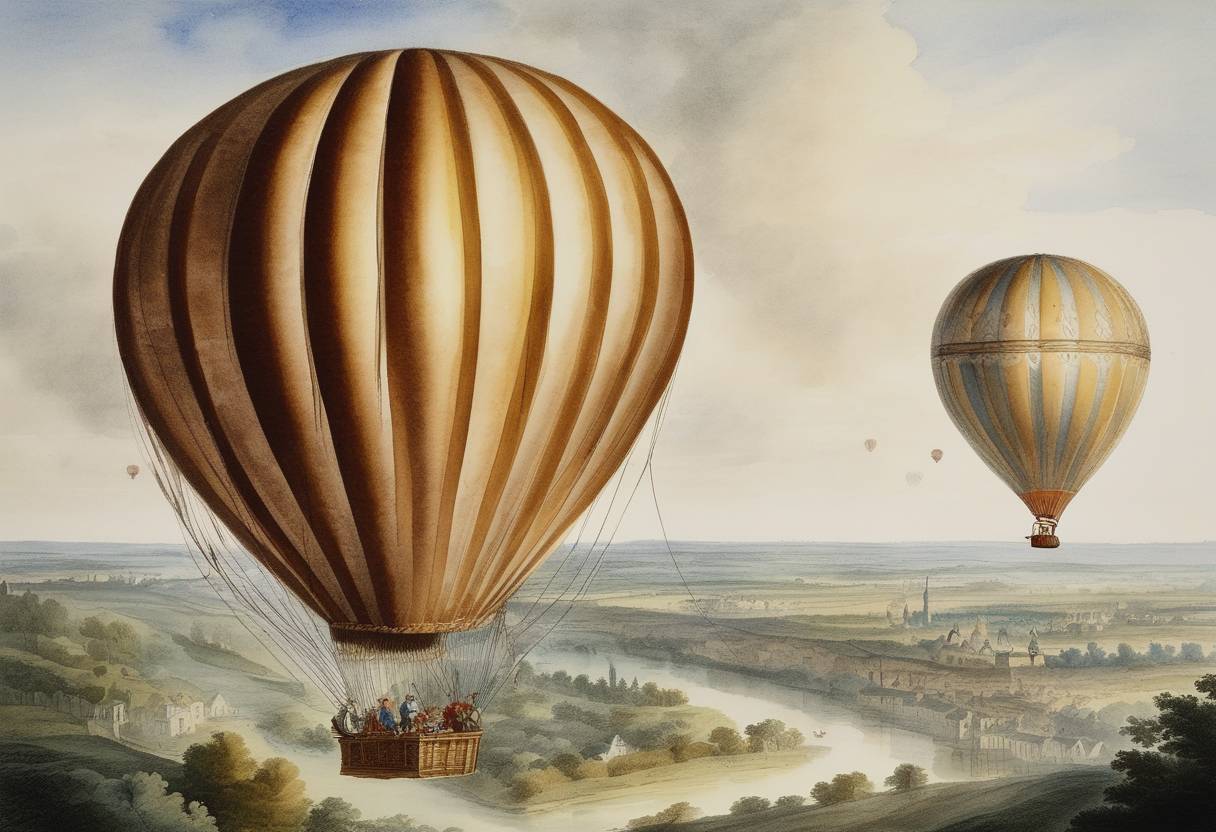
On October 15, 1783, Jean-François Pilâtre de Rozier and François Laurent d’Arlandes embarked on one of the first untethered manned flights in a hot air balloon. This significant event took place in Paris, marking a pivotal moment in the history of aviation.
The hot air balloon, which facilitated this historic flight, was developed by the Montgolfier brothers, Joseph-Michel and Jacques-Étienne Montgolfier. The Montgolfiers were pioneers of lighter-than-air flight, and their innovation laid the groundwork for the balloon ascent. Their balloon was constructed using a combination of paper and silk, a design that would become iconic in aviation history.
Jean-François Pilâtre de Rozier, a teacher in chemistry and physics, and François Laurent d’Arlandes, a marquis and military officer, took off from the grounds of the Château de la Muette in the Bois de Boulogne. The flight took place in the early morning in clear conditions, with a steady breeze. The balloon ascended to an altitude of approximately 3,000 feet (about 900 meters) and traveled a distance of roughly 5 miles (8 kilometers) across the city, landing safely after about 25 minutes.
This successful flight demonstrated the potential of human air travel, capturing the imagination of people worldwide and encouraging further experimentation with powered flight. The achievement provided valuable insights into the practicalities and challenges of manned flight, paving the way for future advancements in aviation technology.
Following this successful ascent, further developments in ballooning continued rapidly. Jean-François Pilâtre de Rozier later attempted another flight that tragically ended in the first fatal aviation accident in 1785. However, the 1783 flight remained a symbol of innovation and human curiosity, widely celebrated and profoundly influential in inspiring subsequent generations of aviators and inventors.
The flight by Pilâtre de Rozier and d’Arlandes contributed to a burgeoning field of scientific inquiry during the Age of Enlightenment. As interest in the science of flight grew, it set the stage for the more advanced and ambitious aeronautical projects of the 19th and 20th centuries, eventually leading to the development of modern aviation.
Source: en.wikipedia.org