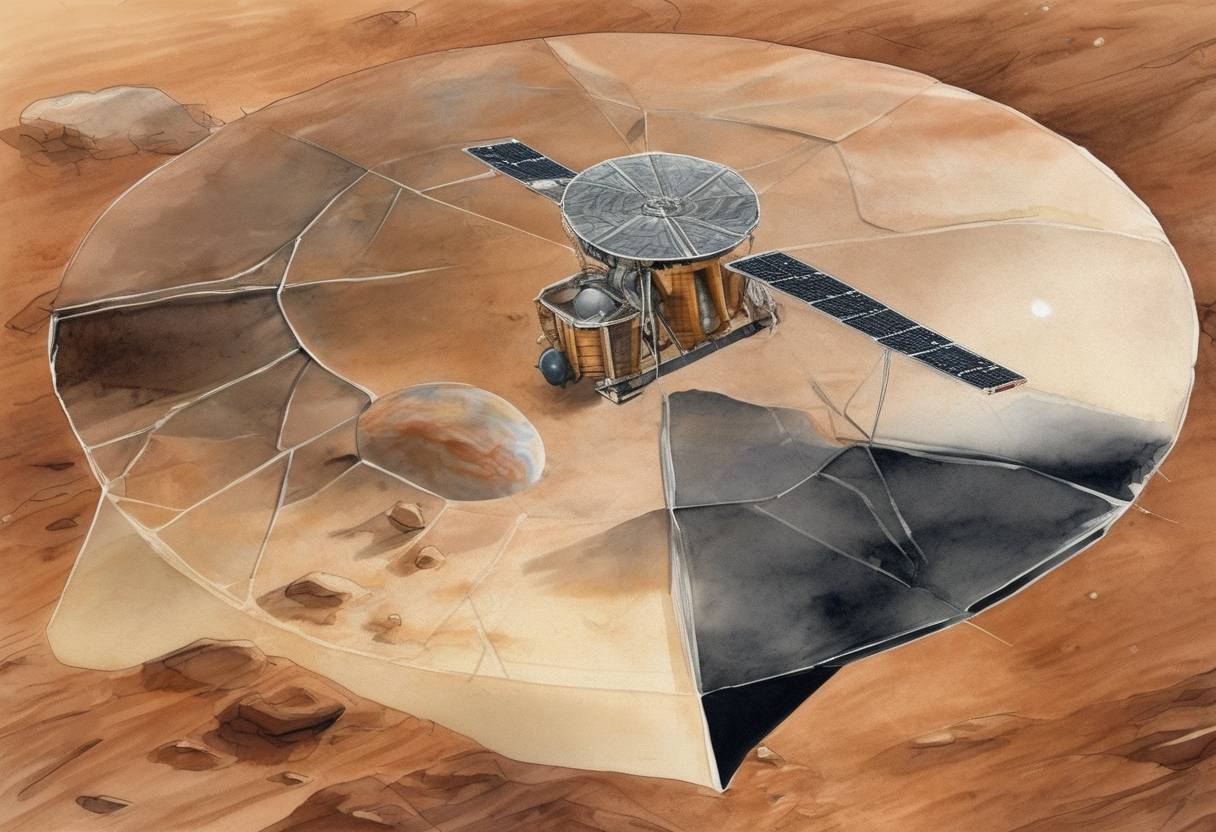
The Beagle 2: A Lost Opportunity on Mars
On December 25, 2003, the Beagle 2, a British-built Mars lander, was scheduled to make its historic landing on the Martian surface as part of the European Space Agency’s (ESA) Mars Express mission. This mission marked a significant milestone for the United Kingdom, as it was the first British-led attempt to land on Mars.
Background and Objectives
The Beagle 2 was named after HMS Beagle, the ship that carried Charles Darwin on his voyage that led to the formulation of his theory of evolution. The lander was designed by a team led by Professor Colin Pillinger from the Open University in the UK. Its primary scientific goals included:
- Searching for signs of past or present life on Mars.
- Studying the Martian surface and atmosphere.
- Conducting experiments to understand the planet’s geology and climate.
The Beagle 2 was equipped with a suite of scientific instruments, including a robotic arm, cameras, and a “mole” to collect soil samples.
The Mars Express Mission
The Beagle 2 was part of the larger Mars Express mission, which was the ESA’s first mission to another planet. The mission included an orbiter, which successfully entered Mars’ orbit on December 25, 2003, and continues to send valuable data back to Earth.
The Landing Attempt
The Beagle 2 was expected to land in Isidis Planitia, a flat region near the Martian equator, on Christmas Day 2003. However, after its release from the Mars Express orbiter on December 19, 2003, no communication was received from the lander. Despite numerous attempts to establish contact, the Beagle 2 was declared lost in February 2004.
Discovery and Analysis
For over a decade, the fate of the Beagle 2 remained a mystery. In January 2015, images from NASA’s Mars Reconnaissance Orbiter revealed that the Beagle 2 had indeed landed on Mars, but it had failed to fully deploy its solar panels. This incomplete deployment likely prevented it from establishing communication with Earth.
Significance and Legacy
The Beagle 2 mission, despite its failure to communicate, was a significant step in European planetary exploration. It demonstrated the potential for international collaboration in space exploration and contributed to the development of future missions. The lessons learned from the Beagle 2 have informed subsequent missions, including ESA’s ExoMars program.
The discovery of the Beagle 2’s landing site provided closure to the mission team and highlighted the challenges of landing on Mars. It remains a testament to human ingenuity and the enduring quest to explore our solar system.