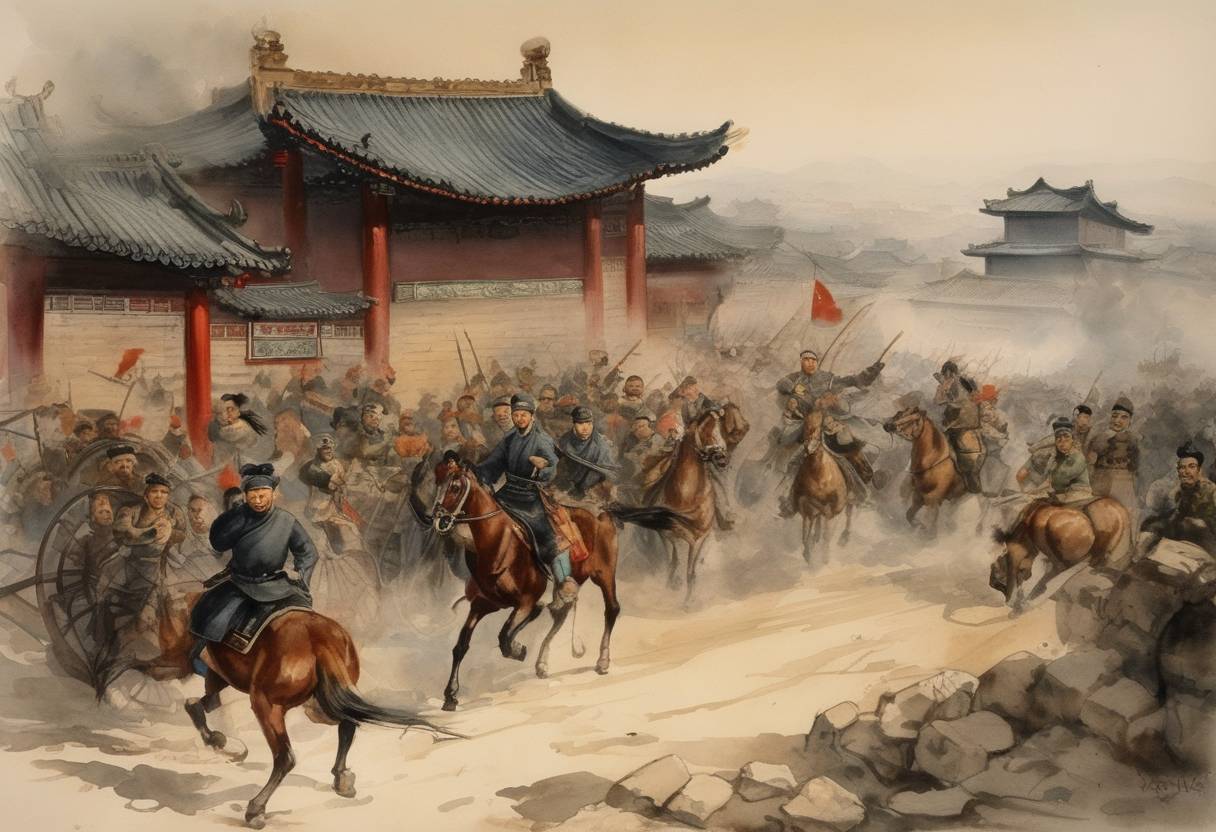
Battle of Beijing (Peking) - August 8, 1900
Background
The Boxer Rebellion, a vehement anti-foreign, anti-colonial, and anti-Christian uprising, swept through China at the turn of the 20th century. Rooted in growing nationalist fervor among the Yihequan (“Righteous and Harmonious Fists”), later dubbed the “Boxers,” the rebellion reflected widespread discontent with foreign influence and internal dynamics within China. The struggle intensified into an international crisis necessitating a response from multiple foreign powers.
The Eight-Nation Alliance
The Eight-Nation Alliance was a coalition of Japan, Russia, Britain, France, the United States, Germany, Italy, and Austria-Hungary. This alliance was formed primarily to quell the Boxer uprising and ensure the safety of their nationals and interests in the region. With growing attacks and the siege of foreign legations in Beijing, these nations planned a concerted military intervention to relieve the besieged settlements and restore order.
The Battle
On August 8, 1900, the conflict escalated with the Battle of Beijing, marking one of the most pivotal moments of the Boxer Rebellion. Although precise records of specific skirmishes on this date are sparse, historical accounts indicate that the larger campaign for the relief and capture of Beijing began around this time.
The advance towards Beijing required overcoming significant logistical challenges, complex diplomacy among coalition forces, and formidable military resistance from Imperial Chinese troops and Boxer militants. The fighting around Beijing was intense as the Eight-Nation Alliance coordinated a massive influx of troops into Chinese territory, making strategic headway toward the capital.
Aftermath and Significance
By mid-August, the Alliance forces had successfully relieved the legation quarter in Beijing, marking the beginning of the end for organized Boxer resistance. The consequential occupation of Beijing had a lasting impact, leading to the Boxer Protocol of 1901. This treaty imposed severe penalties on China, including large indemnities and military occupation, while exacerbating internal strife and undermining the Qing dynasty’s legitimacy.
The Battle and subsequent occupation highlighted the vulnerabilities of the Qing government and exemplified the power dynamics prevalent in the era of imperialism. The ramifications of this rebellion reverberated through China’s political landscape, ushering changes that contributed to the eventual fall of the Qing dynasty and the rise of modern Chinese nationalism.