The Annexation of the Kingdom of Holland: April 1, 1810
1810 · Paris, France
Napoleon annexed the Kingdom of Holland to the French Empire, continuing his efforts to consolidate power across Europe.
May 17, 1809
French Emperor Napoleon I orders the annexation of the Papal States into the French Empire, marking a crucial step in his conflict with the Catholic Church and Pope Pius VII over the independence of the Church.
Rome, Italy | French Empire
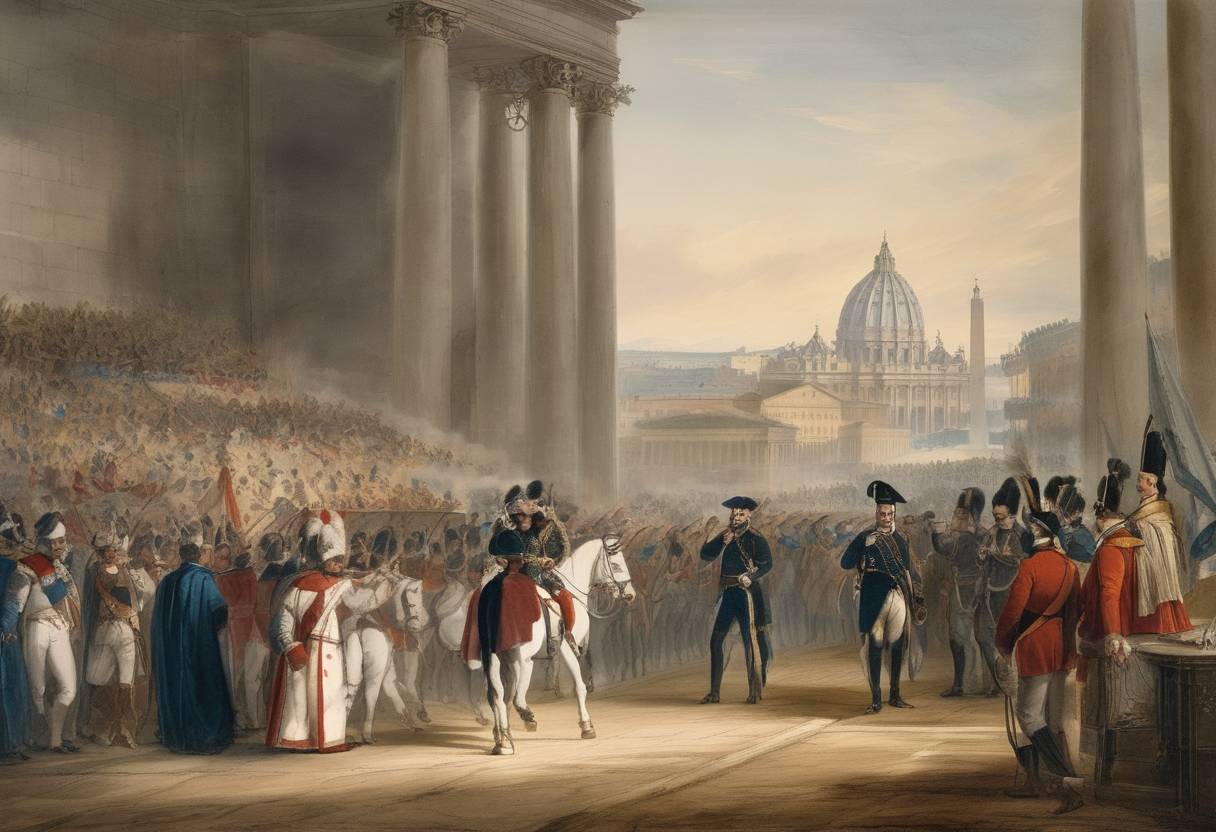
On May 17, 1809, French Emperor Napoleon I issued a decree for the annexation of the Papal States into the French Empire. This significant action was a pivotal moment in Napoleon’s lengthy conflict with the Catholic Church and Pope Pius VII, reflecting the broader tensions between secular power and religious authority during this era.
The relationship between Napoleon and Pope Pius VII was fraught with tension. Initially, the two leaders had cooperated. Pope Pius VII had even attended Napoleon’s coronation in 1804, but the increasing demands and control exerted by Napoleon over church matters strained their relations. The Concordat of 1801 had brought temporary peace, but Napoleon’s ambition to solidify his power and expand the French Empire brought him into direct conflict with the Church’s independence.
Napoleon’s campaigns in Italy had already undermined the Papal States’ sovereignty. The occupation of Ancona in 1799 and the incorporation of several territories into the Kingdom of Italy had already weakened Papal influence in the region. The annexation of the Papal States was part of a broader strategy to consolidate control over the Italian peninsula and reinforce French dominance in Europe.
The decree issued by Napoleon declared that the Papal States were to be annexed directly into the French Empire, effectively abolishing their temporal authority. This was a direct challenge to Pope Pius VII, who had refused to support Napoleon’s ambitions fully. In retaliation for the annexation, Pope Pius VII excommunicated Napoleon and any individuals complicit in the act, although this declaration had limited impact due to the widespread control and influence Napoleon wielded over European affairs at the time.
The annexation of the Papal States prompted significant repercussions. Pope Pius VII was arrested in June 1809 and taken to France, where he spent several years under house arrest. This rift highlighted the deepening conflict between the French Empire and the Vatican, emphasizing the complex dynamic between revolutionary secular ideas and established religious traditions.
The struggle between Napoleon and the Papacy continued until Napoleon’s fall from power. After Napoleon’s abdication in 1814, Pope Pius VII was restored to the Papal throne and the Papal States were re-established. This episode illustrated the challenges of balancing secular and religious authority and underscored the transformative nature of the Napoleonic Wars on European political and religious structures.
Source: www.britannica.com