Nikita Khrushchev Appointed General Secretary of the Communist Party
1953 · Moscow, Soviet Union
Nikita Khrushchev was appointed the General Secretary of the Communist Party of the Soviet Union.
June 26, 1953
Lavrentiy Beria, the head of the Soviet Union's Ministry of Internal Affairs, was arrested after a power struggle within the Kremlin following the death of Joseph Stalin.
Moscow, Soviet Union | Soviet Union government
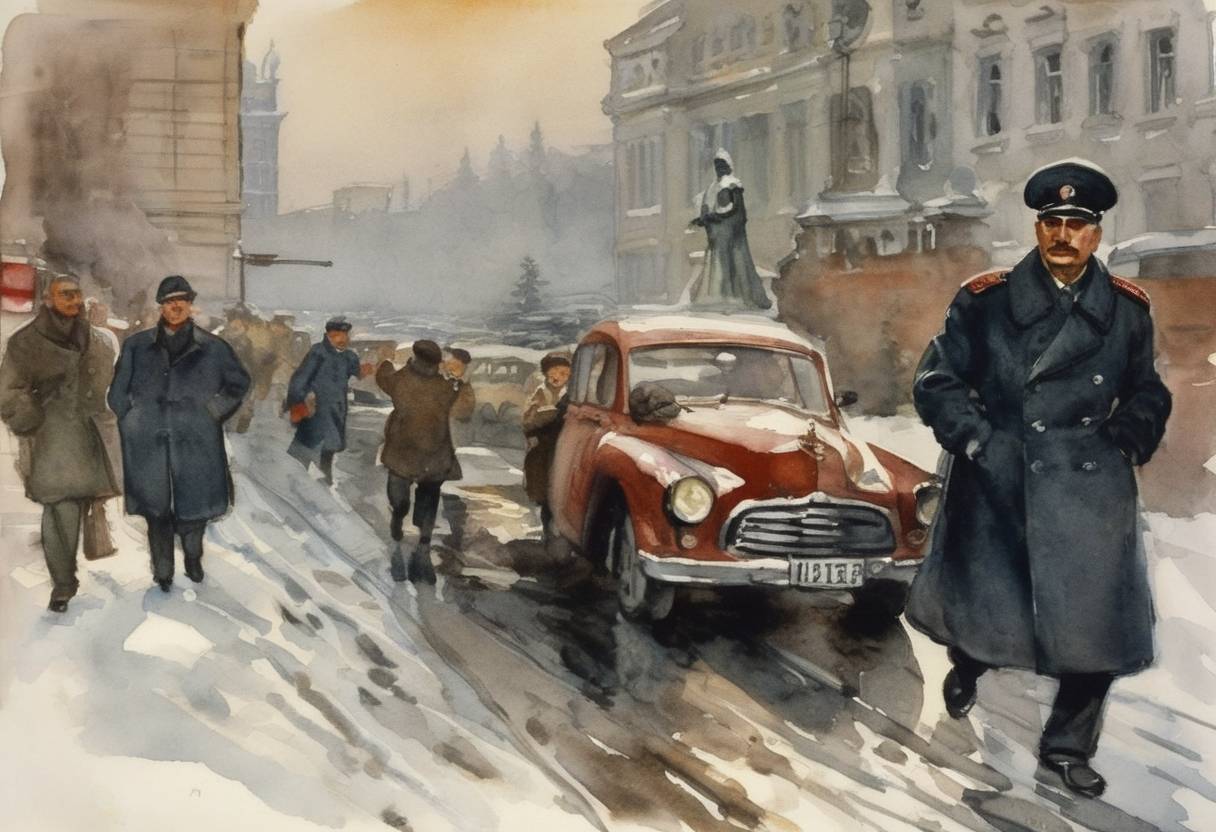
Lavrentiy Beria, once one of the most powerful and feared figures in the Soviet Union, was arrested on June 26, 1953, marking a pivotal moment in post-Stalin Soviet politics. His arrest was a significant event, emblematic of a power struggle within the Kremlin following the death of Joseph Stalin in March 1953.
Beria, born on March 29, 1899, in Georgia, rose to prominence as the head of the NKVD (People’s Commissariat for Internal Affairs), which later became the Ministry of Internal Affairs. Known for his ruthless efficiency, Beria was instrumental in carrying out Stalin’s purges and was deeply involved in the Soviet Union’s security apparatus, overseeing the secret police, labor camps, and espionage activities.
Following Stalin’s death, Beria attempted to position himself as a reformer, advocating for changes in the Soviet system that included reducing the scope of the Gulags and granting greater freedoms. Despite these overtures, Beria was widely mistrusted by his peers due to his immense power and history of manipulation.
The arrest of Beria was orchestrated by a coalition of high-ranking officials, including Nikita Khrushchev, Vyacheslav Molotov, and Georgy Malenkov. These men, wary of Beria’s ambitions and influence, feared he might attempt to take control of the Soviet leadership. The plan to remove him was carefully coordinated to ensure success and minimize his ability to retaliate.
The Soviet leadership summoned Beria to a meeting in the Kremlin on June 26, 1953. During this meeting, Khrushchev and others confronted Beria with accusations of treason and conspiracy. They claimed he was a threat to the security of the state and had been conspiring with foreign powers. Beria was swiftly arrested by military officers on the orders of Marshal Georgy Zhukov, who had positioned troops outside the Kremlin to ensure compliance.
Beria’s arrest was initially kept secret, and he was detained for several months while the charges against him were formalized. On December 23, 1953, Beria was tried in a closed session by a special tribunal without right to appeal. He was found guilty of numerous charges, including treason, and was executed shortly thereafter.
The removal of Beria paved the way for Nikita Khrushchev to consolidate power and steer Soviet policy towards de-Stalinization. This event marked the beginning of significant shifts in Soviet governance, moving away from the oppressive methods of Stalin’s era and leading to a partial thawing of the repressive climate that had characterized the late dictator’s rule.
The arrest and execution of Lavrentiy Beria were critical in shaping the political landscape of the Soviet Union during the early Cold War, influencing both internal reforms and the dynamics of the international communist movement.
Source: www.britannica.com