George H. W. Bush's "New World Order" Speech - September 11, 1990
1990 · Washington, D.C., United States
U.S. President George H. W. Bush delivered a speech to Congress outlining his vision for a 'new world order' following the end of the Cold War.
June 1, 1990
U.S. President George H. W. Bush and Soviet leader Mikhail Gorbachev sign a treaty to end chemical weapon production and begin the destruction of their respective stockpiles.
Washington, D.C., United States | U.S. Government, Soviet Government
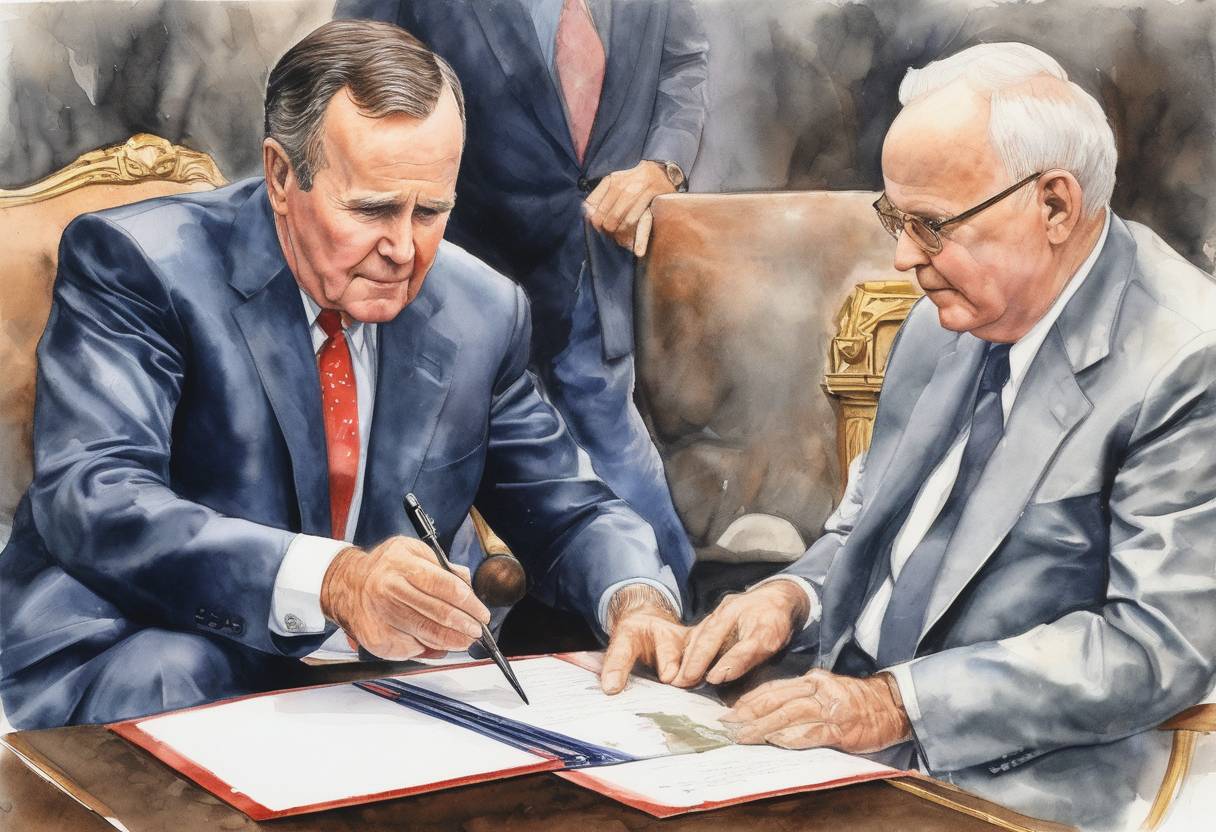
On June 1, 1990, a significant milestone in arms control and international diplomacy was achieved when U.S. President George H. W. Bush and Soviet leader Mikhail Gorbachev signed a treaty to end the production of chemical weapons and initiate the destruction of their existing stockpiles. This agreement was a crucial step in reducing the threat of chemical warfare and marked a pivotal moment in the post-Cold War era of disarmament.
The late 1980s and early 1990s were characterized by a thawing of Cold War tensions, a period often referred to as the “end of the Cold War.” This era saw a series of diplomatic engagements and treaties aimed at reducing the nuclear and conventional arms race between the United States and the Soviet Union. The Chemical Weapons Accord was part of this broader effort to enhance global security and stability.
The Geneva Protocol (1925): Although it prohibited the use of chemical and biological weapons in warfare, it did not address their production or stockpiling, leaving a gap that the 1990 treaty sought to fill.
The Intermediate-Range Nuclear Forces Treaty (1987): This treaty, signed by President Ronald Reagan and Mikhail Gorbachev, eliminated an entire class of nuclear weapons and set a precedent for further arms reduction agreements.
Growing International Pressure: The global community increasingly recognized the devastating potential of chemical weapons, leading to calls for comprehensive bans on their production and stockpiling.
The treaty signed on June 1, 1990, was a bilateral agreement between the United States and the Soviet Union. It committed both nations to cease the production of chemical weapons and to begin the systematic destruction of their existing stockpiles. The agreement included provisions for verification and compliance, ensuring that both parties adhered to the terms.
The 1990 Chemical Weapons Accord was a precursor to the more comprehensive Chemical Weapons Convention (CWC), which was opened for signature in 1993 and entered into force in 1997. The CWC expanded the scope of chemical weapons disarmament to a global scale, involving numerous countries beyond the U.S. and the Soviet Union (later Russia).
In summary, the signing of the chemical weapons treaty on June 1, 1990, was a landmark event in the history of arms control, reflecting a commitment by two superpowers to reduce the threat of chemical warfare and enhance global security.
Source: en.wikipedia.org