The Sack of Rome (May 6, 1527)
1527 · Rome, Italy
The Sack of Rome by the troops of Charles V, Holy Roman Emperor, marked a crucial moment in the Italian Wars, leading to significant political and cultural shifts in Italy.
August 12, 1530
Florence capitulates to the army of Charles V after the Siege of Florence.
Florence, Republic of Florence (now Italy) | Holy Roman Empire
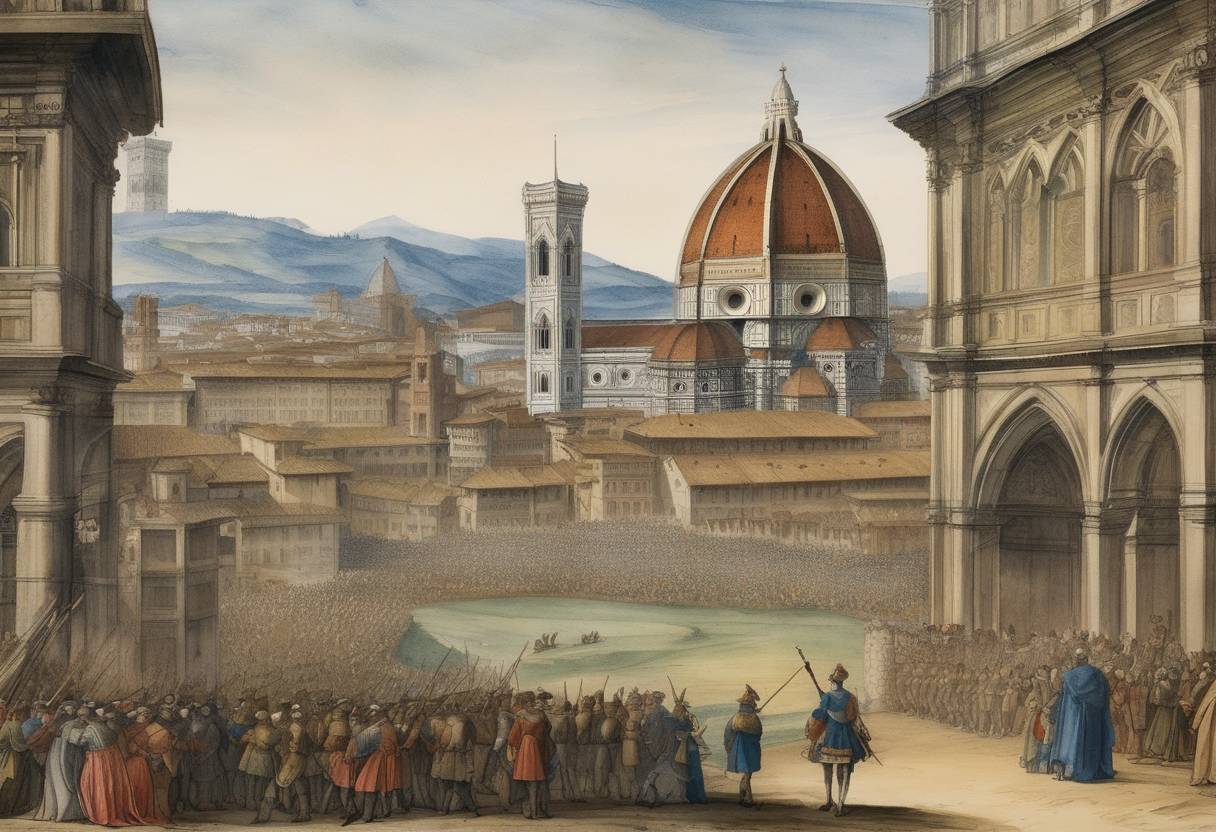
On August 12, 1530, the city of Florence surrendered to the imperial forces of Holy Roman Emperor Charles V, marking the end of the Siege of Florence. This pivotal event concluded the final attempt by the Republic of Florence to maintain its independence and resist the re-imposition of Medici rule, significant in the geopolitical landscape of Renaissance Italy.
The early 16th century was characterized by the intense rivalry of powerful families and city-states within Italy, as well as the overarching authority of the Holy Roman Empire and the Papacy. The Medici family, after losing power in 1527 due to anti-Medici sentiment and the turbulent political climate, had been driven out of Florence when it briefly reinstated a republican form of government.
Pope Clement VII, himself a Medici, allied with Charles V of the Holy Roman Empire to reclaim Florence for the Medici. This was part of a larger realignment of power resulting from the Treaty of Cambrai and other diplomatic maneuvers aimed at stabilizing Charles V’s influence in Italy.
The siege commenced in October 1529 when imperial forces under the command of the Prince of Orange, Philibert of Châlon, surrounded Florence. The Florentines, under the leadership of war strategist Francesco Ferrucci, mounted a determined defense. Despite their military efforts and the construction of additional fortifications designed by Michelangelo, the city found itself cut off, and subject to famine and disease, which intensified the pressures on defenders.
By August 1530, after nearly ten months of resistance, the dire conditions inside the city forced the Florentine leaders to negotiate. Terms of surrender were arranged, which promised lenient treatment for the republic’s leaders and the general population. The Medici were restored to power under Alessandro de’ Medici, although Florence retained nominal autonomy under the conditions set by Charles V, thus effectively ending its short-lived republican experiment.
The fall of Florence reinforced Medici power, leading to the establishment of the hereditary Dukedom under Alessandro de’ Medici, marking a shift from communal republican rule to ducal authority, which prevailed in Florence thereafter. This change contributed significantly to the political centralization occurring throughout Italy during the Renaissance.
Artistically and culturally, the Medici restoration had profound implications, as the family became notable patrons of the arts, fostering the careers of figures like Michelangelo. The Siege of Florence and its aftermath also highlighted the era’s turbulent interplay between local, dynastic, and imperialistic forces, setting a precedent for the relationship between the burgeoning nation-states of Europe and their regional provinces.
Source: en.wikipedia.org