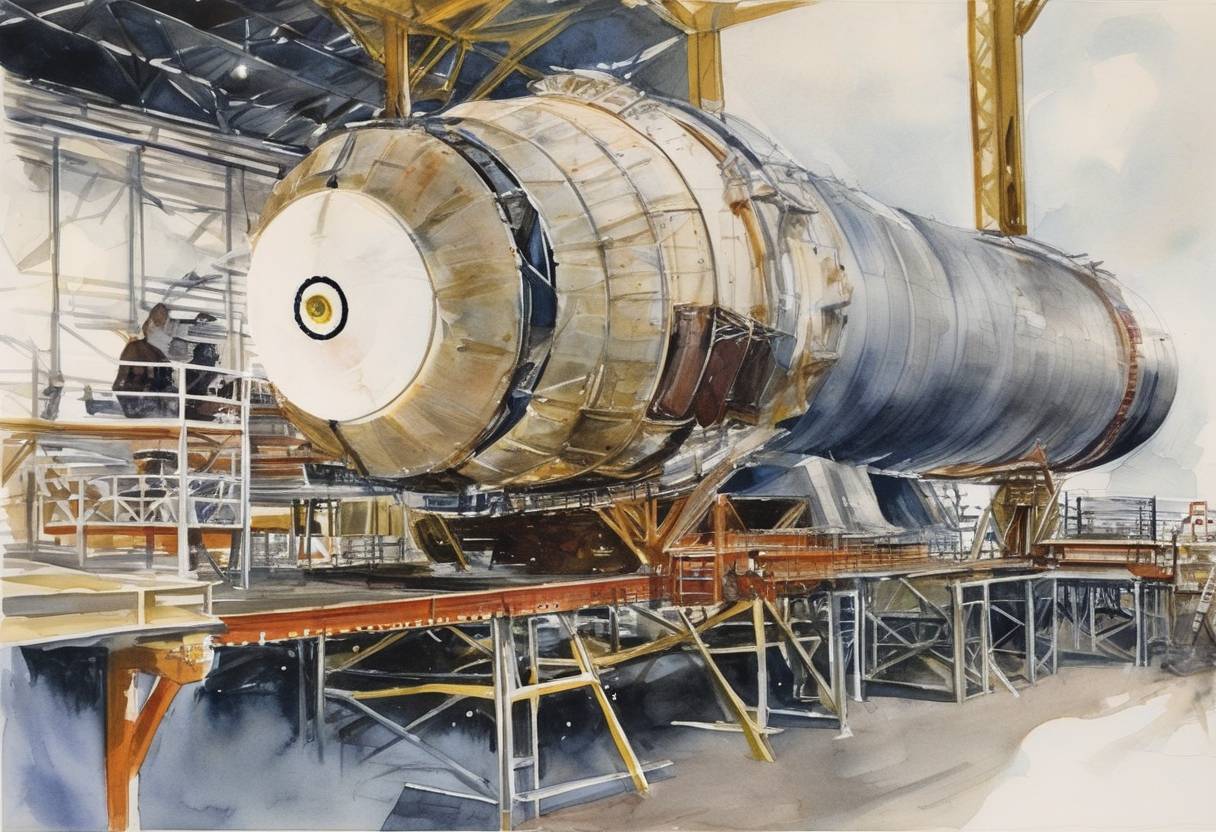
The First Launch of the Saturn IB (AS-201) - February 26, 1966
Overview:
On February 26, 1966, NASA successfully conducted the first launch of the Saturn IB rocket with the mission designated AS-201. This uncrewed mission marked a critical milestone in the Apollo program, which was established to achieve manned lunar landing and safe return to Earth before the end of the 1960s. The Saturn IB was a key advancement in NASA’s rocket technology, serving as an intermediate step between the Saturn I and the larger Saturn V rocket.
Background:
The Apollo program was initiated in the early 1960s as a response to the Soviet Union’s achievements in space, including the launch of Sputnik and the flight of Yuri Gagarin, the first human in space. To achieve the ambitious goal of landing a man on the Moon, NASA required a more powerful launch vehicle. The Saturn IB was developed to test key components and systems that would later be used in the Apollo missions, emphasizing its role in human space exploration.
The Saturn IB Rocket:
The Saturn IB was an upgrade from the earlier Saturn I, designed to carry heavier payloads necessary for the Apollo missions. It featured an eight-engine S-IB first stage and a new S-IVB second stage powered by a single J-2 engine, which would also be used in the Saturn V rocket. The improvements enabled it to carry the Apollo Command and Service Module (CSM) into low Earth orbit.
AS-201 Mission Objectives:
- Testing of the Apollo Command and Service Module (CSM): The primary objective was to test the structural integrity, thermal protection system, and flight capabilities of the Apollo CSM.
- Evaluation of the Saturn IB Rocket: To validate the performance of the Saturn IB as a reliable vehicle for subsequent crewed missions.
- Assessment of propulsion and guidance systems: Testing the J-2 engine, onboard guidance systems, and overall stage separation mechanics.
Mission Details:
- Launch Site: Cape Kennedy Air Force Station, Launch Complex 34.
- Launch Time: 11:12:01 a.m. EST.
- Flight Duration: Approximately 37 minutes.
- Outcome: Successful trajectory and execution of planned objectives, including engine firing and stages separation.
Significance:
The success of the AS-201 mission was pivotal in validating the design and capabilities of the Saturn IB and the Apollo Command and Service Module. It provided critical data that informed subsequent missions and underscored the readiness of the Apollo program to proceed toward crewed flights and, eventually, lunar exploration. This mission laid the groundwork for later landmark missions, such as Apollo 7, which would be the first crewed flight of the Apollo command and service module, and ultimately the historic Apollo 11 moon landing in 1969.
Aftermath:
Following the success of AS-201, NASA continued to test and refine its hardware and mission plans. Subsequent Saturn IB launches and uncrewed tests further assured the program’s reliability, eventually leading to the triumph of humanity’s first steps on the lunar surface.
In essence, AS-201 represented a critical component of the technologically and logistically complex puzzle that comprised NASA’s extraordinary journey to the Moon.