1650 · Drogheda, Ireland
The Battle of Drogheda took place during the Cromwellian conquest of Ireland, leading to the capture of Drogheda by the Parliamentarian forces led by Oliver Cromwell.
July 1, 1690
The Battle of the Boyne occurred, with the forces of Protestant King William III defeating the Catholic King James II in Ireland.
Drogheda, Ireland | Williamite forces
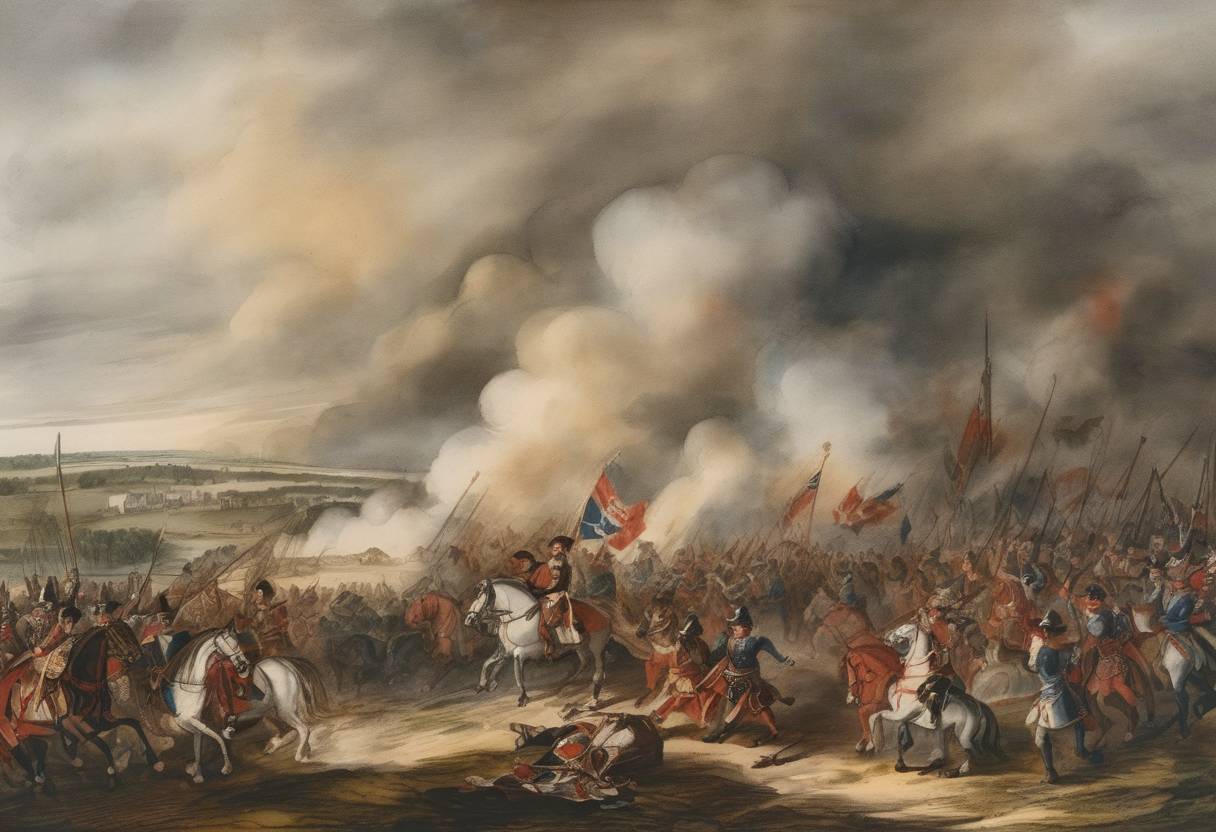
The Battle of the Boyne was a pivotal event in the struggle for power between Protestant and Catholic monarchies in late 17th-century Europe. It took place near the River Boyne, close to the town of Drogheda in Ireland. The battle was part of the larger Williamite War in Ireland, which itself was a subset of the wider conflict between supporters of Protestant King William III of England and the deposed Catholic King James II. This clash was fundamentally about securing the English, Scottish, and Irish thrones, and it also had significant religious and cultural implications for the British Isles.
King William III of Orange: A Protestant ruler who became the King of England, Scotland, and Ireland after the Glorious Revolution of 1688. His marriage to Mary, daughter of James II, provided a claim to the thrones.
King James II: The last Catholic monarch of England, Scotland, and Ireland, deposed in 1688 due to fears of a Catholic absolutist regime aligning with France against Protestant interests in Britain.
On July 1, 1690, William’s forces, numbering approximately 36,000 men, clashed with James II’s army of around 25,000 troops. James II commanded a force composed largely of Irish Catholics, alongside French soldiers supplied by his ally, King Louis XIV of France.
The Boyne River presented a natural obstacle, which James hoped to use to his advantage, but William’s army, better trained and equipped, successfully crossed under fire. The fighting was intense, with William taking personal command, demonstrating tactical acumen, and exploiting weaknesses in James’s defensive positions.
The battle ended in victory for William III, as his forces overran James’s positions, causing the Jacobite army to retreat. The defeat was not a total rout, but it severely weakened James’s position in Ireland, leading to his eventual departure to France. The victory secured William’s rule over England and Ireland, bolstered his allies in Europe, and contributed to the broader Protestant ascendancy in Ireland.
The Battle of the Boyne had enduring historical importance:
Religious Impact: The battle reinforced Protestant dominance in Ireland, leading to harsh penalties and laws against Catholics, known as the Penal Laws. This battle is commemorated annually by Unionists in Northern Ireland on the “Twelfth” (July 12th by the Gregorian calendar), reflecting its lasting cultural and sectarian reverberations.
Political Consequences: It sealed William’s position as the monarch, contributing to the stabilization of the British throne and William’s policies that eventually established a constitutional monarchy.
Cultural Legacy: The battle is remembered as both a symbol of Protestant victory and Catholic resistance, highlighting the complex legacy of British-Irish history.
Overall, the Battle of the Boyne was a turning point in the Williamite War in Ireland, shaping the political and religious landscape of the British Isles for generations.
Source: en.wikipedia.org