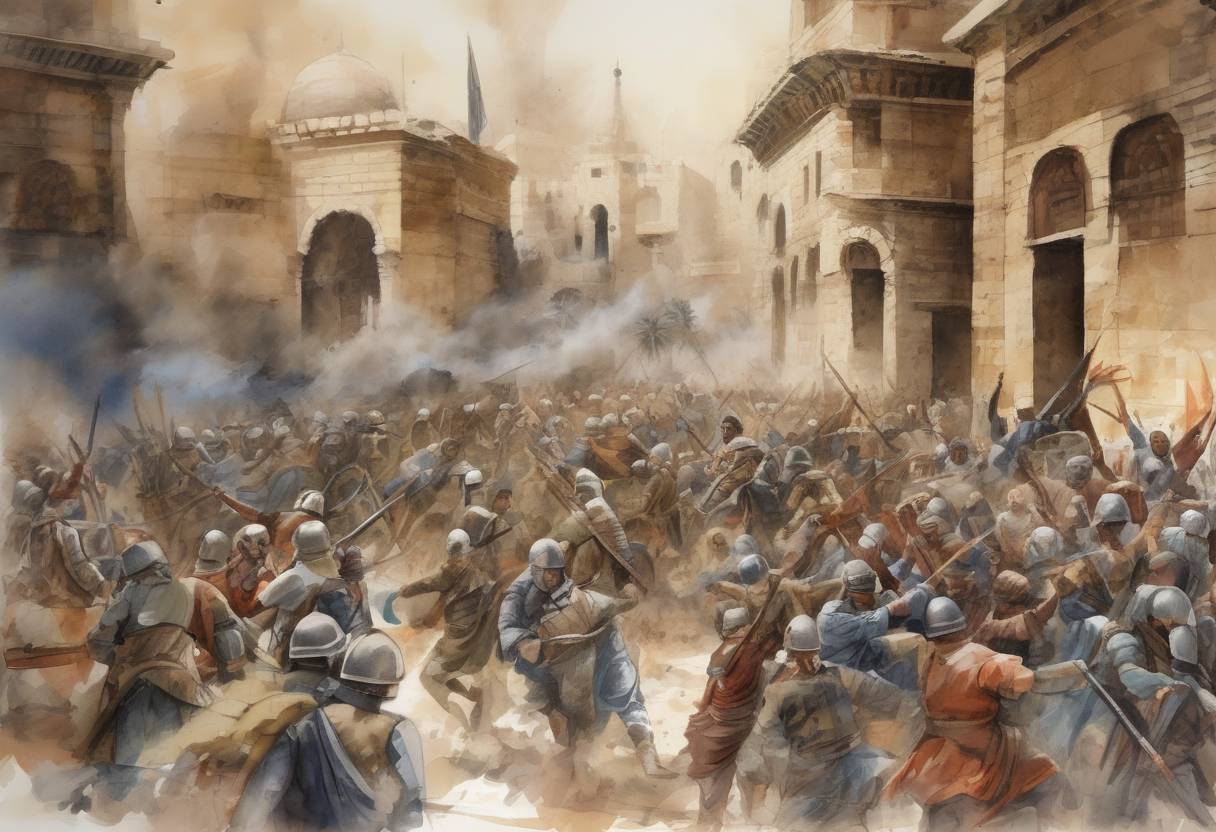
The Battle of Yarmouk: A Turning Point in the Muslim Conquest of the Levant
Date and Context
Date: August 20, 636
Location: Near the Yarmouk River, along the borders of modern-day Syria and Jordan.
The Battle of Yarmouk was a pivotal engagement between the Rashidun Caliphate and the Byzantine Empire. This battle marked a significant turning point in the Muslim conquest of the Levant, leading to the rapid expansion of Islamic rule in the region.
Background
The early 7th century was a period of intense conflict and transformation in the Middle East. The Byzantine Empire, under Emperor Heraclius, had been engaged in protracted wars with the Sassanian Empire, which weakened both empires. Meanwhile, the newly established Rashidun Caliphate, under the leadership of Caliph Abu Bakr and later Caliph Umar, sought to expand its territories beyond the Arabian Peninsula.
Prelude to the Battle
- Initial Conquests: The Muslim forces had already achieved significant victories in the Levant, capturing key cities like Damascus.
- Byzantine Response: In response to these losses, Emperor Heraclius assembled a large army to reclaim the lost territories and halt the Muslim advance.
The Battle
The Battle of Yarmouk took place over six days, from August 15 to August 20, 636. It was characterized by strategic maneuvers and intense combat.
- Rashidun Caliphate: The Muslim forces were led by the capable general Khalid ibn al-Walid, renowned for his military prowess and strategic acumen.
- Byzantine Empire: The Byzantine forces were commanded by a group of generals, including Vahan, a prominent Armenian leader.
Course of the Battle
- Initial Skirmishes: The battle began with a series of skirmishes and probing attacks by both sides.
- Tactical Maneuvers: Khalid ibn al-Walid employed brilliant tactics, including the use of mobile cavalry units to outflank and disrupt the Byzantine formations.
- Decisive Engagement: On the final day, the Muslim forces launched a coordinated assault, exploiting weaknesses in the Byzantine lines and causing a rout.
Outcome and Significance
- Decisive Victory: The Rashidun Caliphate achieved a decisive victory, effectively annihilating the Byzantine army.
- Territorial Gains: This victory paved the way for the Muslim conquest of the entire Levant, including key cities such as Jerusalem and Antioch.
- Strategic Impact: The battle significantly weakened Byzantine control in the region and marked the beginning of Islamic dominance in the Eastern Mediterranean.
Aftermath
The success at Yarmouk had far-reaching consequences:
- Expansion of Islam: The victory facilitated the spread of Islam and the establishment of Islamic governance across the Levant.
- Byzantine Retreat: The Byzantine Empire was forced to retreat to Anatolia, losing its influence over the Levantine territories.
- Cultural and Religious Transformation: The region underwent significant cultural and religious changes as Islamic culture and institutions took root.
The Battle of Yarmouk remains a landmark event in the history of the Islamic conquests, symbolizing the rise of the Rashidun Caliphate as a dominant power in the Middle East.