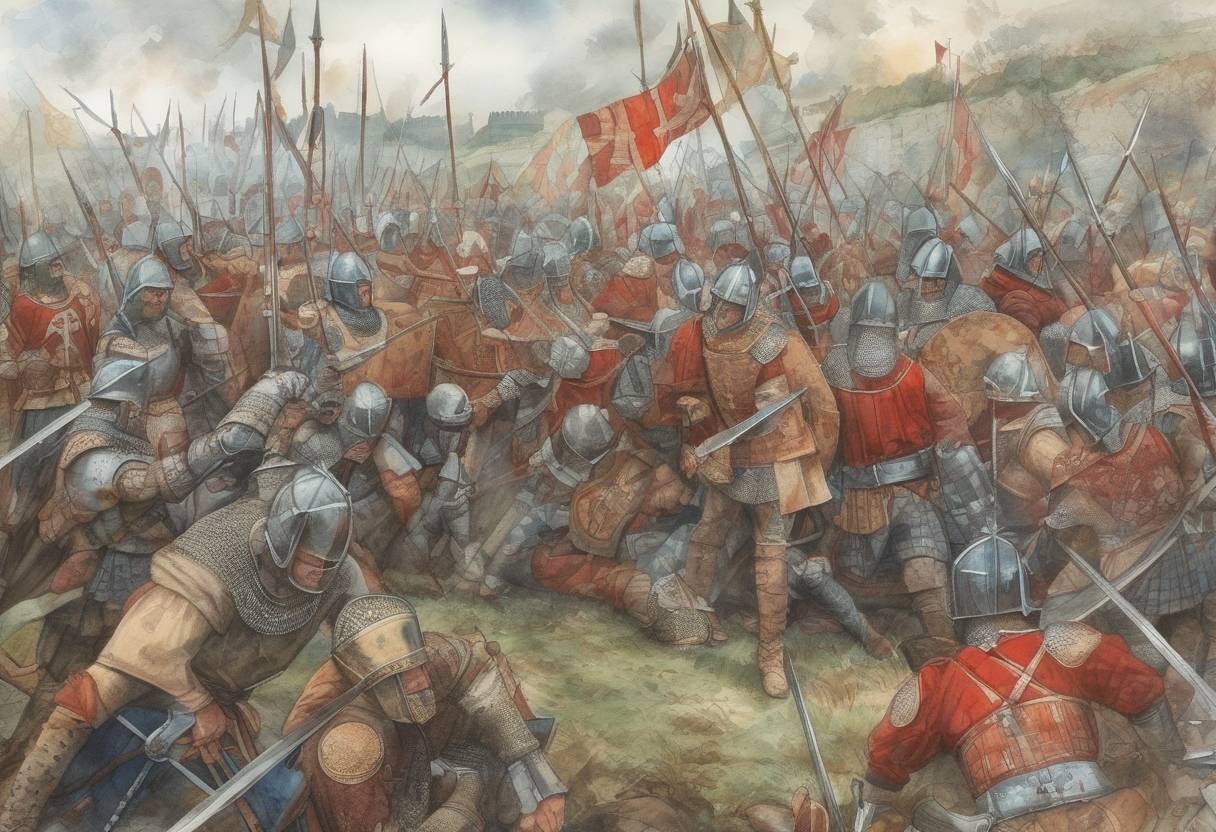
The Battle of Neville’s Cross: October 17, 1346
The Battle of Neville’s Cross was a significant conflict that took place on October 17, 1346, during the Second War of Scottish Independence. This battle saw English forces decisively defeat the Scots, leading to the capture of King David II of Scotland.
Context and Prelude
The battle occurred against the backdrop of the Hundred Years’ War between England and France. In 1346, King Edward III of England was campaigning in France, achieving a notable victory at the Battle of Crécy in August. Encouraged by the French, King David II of Scotland sought to capitalize on Edward’s absence by invading northern England, hoping to relieve pressure on their French allies.
Key Events Leading to the Battle
- Scottish Invasion: In early October 1346, David II led a Scottish army southward, crossing the border into England. The Scots aimed to draw English forces away from France and possibly capture key territories.
- English Response: The English, under the command of Ralph Neville, the Bishop of Durham, and other northern lords, quickly mobilized to counter the Scottish threat. Despite being outnumbered, the English forces were well-prepared and strategically positioned.
The Battle
- Location: The battle took place near Durham, at a site known as Neville’s Cross, named after a stone cross that stood there.
- Tactics and Engagement: The English forces utilized the terrain to their advantage, positioning themselves on high ground. The battle began with an exchange of arrows, with English longbowmen playing a crucial role in disrupting the Scottish formations.
- Decisive English Victory: The English forces, employing disciplined infantry tactics, managed to break the Scottish lines. The Scots, unable to regroup effectively, suffered heavy casualties.
Capture of King David II
One of the most significant outcomes of the battle was the capture of King David II. He was found hiding in a nearby wood, wounded and unable to escape. His capture was a severe blow to Scottish morale and leadership.
Aftermath and Consequences
- Impact on Scotland: The defeat at Neville’s Cross left Scotland politically destabilized. With their king in English captivity, the Scots faced internal strife and a weakened position in their ongoing struggle for independence.
- Ransom and Release: King David II remained a prisoner in England for eleven years. He was eventually released in 1357 after a substantial ransom was agreed upon, known as the Treaty of Berwick.
- Broader Historical Significance: The battle reinforced English dominance in the region and allowed Edward III to continue his campaigns in France without the immediate threat of a Scottish invasion.
The Battle of Neville’s Cross stands as a pivotal moment in the medieval history of England and Scotland, illustrating the complex interplay of regional power dynamics and the far-reaching impact of the Hundred Years’ War.